Correction (2026-05-29): An earlier version of this article ran under the headline "Three-Quarters of Nebraska's Districts Have Fewer Than 500 Students" and reported 310 of 422 districts under 500 students (17.6% of state enrollment), 81 districts under 100, 11 large districts holding 50.6% of children, and a 23.1-point index gap between large and small districts. The Nebraska Department of Education file we drew from pools public school districts with non-public and state-operated entities, and our data package was treating all of them as public school districts. The corrected figures are 151 of 244 public school districts under 500 students (12.3% of state enrollment), 5 districts under 100, 11 large districts holding 56.3% of children, and a 24.9-point index gap. The underlying argument is unchanged: small districts continue to thin out while a handful of suburban districts absorb virtually all of the state's growth. Thanks to a reader for flagging this.
Data-quality update (2026-08-20): We re-ran the analysis against the current Nebraska Department of Education data reports and reconciled the six district-size bins to Nebraska's published 2025-26 statewide TOTAL row. The student-share denominator is now explicit in the analysis code. We also removed a prior Hastings Catholic example because the current frame is limited to public school districts.
Bennington Public Schools↗ET enrolled 838 students in 2006-07. By 2025-26, it enrolled 4,540, a gain of 442%. Over the same period, Morrill Public Schools↗ET, in the panhandle, fell from 486 students to 252, a loss of 48.1%. Nebraska added about 41,000 students statewide during those 19 years. Virtually all of that growth landed in a handful of Omaha-area suburbs. The rest of the state's district map is thinning out.
In 2025-26, 151 of Nebraska's 244 public school districts enroll fewer than 500 students. That is 61.9% of all districts, responsible for 12.3% of state enrollment. At the other end of the scale, 11 districts with 5,000 or more students hold 56.3% of all children. The under-500 group includes 46 districts below 200 students, 5 below 100, and one below 50.
A 25-point divergence
The gap between large and small districts is not static. It is widening.
Since 2007, districts with 500 or more students have grown their combined enrollment by 18%, from 243,841 to 287,839. Districts under 500 have shrunk by 6.9%, from 43,299 to 40,309. Indexed to 2007, the two groups now sit 24.9 points apart. The under-500 group has not been above its 2007 baseline since 2020. (The size grouping is recalculated each year, so districts can shift between groups. The aggregate pattern holds regardless: small-district enrollment has been flat or declining for 19 years while large-district enrollment has climbed steadily.)
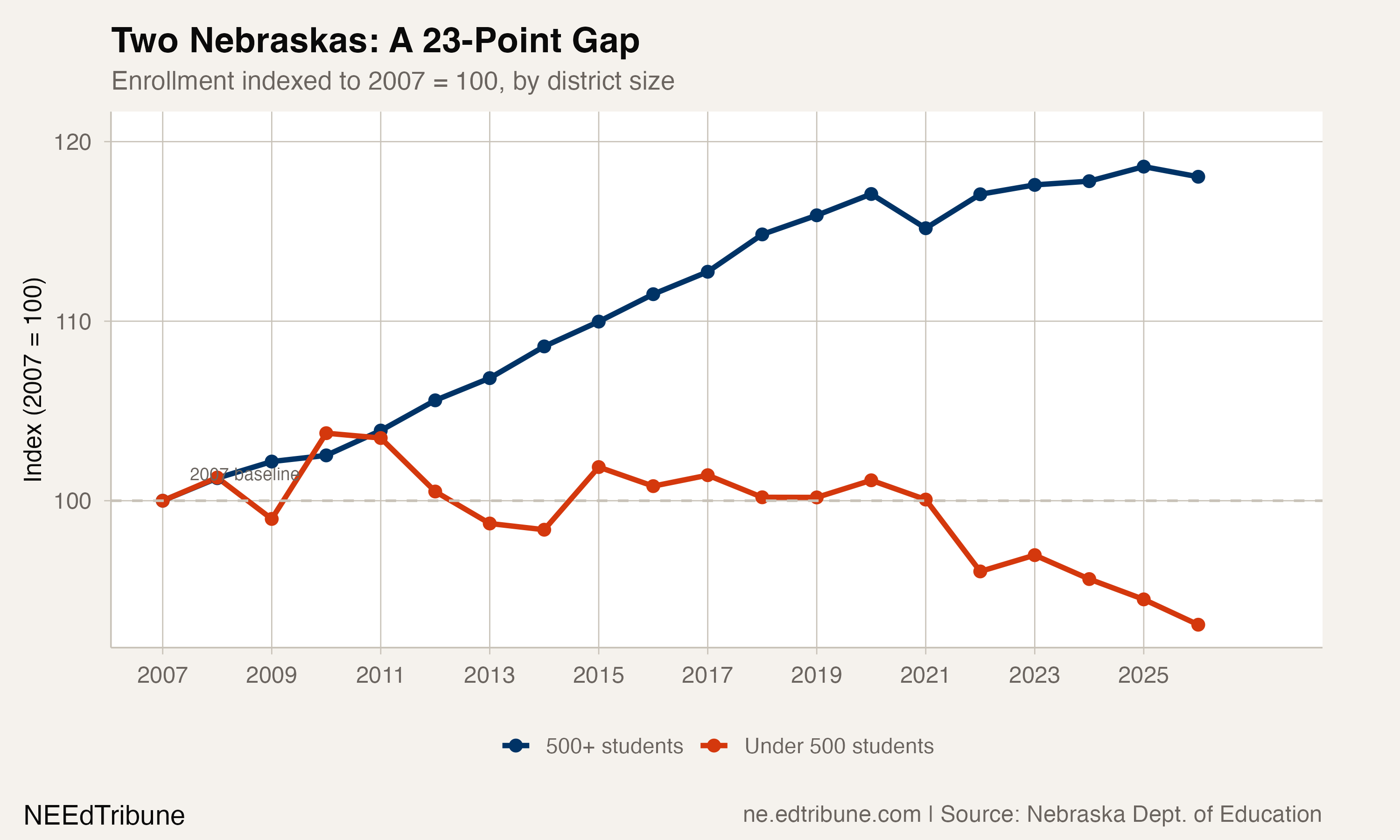
This is not a COVID story. The under-500 districts were flat or declining for the entire decade before the pandemic. COVID pushed them below their baseline, and they have continued to fall since.
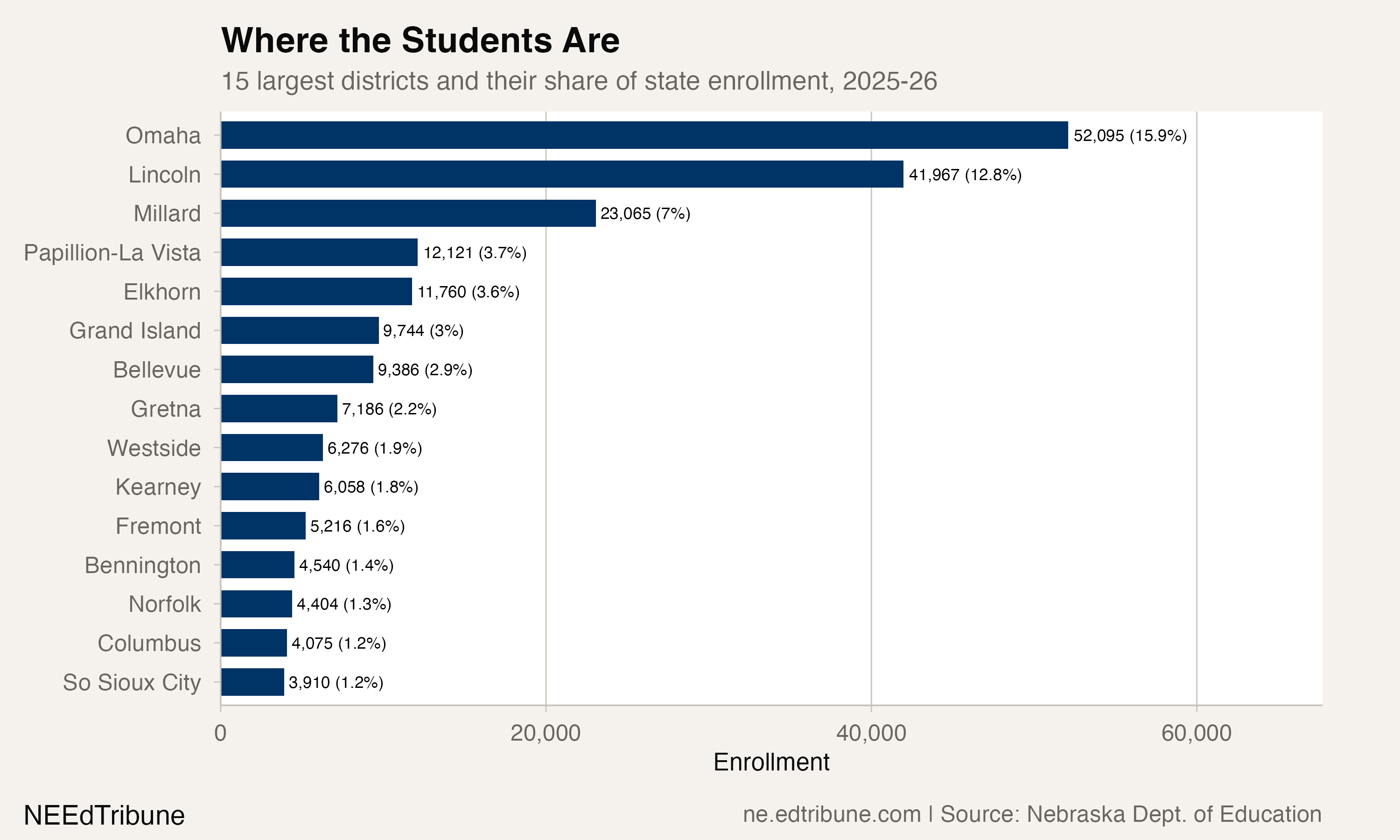
The enrollment lost from small districts did not vanish. It concentrated. Omaha↗ET, Lincoln↗ET, Millard↗ET, Papillion-La Vista↗ET, and Elkhorn↗ET together enrolled 141,008 students in 2025-26, or 43.0% of the state total. The 11 districts with 5,000 or more students hold 56.3% of all children in the state.
The mismatch: 62% of the map, 12% of the students
Nebraska's district size distribution is one of the most lopsided in the country. The 151 under-500 districts collectively enroll 40,309 students, fewer than Omaha Public Schools alone (52,095) and fewer than Omaha and Lincoln Public Schools combined (94,062). Five districts have fewer than 100 students, enrolling 370 children total, about 0.1% of the state.
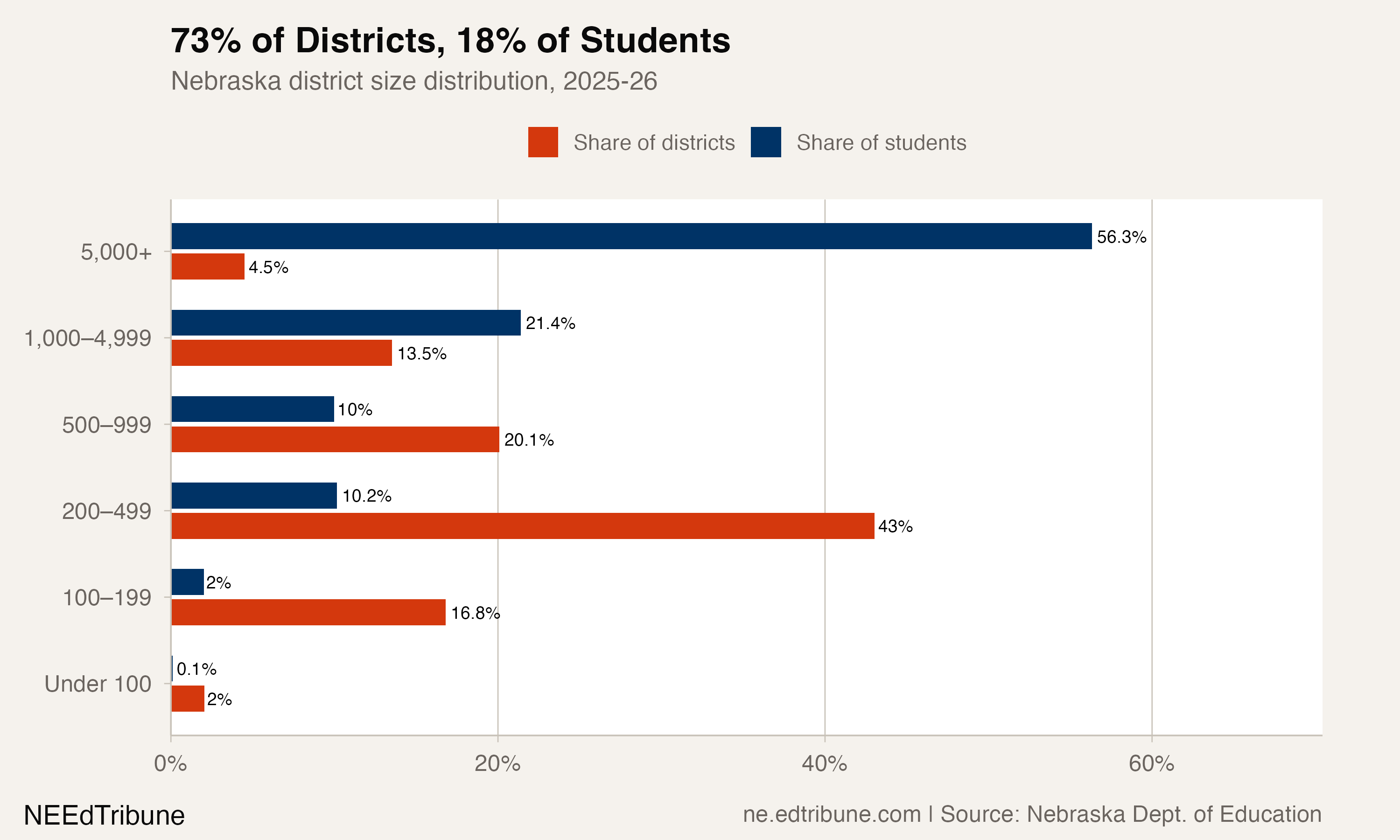
Within the under-500 group, most districts cluster in the 200-to-499 range, but 46 fall below 200 students and one below 50. At these scales, a single-section elementary school may serve kindergarten through eighth grade, and graduating classes are small.
Panhandle and Sandhills districts like Sioux County↗ET (68 students), McPherson County↗ET (48), and Arthur County↗ET have enrollment low enough that maintaining a full K-12 program strains every budget line.
Why the Sandhills are emptying
The most direct driver is population loss in rural Nebraska counties. Recent population estimates show that many counties are losing residents, while metro-area counties account for most new residents statewide. The growth is not diffusing. It is pooling. Nebraska News Service documented the pattern.
Birth rates compound the problem. Nebraska counties experience natural population loss, meaning more deaths than births each year. For districts already below 200 students, each year's kindergarten class is a coin flip. The pipeline does not stabilize at these scales.
The economic engine is also part of the story. Nebraska's high rate of privately owned agricultural land means farming remains profitable without residential development, limiting housing starts in exactly the counties that need young families. Counties without Interstate 80 access face additional competitive disadvantages for attracting employers.
The fiscal math of small scale
For districts with declining headcounts, the per-pupil cost of maintaining a building, a bus fleet, and a superintendent rises with each student lost. An OpenSky Policy Institute analysis noted the "combined effect of declining enrollment and fixed costs in many rural districts" is a structural driver of rising statewide per-pupil spending.
The Friend-Exeter-Milligan consolidation, which took effect in July 2025, illustrates the arithmetic. Nebraska News Service reported a steep enrollment decline over two decades at the two districts, with per-pupil spending diverging sharply. In state data, Friend fell from 339 students in 2006-07 to 227 in 2024-25, and Exeter-Milligan from 264 to 170 over the same span.
The consolidated EMF district expects to need less annually in taxpayer dollars to operate, according to the same reporting. In the data, Friend and Exeter-Milligan appear merged as Exeter-Milligan-Friend Public Schools↗ET in 2025-26, enrolling 388 students. The consolidation did not create a large district. It created a single small one.
A different Nebraska, demographically
Small districts are not just smaller versions of the state. They are compositionally distinct. In 2025-26, students in under-500 districts are 86.6% white, compared to 60.8% statewide. Hispanic students make up 8.2% of enrollment in small districts, well under the 23% statewide share.
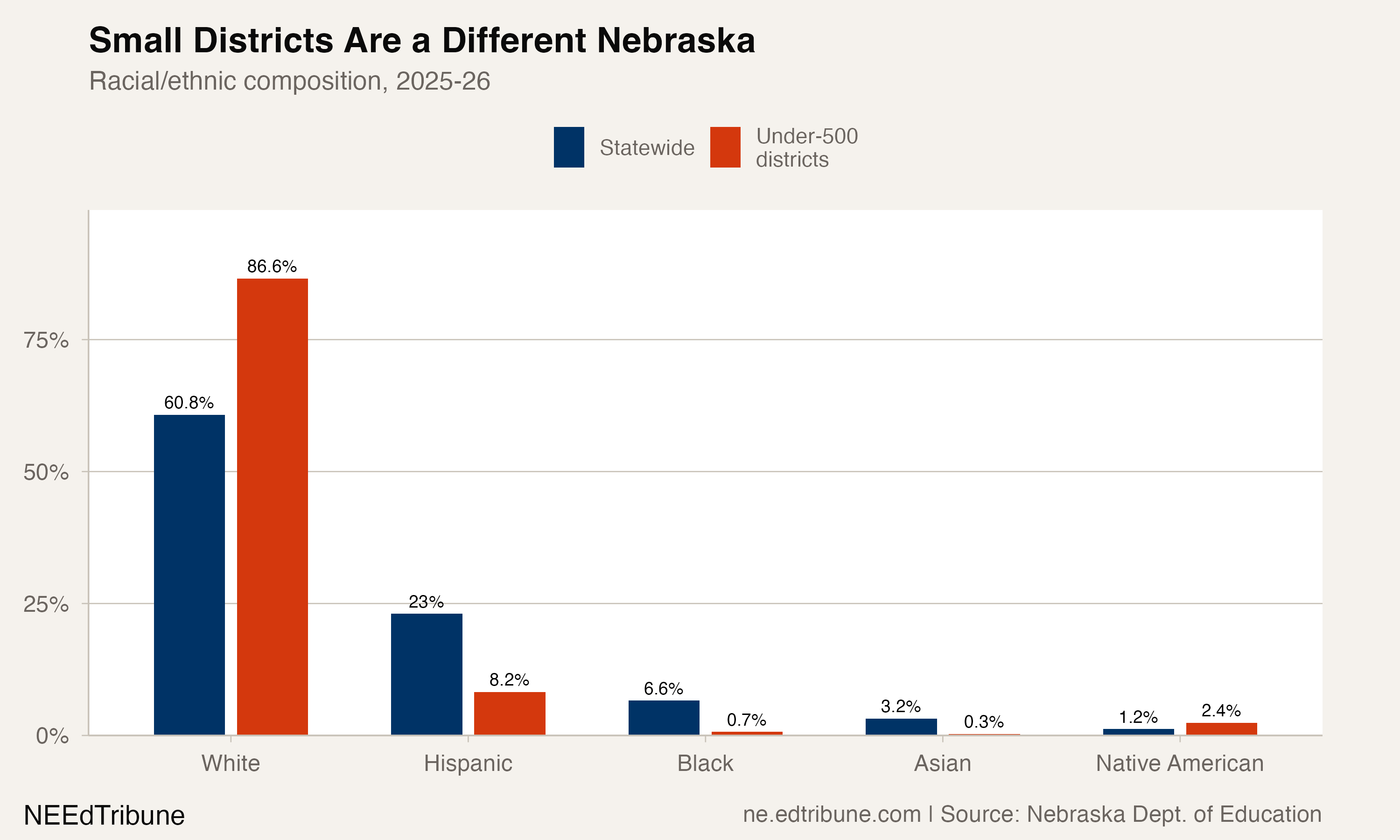
The gap has been narrowing slowly. Hispanic enrollment in under-500 districts has roughly doubled its share since 2007, from 3.9% to 8.2%, driven in part by meatpacking communities like Crete↗ET, Lexington↗ET, and Schuyler↗ET whose districts straddle the 500-student threshold. But the diversification of rural Nebraska is happening at roughly a third the pace of the state overall, where the Hispanic share has risen from an even lower base to 23%.
Consolidation: slow, voluntary, and insufficient
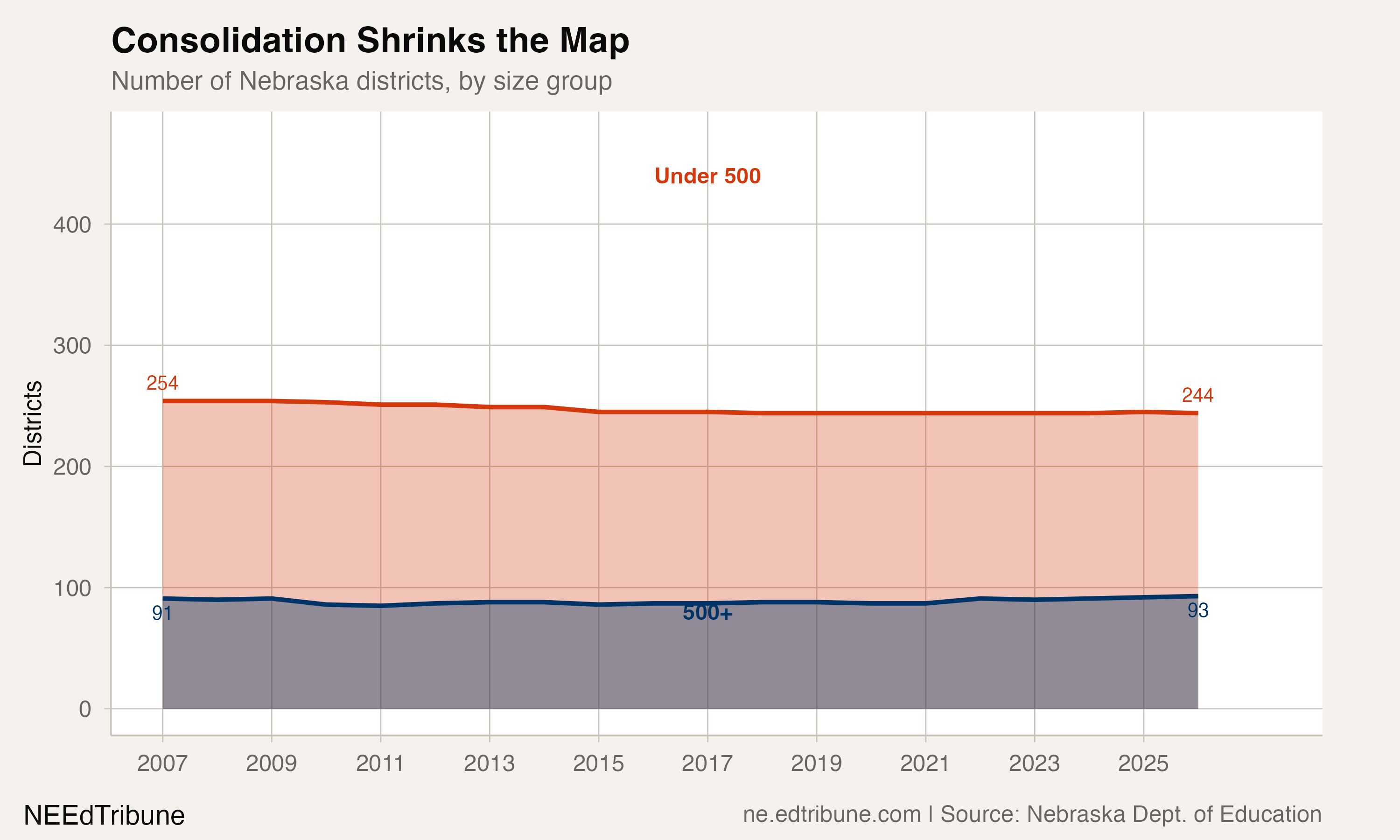
Nebraska has been consolidating districts for a century. The most aggressive modern intervention was Legislative Bill 126 in 2005, which eliminated K-only and high-school-only districts and forced mergers. That compressed the count below 500. Since 2007, the state has gone from 254 to 244 public school districts, a net loss of 10.
That pace, roughly one consolidation every two years, has not changed the structural picture. The share of public school districts under 500 students was 64.2% in 2007 and is 61.9% in 2026. Consolidation has removed some of the smallest entities, but the remaining ones continue to shrink. Of the 34 districts at all-time enrollment lows in 2025-26, 24 are under-500 districts.
Districts that enrolled 500 or more students in 2007 have since fallen below that line, including Kimball↗ET (605 to 408), Wood River Rural (573 to 479), and Ainsworth↗ET (502 to 393). The 500-student threshold is not a policy line, but it marks an operational boundary. Below it, offering a full range of electives, advanced courses, and extracurricular programs becomes progressively harder, and sharing staff, buses, and even students with neighboring districts becomes the norm.
What comes next
The question for Nebraska is not whether small districts will continue to lose students. The demographic trajectory is locked in: rural counties are aging, births are declining, and metro-area job markets will continue to pull families east. The question is whether the state's tradition of local control, which has resisted mandatory consolidation for decades, can coexist with districts where a small kindergarten class costs the same to operate as a full one.
The EMF consolidation saved money, but it did not create scale. With 388 students, the merged district is still well under 500. The next merger will face the same arithmetic. McPherson County has 48 students. Sioux County has 68. Arthur County's graduating class can fit in a single row of bleachers. Nebraska's public-district count has fallen to 244 over the modern period, and the smallest among them remain buildings on the prairie with a few families' kids inside, sustained by property taxes on land that produces cattle and corn but not enough children to fill a classroom.
Detailed code that reproduces the analysis and figures in this article is available exclusively to EdTribune subscribers.
Discussion
Sign in to join the discussion.
Loading comments...