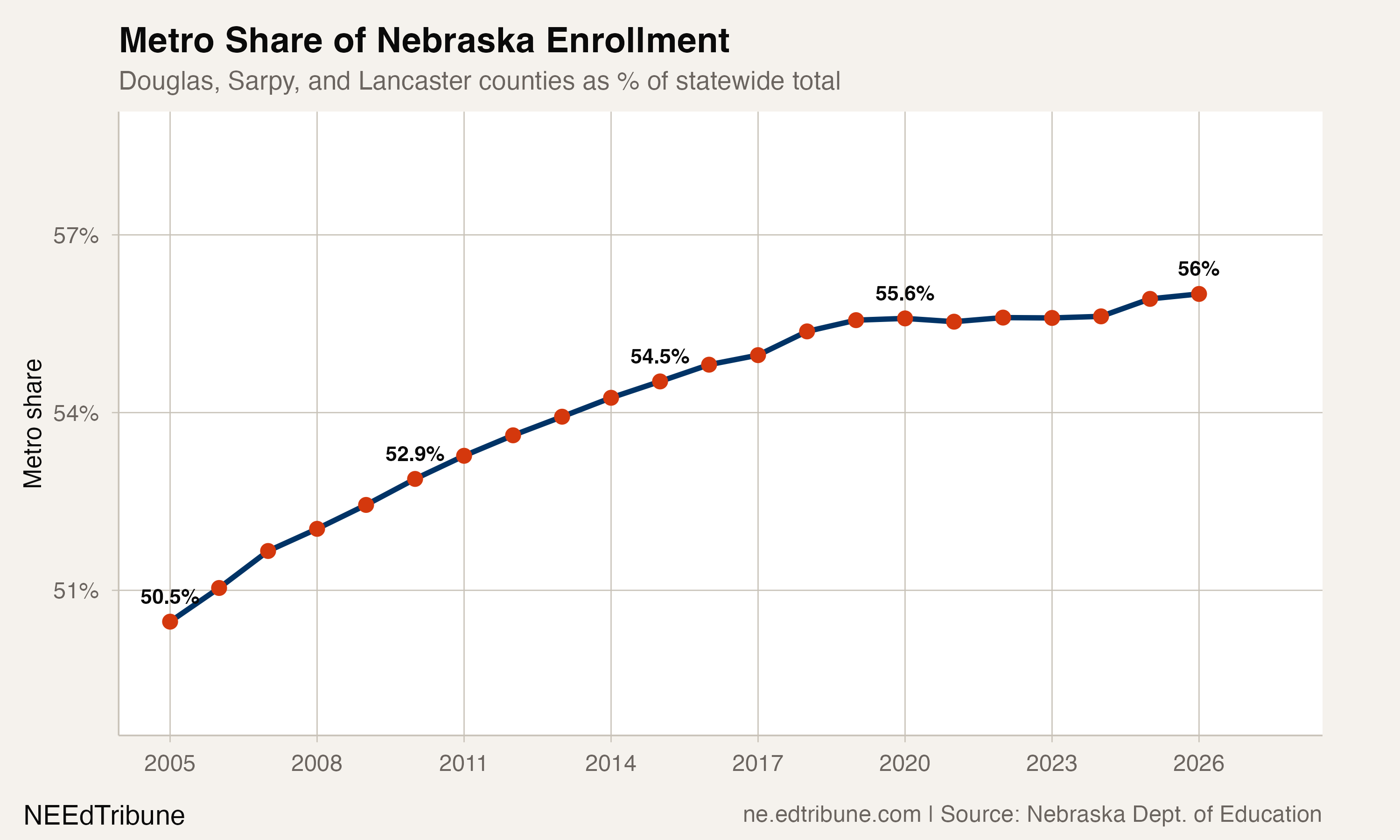
Correction (2026-05-29): An earlier version of this article said three counties enroll 56.0% of Nebraska's students (up from 50.5% in 2005), that metro districts gained 40,015 students while the rest of the state lost 775, and reported district counts and demographic shares that drew on a contaminated total. The Nebraska Department of Education file we drew from pools public school districts with non-public and state-operated entities, and our data package was treating all of them as public school districts. The corrected figures put three counties at 54.9% of state enrollment (up from 48.7% in 2005), with metro gaining 41,573 students and the rest of the state adding 1,976. The non-metro district counts, the small-district size distribution, the 2025-26 year-over-year changes, and the metro and non-metro race shares for 2026 have been updated below. The suburban-growth story (Elkhorn, Gretna, Bennington, Papillion-La Vista), the OPS and LPS totals, and all externally-sourced numbers are unchanged. Thanks to a reader for flagging this.
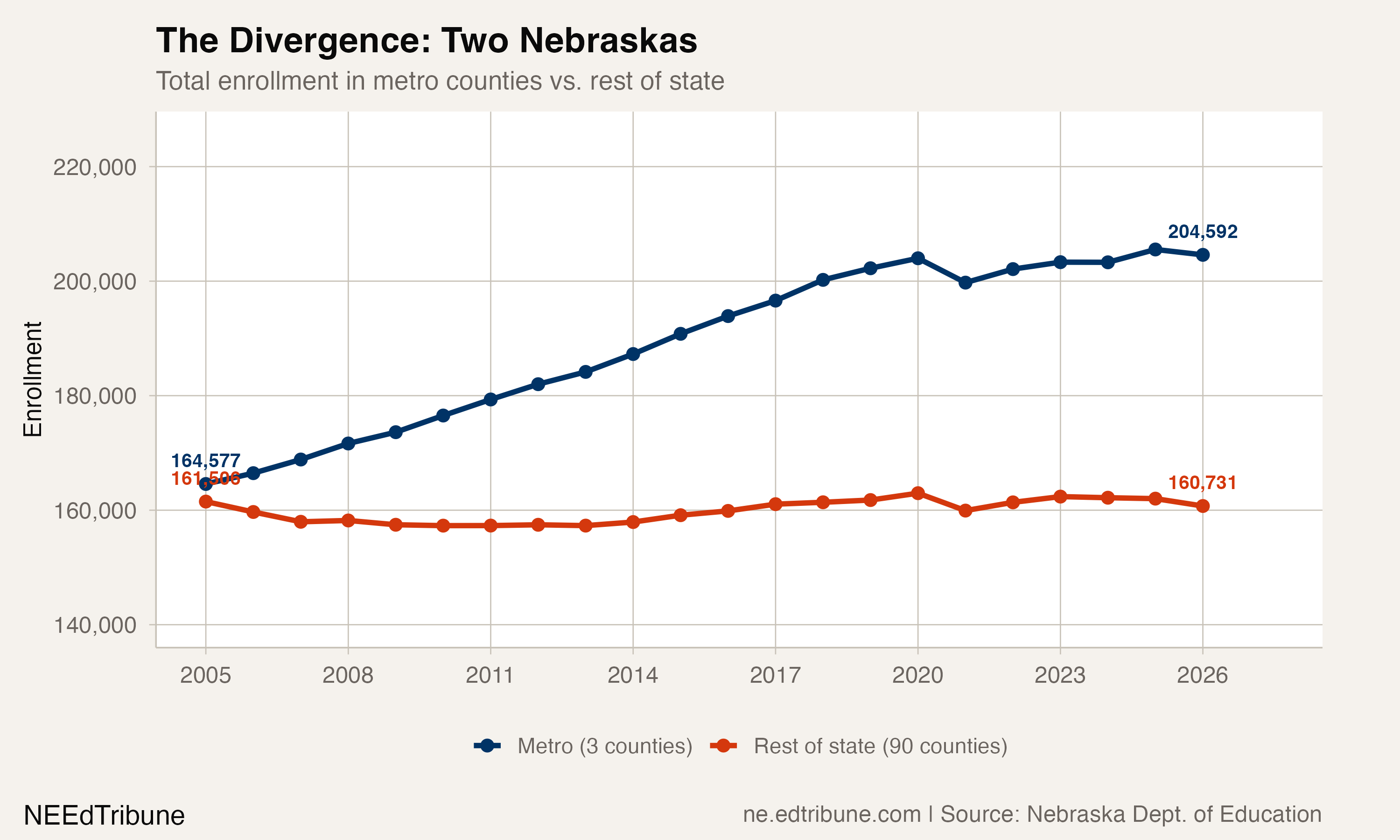
In 2005, Nebraska's enrollment leaned slightly toward the rest of the state. Districts in Douglas, Sarpy, and Lancaster counties, the greater Omaha and Lincoln metro, enrolled 138,462 students. The other 90 counties enrolled 146,137. The non-metro side held a 7,675-student edge.
By 2026, that picture has flipped. Metro enrollment has reached 180,035 while the rest of the state sits at 148,113. Three counties out of 93 now educate 54.9% of all Nebraska students, up from 48.7% two decades ago. The 6.2 percentage-point shift may sound modest, but it represents 41,573 students added to the metro while the remaining 90 counties collectively added just 1,976.
The growth was not evenly distributed
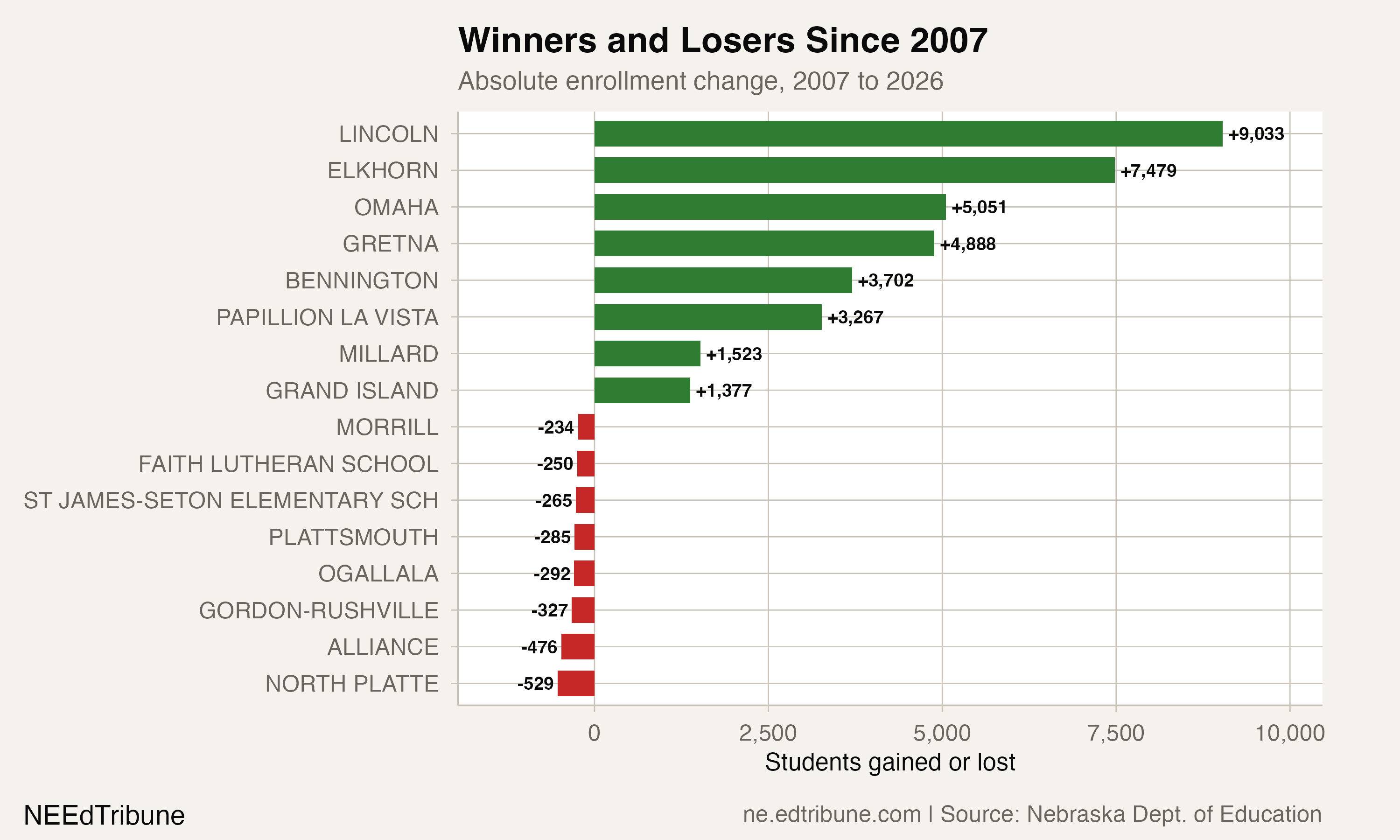
The metro's 41,573-student gain is not simply an Omaha and Lincoln story. The largest gains since 2005 came from suburban ring districts that barely registered two decades ago. Elkhorn↗ET grew from 3,691 to 11,760 students, a 218.6% increase. Gretna↗ET went from 1,963 to 7,186, up 266.1%. Bennington↗ET, which enrolled 598 students in 2005, now serves 4,540, a 659.2% increase that made it larger than dozens of outstate county seats.
The two anchor districts grew at different rates. Lincoln Public Schools↗ET added 9,697 students (+30.0%), reaching 41,967. Omaha Public Schools↗ET, the state's largest district, added 5,546 students (+11.9%) to reach 52,095. But the suburban ring districts, Elkhorn, Gretna, Bennington, and Papillion-La Vista↗ET, together added 20,891 students, more than OPS and LPS combined.
This pattern mirrors statewide population trends. From 2023 to 2024, Douglas, Sarpy, and Lancaster counties accounted for nearly nine of every 10 new Nebraska residents, a concentration that researcher Josie Shafer called part of the metro areas' role in now housing "around 67% of all Nebraska's population."
Ninety counties, net zero
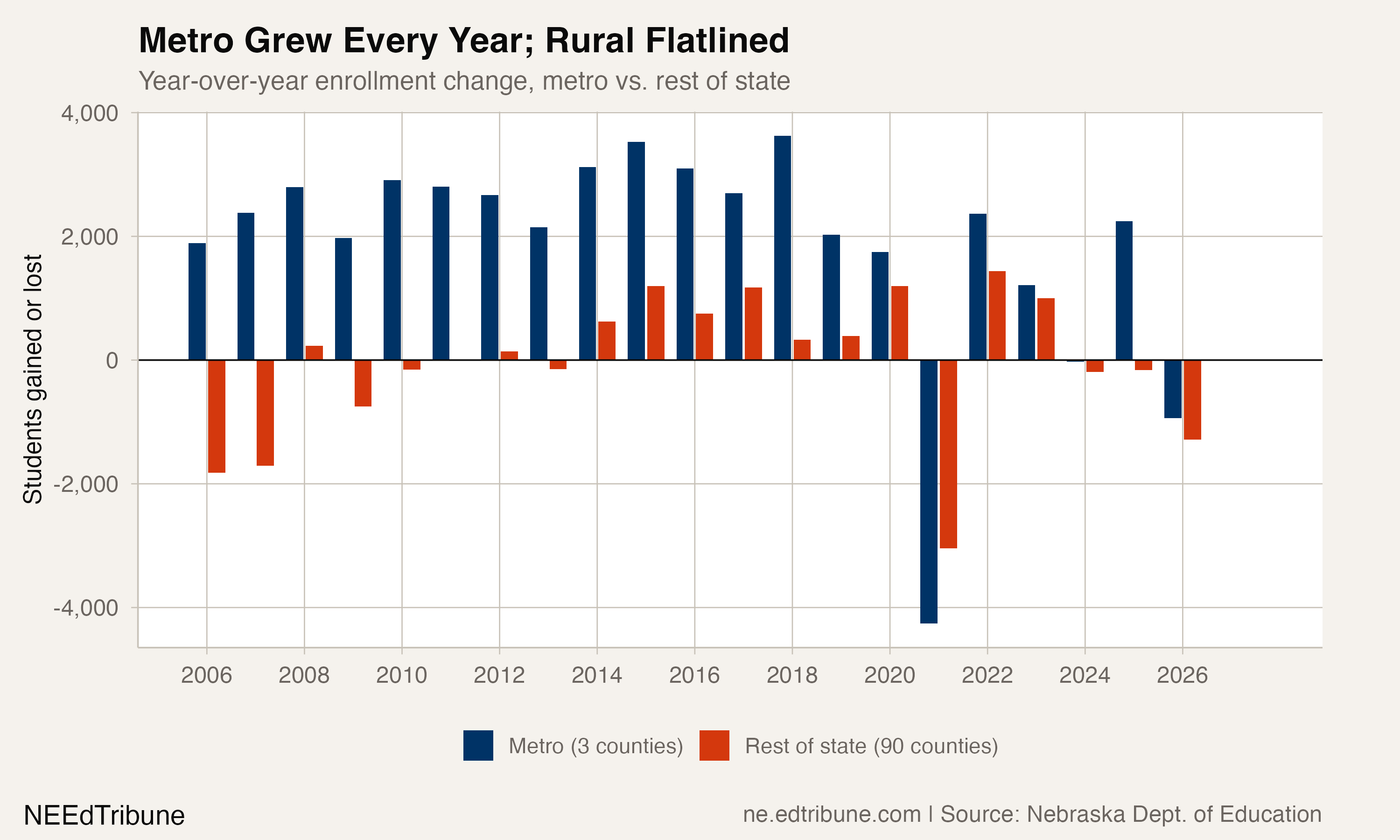
The year-over-year pattern is stark. Metro enrollment grew in 18 of 21 years from 2005 to 2026, declining only during the COVID disruption of 2021 and in the small dips of 2024 and 2026. Non-metro enrollment, by contrast, oscillated: growing in roughly half the years and shrinking in the rest, netting a small gain of 1,976 students over the full period. In the years when the rest of the state did grow, the gains were typically small, averaging 707 students in positive years compared to the metro's average annual gain of 2,490 in its growth years.
The flatline is not evenly distributed across the 90 non-metro counties. Of 216 non-metro districts with data in both 2007 and 2026, 117 shrank while 98 grew. The biggest non-metro gainer, Grand Island↗ET, added 1,377 students (+16.5%), powered by a growing Hispanic population in the meatpacking corridor. Kearney↗ET added 1,062 (+21.3%). But at the other end, North Platte↗ET lost 529 students, Alliance↗ET lost 476 (-27.6%), and Gordon-Rushville↗ET lost 327 (-39.1%).
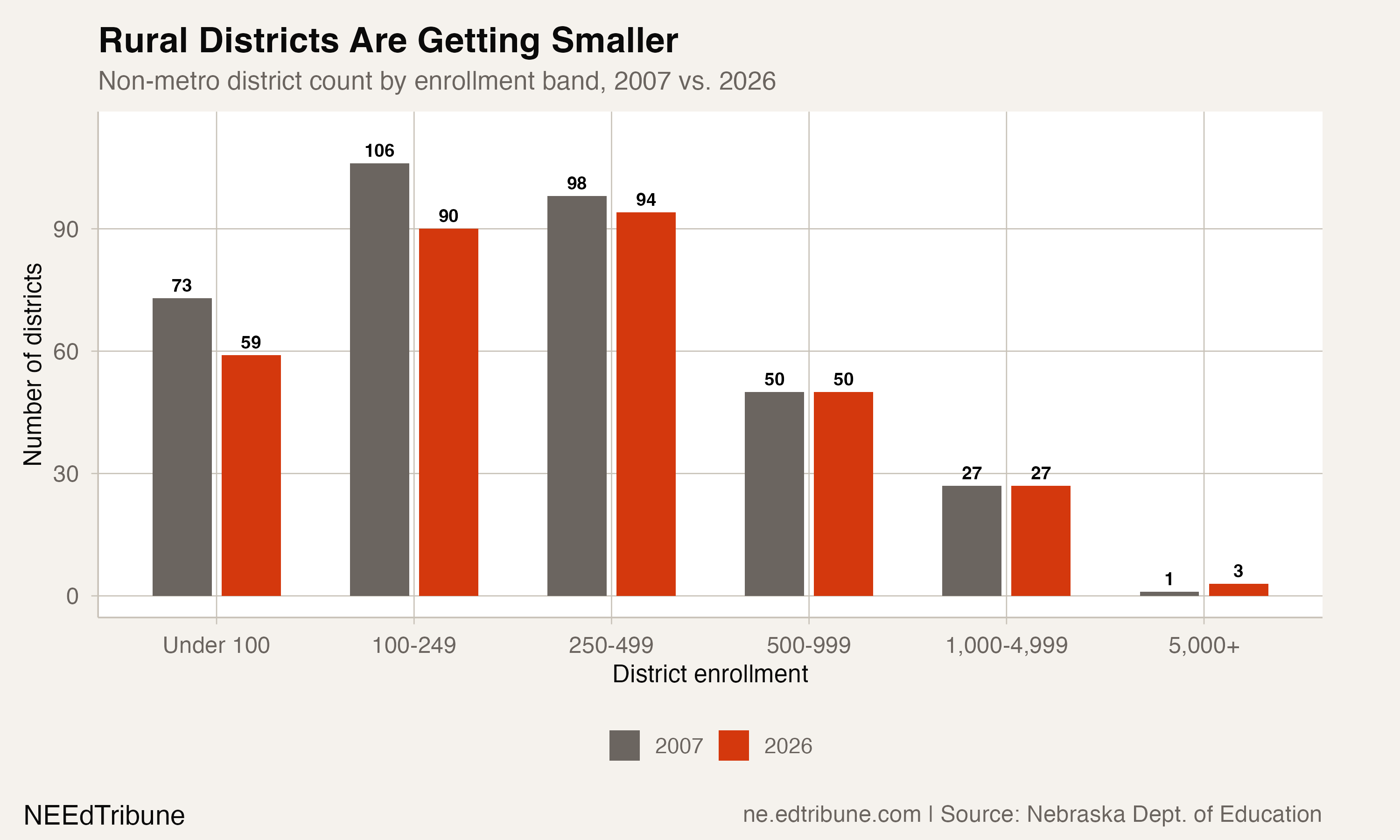
The top 10 non-metro districts enroll 47,285 students, 31.9% of the non-metro total. The remaining 218 non-metro districts share the other 68.1%. Many are very small: 5 non-metro districts enrolled fewer than 100 students in 2026, and another 65 enrolled between 100 and 249.
What holds rural districts in place
The population dynamics behind this concentration are well documented. Rural Nebraska faces a structural employment problem that directly feeds enrollment loss. Dawes County clerk Cheryl Feist described the bind to the Nebraska News Service:
"The main reason our census population decreased is due to lack of employment here."
Agricultural mechanization reduces the labor a family farm needs. Young people leave for college and do not return. Housing stock is limited, which constrains new arrivals even when jobs exist. Jefferson County commissioner Gale Pohlman identified workforce housing and childcare availability as the twin barriers preventing families from settling in rural communities.
The suburban boom districts, by contrast, benefit from a feedback loop. New housing developments in Gretna, Bennington, and Elkhorn attract young families. School quality rankings draw more families. As district enrollment grows, the per-pupil cost of programs drops and facility investments become more efficient, further strengthening the districts' appeal. A University of Nebraska-Omaha analysis found that these exurbs had begun outpacing even traditional suburbs in population growth, with families seeking "housing either more affordable or more reclusive than what is available closer to the cores of central cities."
The funding formula catches some of this, but not all
Nebraska's school finance formula, TEEOSA, is designed to equalize resources across districts. In practice, it creates a paradox. Only 84 of the state's 244 districts receive equalization aid, but those 84 districts educate about 80% of Nebraska's students. The remaining districts, overwhelmingly rural, rely on property tax revenue. In rural districts, property taxes cover about 75% of the school budget, compared to roughly 33% in urban districts.
The state ranks 49th nationally in state dollars sent to schools. For a shrinking rural district, the math becomes punishing: fewer students mean less state aid, but fixed costs for buildings, transportation, and staff do not shrink at the same rate. Exeter-Milligan, a district outside the metro, spent nearly $28,000 per student annually before its consolidation with Friend. The combined district projects $1.5 million in annual savings.
Friend School Board Vice President Scott Spohn described the classroom reality of a shrinking district:
"How do you do a group project with four or five kids in a class? You don't; it's one group."
Two Nebraskas, two student bodies
The metro-rural divide is not only about headcount. The student populations look different, too. In metro districts, white students make up 53.9% of enrollment, with Hispanic students at 22.3%, Black students at 10.7%, and Asian students at 5.4%. In non-metro districts, white students account for 69.1% and Hispanic students 23.9%, with Black and Asian populations each below 2%.
The non-metro Hispanic share actually exceeds the metro's, a function of meatpacking-corridor towns like Grand Island, Lexington, Schuyler, and South Sioux City, where Hispanic enrollment growth has driven most of the outstate population stability. Without those communities, the non-metro enrollment line would slope downward far more steeply.
A shared decline in 2026
The most recent year introduced something new. In 2026, both metro (-627) and non-metro (-1,361) districts lost students. Metro's loss is only its third decline in 21 years, alongside the COVID dip of 2021 and a small dip in 2024. Non-metro's loss continued its recent pattern of small year-over-year declines.
Whether 2026 marks a structural turning point or a one-year fluctuation depends on what happens to kindergarten cohorts in both regions. Birth rates in Nebraska, like the rest of the country, have been declining. If the pipeline is thinning for both Omaha's suburbs and the Sandhills alike, the concentration story may plateau even as rural districts continue to hollow out.
Bennington added 357 students in 2020 and 159 in 2026. Elkhorn added 465 in 2020 and 107 in 2026. Census data already shows exurbs like Plattsmouth and Wahoo outpacing these inner-ring suburbs in population growth. If the development frontier leapfrogs west again, the three counties that held 55% of Nebraska's students in 2025-26 may find themselves in the same position as the 90 counties they left behind, watching the growth wave recede toward the next cornfield.
Detailed code that reproduces the analysis and figures in this article is available exclusively to EdTribune subscribers.
Discussion
Sign in to join the discussion.
Loading comments...