Correction (2026-05-29): An earlier version of this article cited 9,179 pre-K students in 2005 and 22,473 in 2026, a 144.8% increase, with kindergarten at 24,170. The Nebraska Department of Education file we drew from pools public school districts with non-public and state-operated entities, and our data package was treating all of them as public school districts. The corrected figures are 5,698 pre-K students in 2005 and 19,599 in 2026, a 244% increase, with kindergarten at 21,275. The PK/K ratio, district-coverage counts, and COVID impact figures have also been updated. Pre-K has now slightly surpassed its pre-COVID peak (19,149 in 2020) rather than falling short of it. District-level numbers for Gering, Hastings, Kearney, and Grand Island were not affected, and the article's central finding (PK growth driving a large share of Nebraska's enrollment gains) is unchanged. Thanks to a reader for flagging this.
In 2005, Nebraska enrolled 5,698 students in pre-kindergarten programs, roughly one for every four kindergartners. In 2026, the state enrolled 19,599, closing in on kindergarten's 21,275. The gap between those two grade levels has shrunk from 15,493 students to 1,676.
That convergence is not because kindergarten surged. Kindergarten enrollment barely moved over two decades, ticking up by just 84 students. Pre-K grew by 13,901, a 244% increase that accounts for nearly one in three students Nebraska added to its total enrollment since 2005.
The three eras of Nebraska pre-K
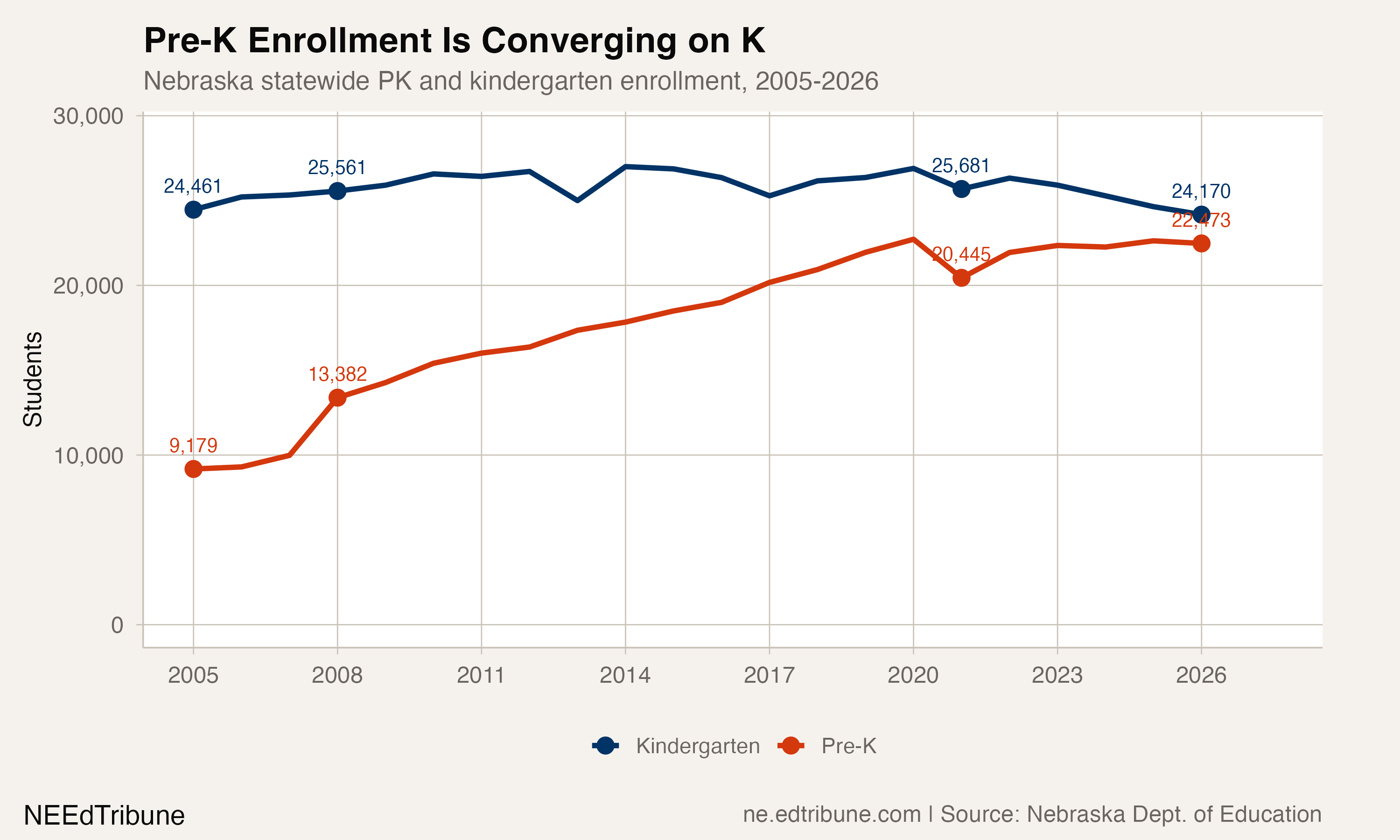
The growth happened in distinct phases. Between 2005 and 2007, pre-K was small, enrolling fewer than 7,000 students across a relatively small set of districts. Then came the jump: between 2007 and 2008, PK enrollment leapt from 6,935 to 10,081, a single-year gain of 3,146 students (45.4%). The number of districts reporting PK enrollment climbed sharply that year.
That spike coincides with an expansion of the state's Early Childhood Education Grant Program, which provides competitive grants to public schools and education service units that partner with Head Start agencies, child care centers, and human services organizations. Each project receives state funding for up to half its operating budget, with local and federal sources covering the rest.
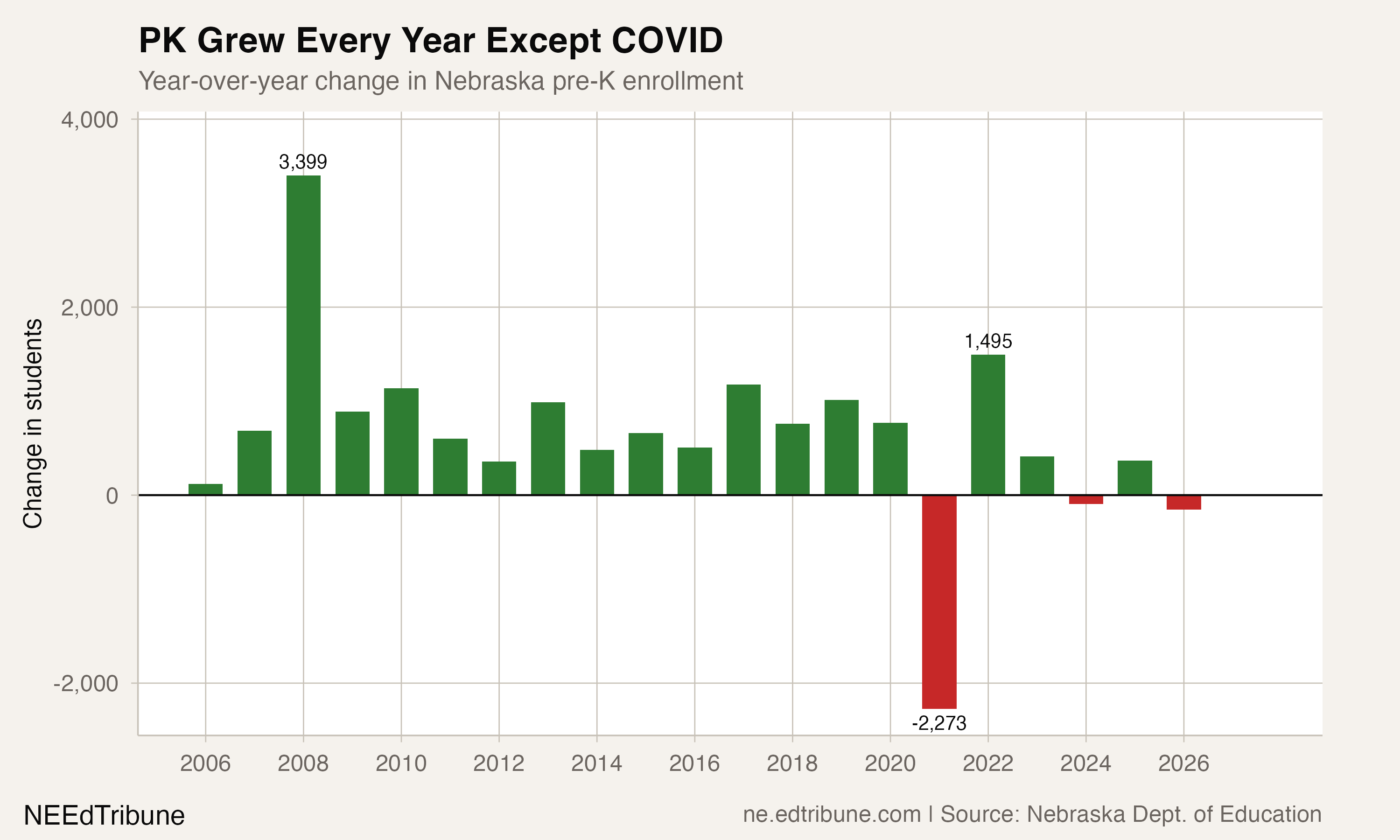
From 2008 through 2020, PK grew at a steady clip, reaching 19,149 by the eve of the pandemic. COVID erased about 1,596 of those students in a single year, an 8.3% drop. Recovery is now complete: PK in 2026 stands at 19,599, slightly above its pre-COVID peak.
Closing in on kindergarten
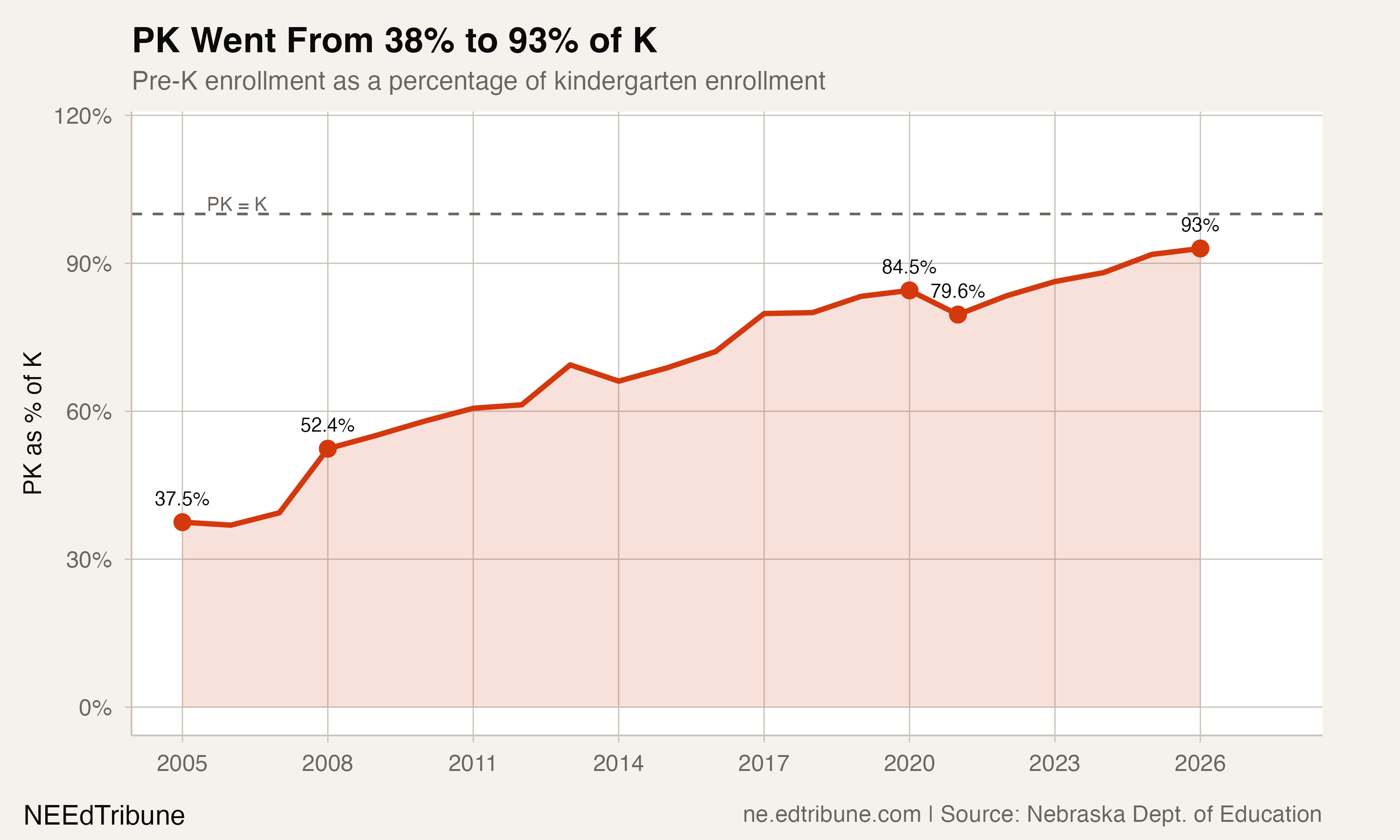
The PK-to-K ratio tells the story most clearly. In 2005, pre-K enrollment equaled about 27% of kindergarten. By 2026, it reached roughly 92%. At the current trajectory, statewide PK enrollment could equal kindergarten within a few years.
At the district level, PK has already overtaken K in many places. Among districts that report both grade levels, 164 of 243 enrolled more pre-K students than kindergartners in 2026. Gering Public Schools↗ET went from 37 PK students and 140 kindergartners in 2005 to 334 PK and 123 K in 2026, a ratio of 2.7 to 1. Hastings Public Schools↗ET enrolls more than twice as many pre-K students (454) as kindergartners (219).
These ratios partly reflect program design: many districts operate half-day or part-time PK programs that serve multiple cohorts of three- and four-year-olds across a single kindergarten-sized cohort of five-year-olds. A district with PK enrollment exceeding K does not necessarily have more individual children in PK than in kindergarten. It may have more program slots spread across two age groups.
What built the system
Nebraska's pre-K infrastructure grew through a combination of state grants, funding formula incentives, and federal support. The state ECE Grant Program, which began as a pilot in 1992 and expanded in 2001, targets districts where at least 70% of enrolled children demonstrate risk factors such as economic disadvantage, disability, or English learner status.
The TEEOSA state aid formula counts PK students at 0.6 of a full-time equivalent, weighted by the ratio of planned instructional hours to 1,032. In 2023, the legislature established foundation aid that gave every district baseline per-student funding, including a reduced rate for pre-K students. Previously, only equalized districts received an early childhood calculation through state aid.
That foundation aid change may have been less about expanding access than formalizing what districts had already built. By 2023, 82% of districts already reported PK enrollment.
"The Nebraska Early Childhood Education Program began as a pilot program in 1992 and expanded in 2001, providing preschool education for children ages three to five." -- National Institute for Early Education Research, 2023 State Profile
The NIEER profile reports state spending at $30.8 million for 2022-2023, with per-child spending of $2,335 from state sources alone and $11,634 when federal and local contributions are included. That gap signals that state dollars are a minority of total PK funding. Federal Head Start grants, local property tax revenues, and private partnerships carry most of the weight.
Where the growth landed
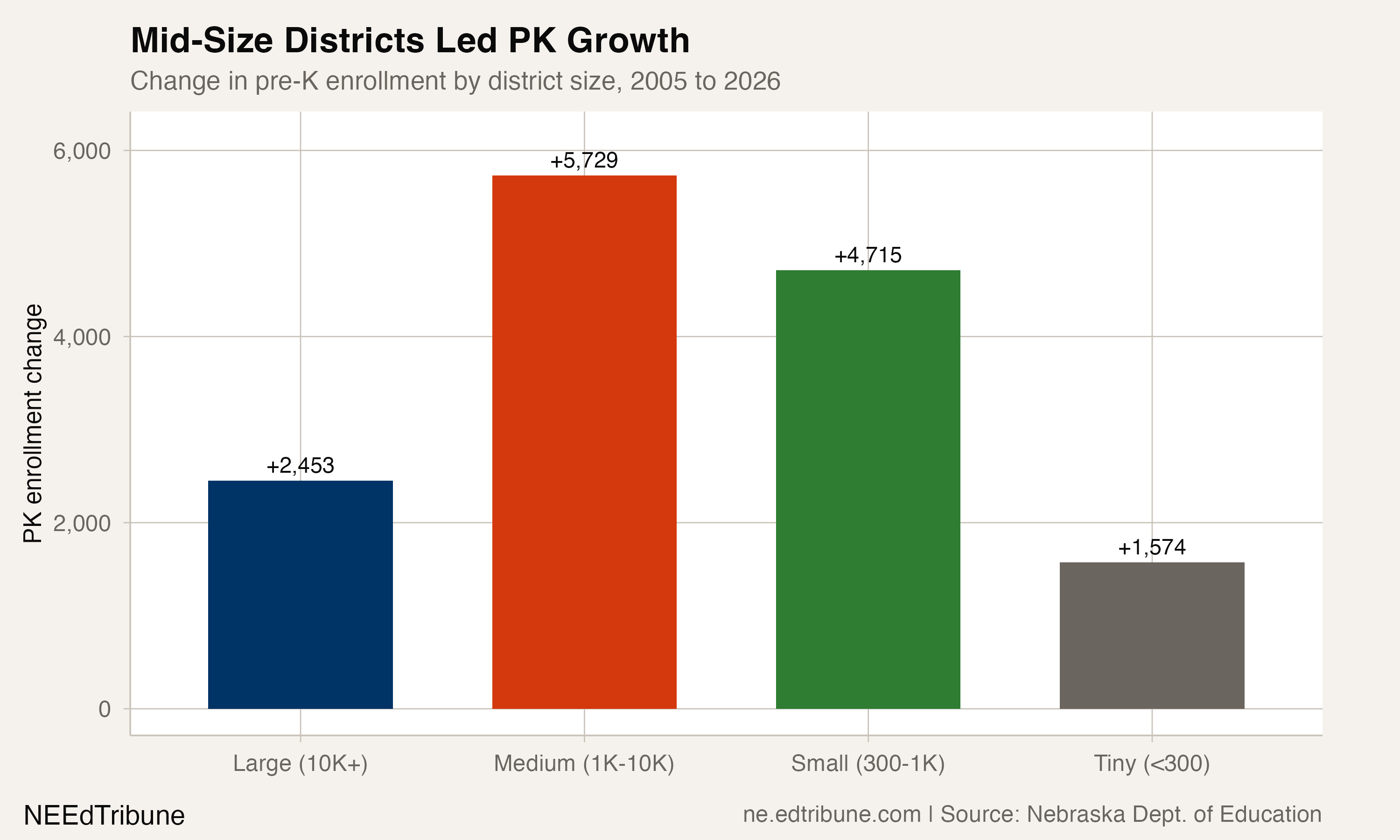
The PK expansion was not concentrated in Omaha and Lincoln. Mid-size districts (1,000 to 10,000 students) added 5,729 PK students since 2005, more than any other size tier. Small districts (300 to 1,000 students) added 4,197. The five largest districts added 2,453.
Kearney Public Schools↗ET grew from 98 PK students to 521. Grand Island Public Schools↗ET went from 370 to 720. Scottsbluff, which had 17 PK students in 2005, now enrolls 275. These are not Omaha suburbs riding a population boom. They are regional centers in central and western Nebraska where PK programs filled a vacuum that private child care and Head Start could not cover alone.
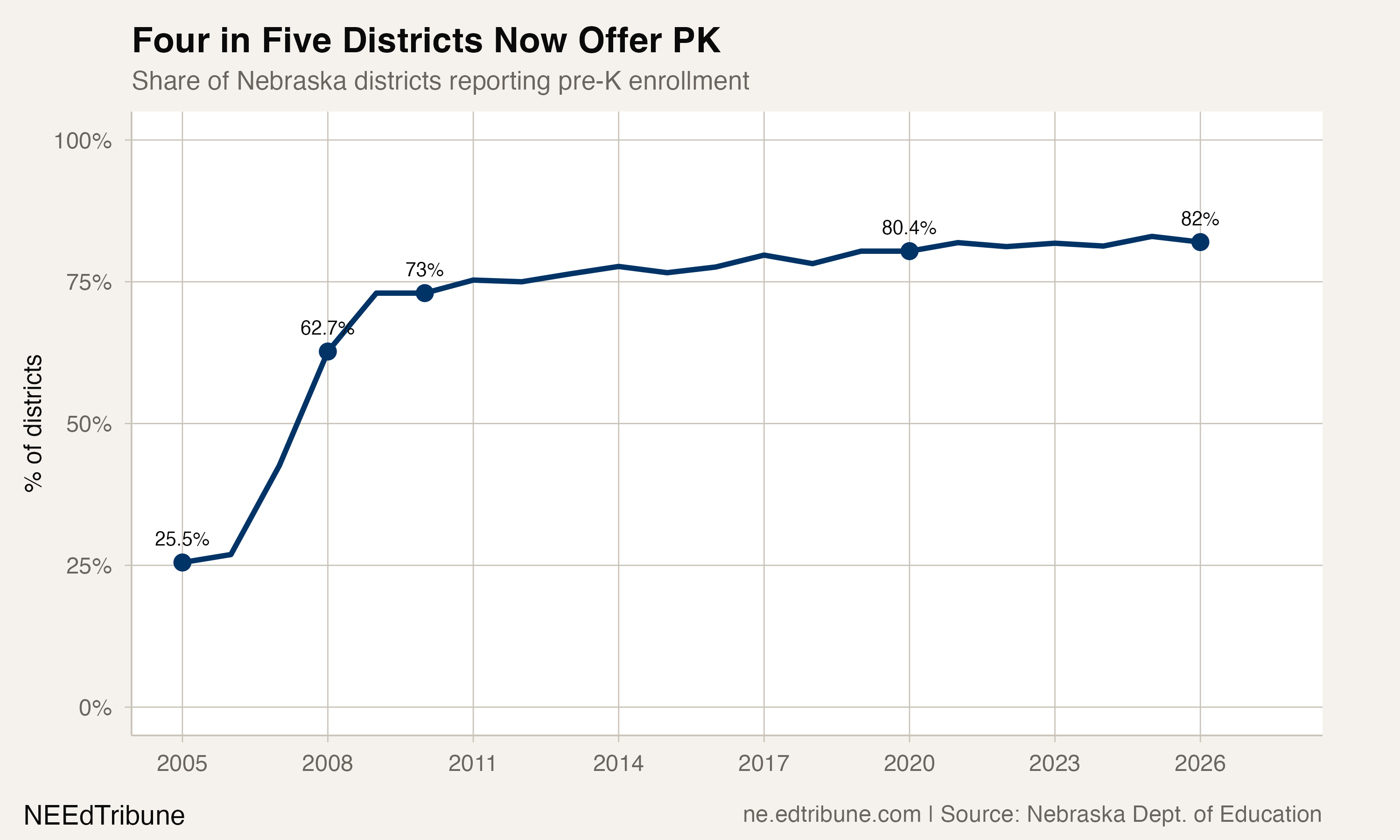
The district coverage chart tells the expansion story. In 2005, 74 of Nebraska's 477 public districts reported PK enrollment. By 2008, that figure jumped to 188 of 254. By 2026, 243 of 244 public school districts (essentially all of them) report pre-K students. The sharp percentage change between 2005 and 2008 partly reflects the Class I/VI consolidation that reduced the total district count, but the absolute growth in districts offering PK is unambiguous. Pre-K is now nearly universal across Nebraska's public school system.
How PK changed Nebraska's enrollment numbers
Nebraska added 43,549 students to its total enrollment between 2005 and 2026, a 15.3% increase. Without PK growth, that figure drops to 29,648 (10.6%). Pre-K accounts for nearly one-third (31.9%) of the state's total enrollment gains.
That distinction matters for fiscal planning. PK students are weighted at 0.6 FTE in the state aid formula, not 1.0. A district adding 100 PK students does not receive the same state support as one adding 100 third-graders. The growth shows up in headline enrollment figures but produces less per-student revenue than K-12 growth does.
Pre-K's share of total enrollment rose from 2.8% in 2005 to about 6.0% in 2026. Meanwhile, kindergarten's share fell from about 7.4% to 6.5%. The grade that once defined the start of public education in Nebraska now enrolls only modestly more students than the grade below it.
The open question is whether PK enrollment has reached its ceiling. It hit 19,149 in 2020, dropped during COVID, and has since climbed back to 19,599 in 2026, slightly above the pre-pandemic mark. If the state's grant program and funding formula have brought PK access to the districts willing and able to offer it, further growth may require either new state investment or a policy shift toward universal access rather than the current risk-factor targeting model.
Detailed code that reproduces the analysis and figures in this article is available exclusively to EdTribune subscribers.
Discussion
Sign in to join the discussion.
Loading comments...