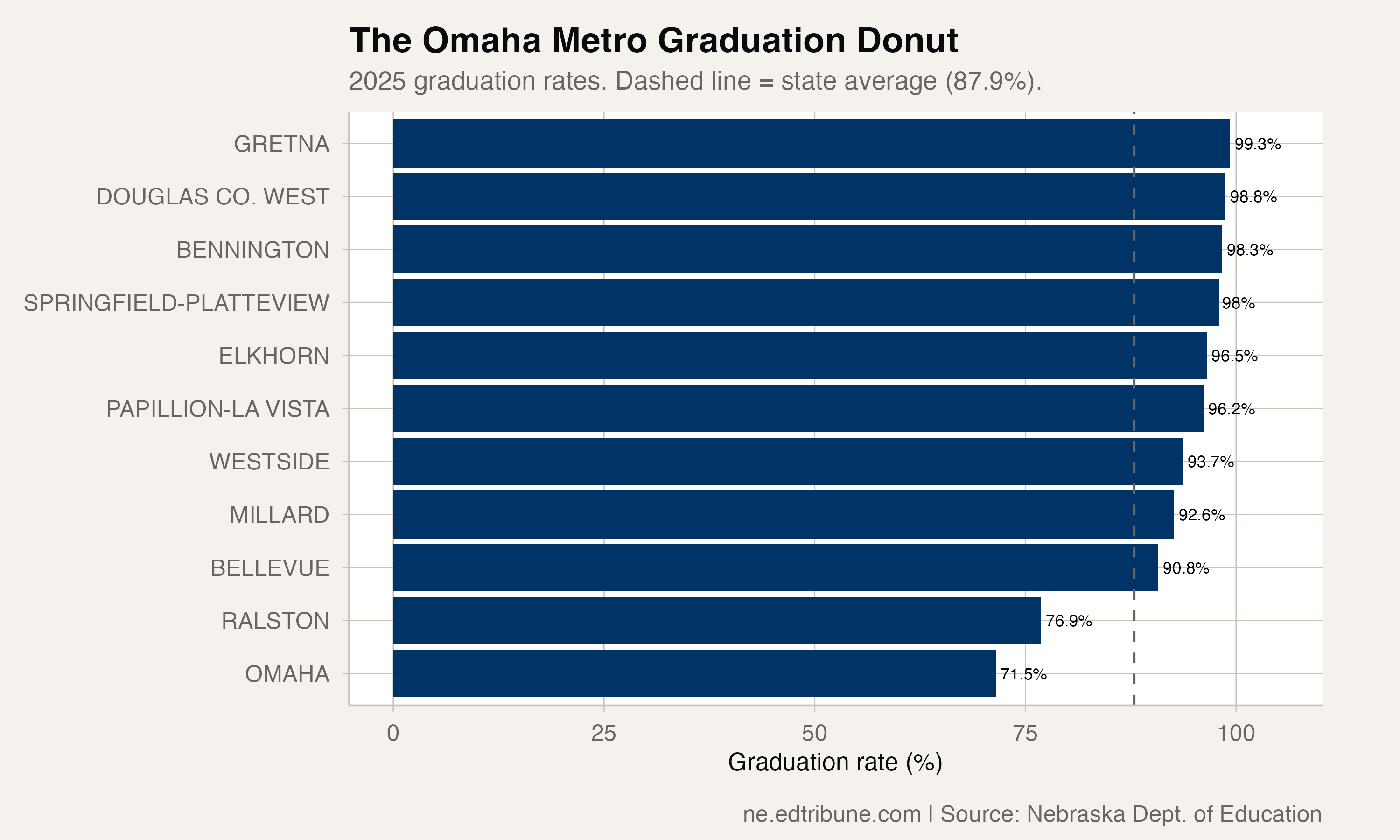
Draw a circle around Omaha Public Schools on a map and check the graduation rates of every district that touches it. The picture that emerges is among the starkest in American public education.
Gretna Public Schools: 99.3%. Bennington Public Schools: 98.3%. Douglas County West: 98.8%. Springfield Platteview: 98.0%. Elkhorn: 96.5%. Papillion-La Vista: 96.2%. Millard: 92.6%.
At the center of the ring: Omaha Public Schools at 71.5%.
The 27.8 percentage point gap between OPS and Gretna — districts separated by a municipal boundary — is not a statistical abstraction. It means that for every 100 students entering high school on one side of the line, roughly 28 more will graduate on time than on the other.
The ring and the core
The Omaha metro donut is a graduation rate phenomenon that tracks geography almost perfectly. The suburban ring of districts — Gretna, Bennington, Douglas County West, Springfield Platteview, Elkhorn, Papillion-La Vista, Millard — all graduate above 92%. Westside Community Schools, which straddles the OPS-suburban boundary, posted 89.7% with 488 students. Bellevue Public Schools finished at 86.9% with 693 students.
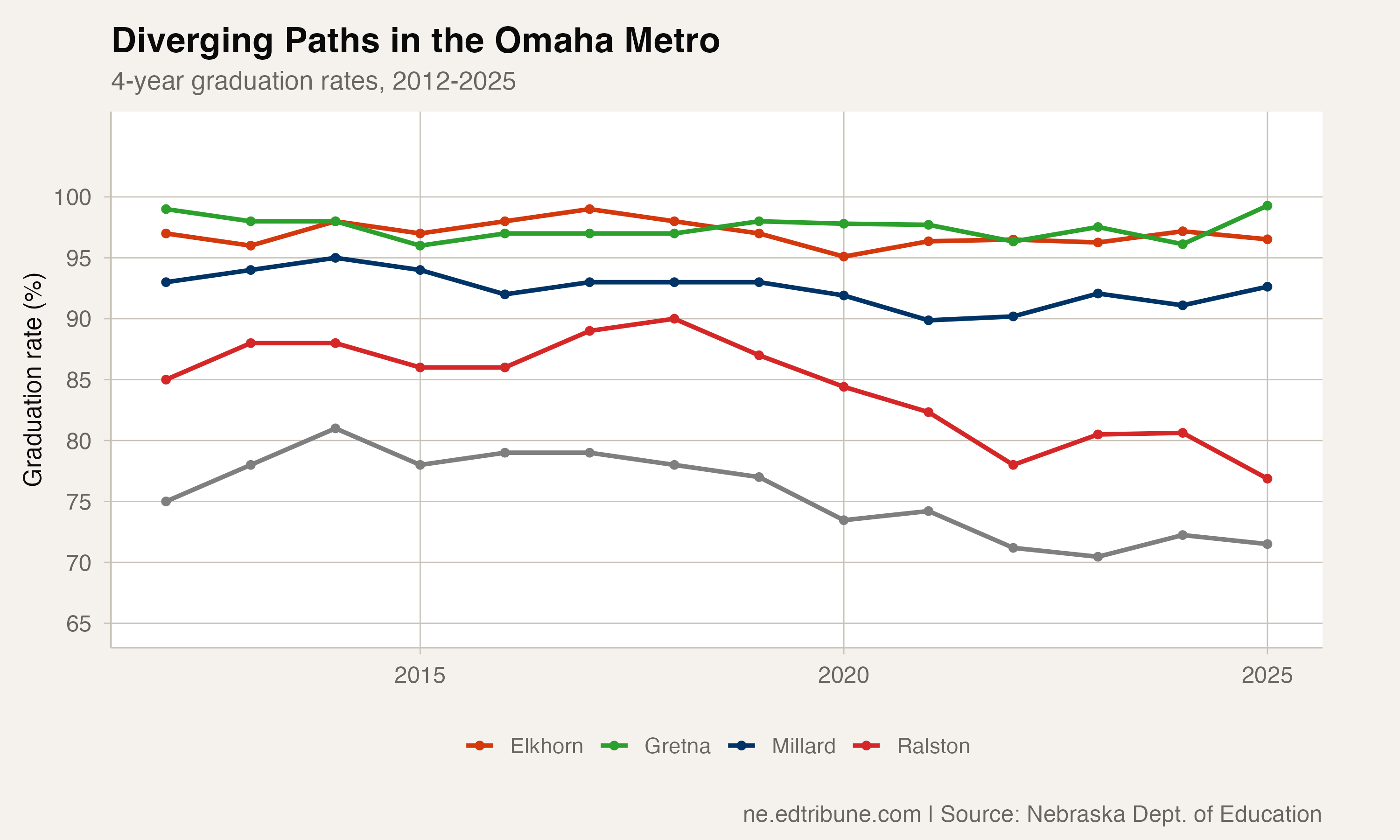
Then there is Ralston Public Schools. An enclave entirely surrounded by Omaha, Ralston has watched its graduation rate decline from 90% in 2018 to 76.9% in 2025. It now sits closer to OPS than to any of its suburban neighbors.
Scale complicates every comparison
The most important caveat in any discussion of metro graduation rates is size. OPS graduated 3,806 students — more than the next five suburban districts combined. Gretna's cohort of 417, Bennington's 238, Douglas County West's 81 — these are fundamentally different operations.
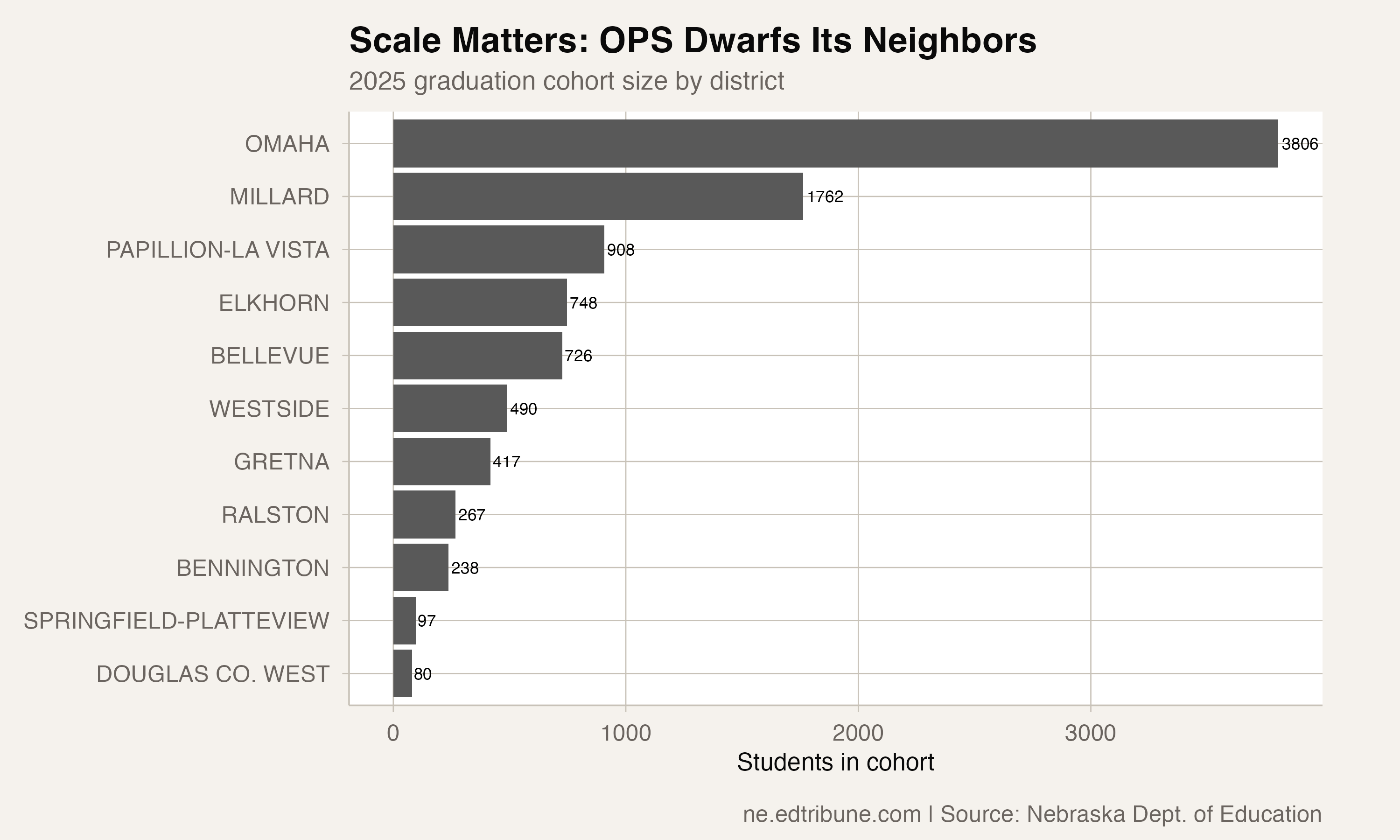
Millard, with 1,762 students and a 92.6% rate, offers the most meaningful comparison to OPS in terms of scale. Papillion-La Vista (908 students, 96.2%) and Elkhorn (748 students, 96.5%) are large enough to be credible benchmarks. Even against these larger suburban systems, OPS trails by 21 to 25 percentage points.
The scale argument cuts both ways. A district serving 3,806 seniors cannot be fairly compared to one serving 81. But a 27.8-point gap is not explained by scale alone. Lincoln Public Schools serves 3,174 seniors and graduates 84.5% — not suburban territory, but 13 points above OPS.
The Ralston warning
Ralston's trajectory deserves particular attention. In 2018, the district posted a 90% graduation rate — solidly in the suburban tier. Since then, the rate has dropped in all but one year: 87% in 2019, 84.4% in 2020, 82.3% in 2021, 78% in 2022, 80.5% in 2023, 80.6% in 2024, 76.9% in 2025.
At 76.9%, Ralston is now just 5.4 points above OPS. If the current trajectory continues, the two districts will converge within a few years — raising the question of whether the donut's inner ring is expanding outward.
Ralston's demographics have shifted significantly in recent years. The district's LEP graduation rate in 2025 was 31.7% — the lowest of any district reporting LEP data in Nebraska. Its Hispanic graduation rate was 66.7%.
What the donut maps
The graduation donut follows familiar lines: income, housing costs, tax base, demographic composition. The suburban ring districts tend to serve wealthier, whiter, more stable populations. OPS serves 71 languages, a large refugee population, and a student body that is majority students of color.
But the donut also maps something subtler. The state average is 87.9%. Every suburban Omaha district exceeds it, most by 5 to 11 points. OPS falls 16.4 points below it. Bellevue and Westside sit near the state average. And Ralston is drifting from the suburban tier toward the core.
The physical distance between a Gretna senior and an OPS senior might be a 20-minute drive. In graduation probability, the distance is 27.8 percentage points.
Detailed code that reproduces the analysis and figures in this article is available exclusively to EdTribune subscribers.
Discussion
Sign in to join the discussion.
Loading comments...