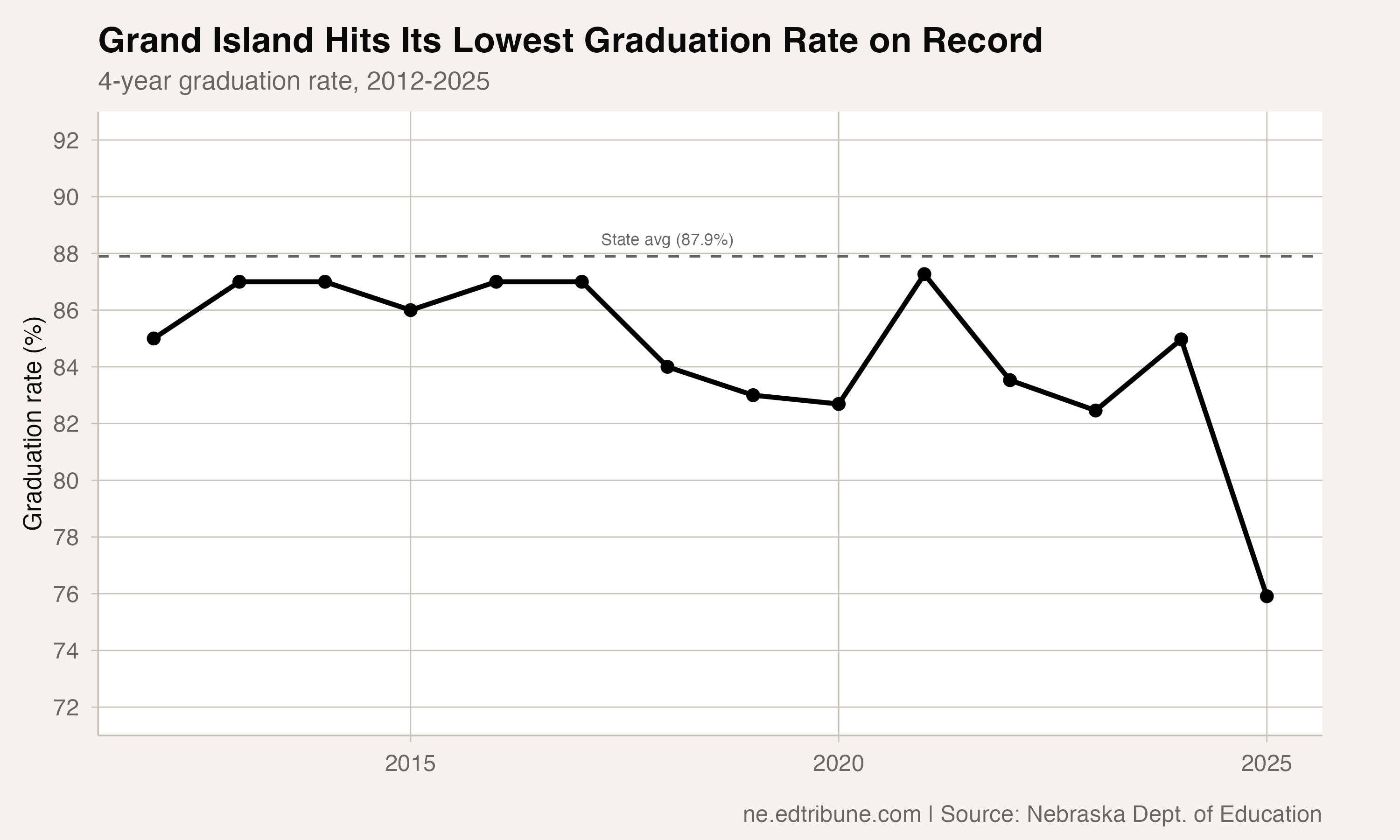
Grand Island Public Schools, the sixth-largest district in Nebraska with a cohort of 739 seniors, recorded a 75.9% graduation rate in 2025. It is the lowest rate in the 14 years the state has tracked four-year graduation rates, and it represents a 9.1 percentage point drop from the 85.0% the district posted just one year earlier.
The district has an explanation. Grand Island says the dip is a one-time "bubble year" caused by a policy change in how incoming English learners were enrolled. Under the old practice, ELL students were placed as freshmen regardless of age or prior schooling. The district shifted to age-appropriate enrollment, meaning the 2025 graduating class was the last cohort to include students enrolled under the old policy — students who entered as freshmen but may not have been academically prepared for a four-year graduation timeline.
Grand Island expects the rate to return to the mid-to-high 80s. The data, though, shows a district that was already declining before the bubble year hit.
The trend before the bubble
Grand Island graduated at 87% or above from 2013 through 2016. The rate slipped to 84% in 2017, recovered to 87% in 2018, then began a sustained decline: 84% in 2019, 81.8% in 2020, 82.2% in 2021, 81.2% in 2022, 80.2% in 2023, 85.0% in 2024, and 75.9% in 2025.
Even setting aside the 2025 bubble year, the five-year average from 2020-2024 was 82.1% — well below the 86% average from 2012-2016. The district's trajectory was already pointing downward before the ELL policy change accelerated it.
The 2024 spike to 85.0% might itself have been the outlier. Or it might have reflected the transition period before the bubble cohort reached its graduation window. Either way, the underlying pattern since 2017 has been a district operating 5 to 10 points below its early-decade performance.
Inside the numbers
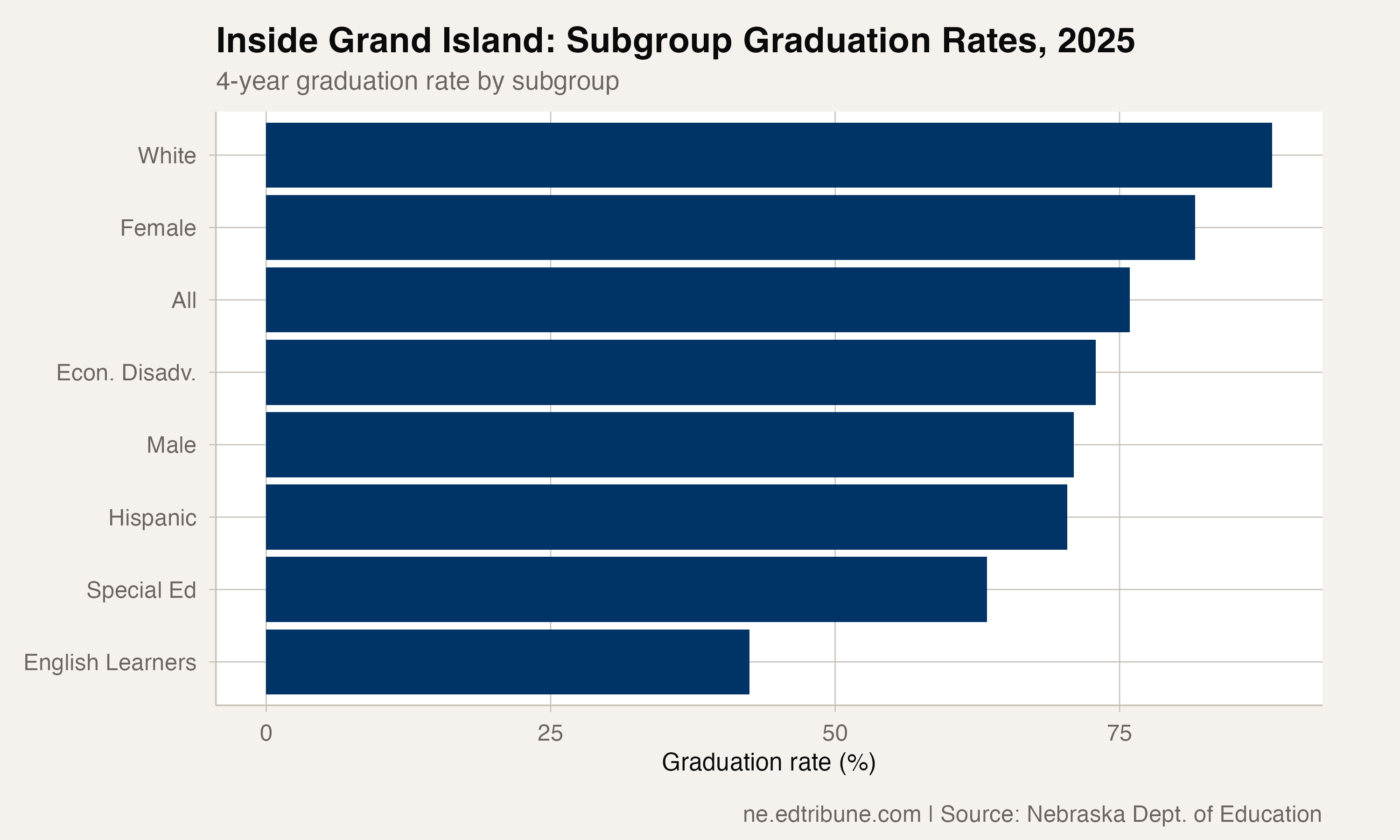
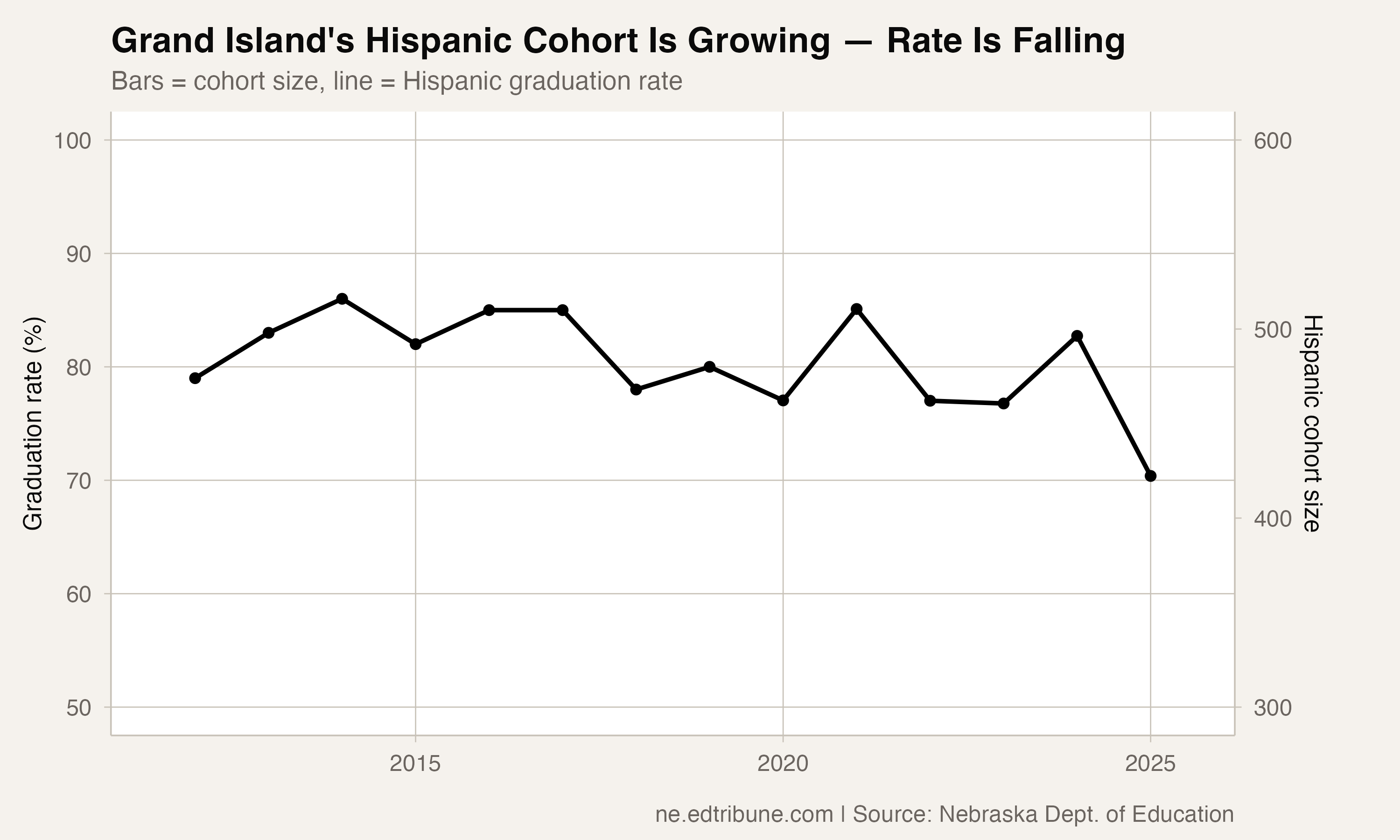
Grand Island's student body is heavily Hispanic — 475 of 739 seniors, or 64.3% of the cohort. The Hispanic graduation rate in 2025 was 70.4%. English learners, a subset of the Hispanic population in many cases, graduated at 42.5% with 186 students in the cohort.
White students graduated at 87.3% — roughly at the state average — but they represent only 203 of the 739 seniors. The district's overall rate is driven by outcomes for Hispanic and LEP students, who together make up the majority.
Males graduated at 71.0% while females posted 81.6%, a 10.7-point gender gap that mirrors the OPS pattern. Economically disadvantaged students finished at 71.2%.
The ELL bubble, explained
The mechanics of the bubble are straightforward. Under Grand Island's previous enrollment policy, a 17-year-old ELL student arriving from another country would be enrolled as a freshman. That student would then have four years to complete Nebraska's 200 credit hours and 80% core curriculum — but many were starting with limited English proficiency and, in some cases, interrupted prior schooling.
When the district shifted to age-appropriate enrollment, these students were placed in the grade that matched their age. A 17-year-old would become a junior, with two years instead of four to accumulate credits. This is the practice most districts follow, and it removes the artificial inflation of the freshman class.
The 2025 graduating class was the last to include students enrolled under the old policy. The LEP cohort at Grand Island swelled to 186 students — up from numbers that varied year to year — and the 42.5% LEP rate dragged the overall rate down significantly.
The question is whether the district's explanation fully accounts for the 9.1-point drop, or whether it masks a broader decline. The Hispanic rate of 70.4% includes LEP and non-LEP students alike. Even among non-LEP Hispanic students, Grand Island appears to be graduating at rates below the state average for Hispanic students (76.8%).
Grand Island in context
Among Nebraska's meatpacking communities, Grand Island's outcomes stand out on the low end. Lexington graduates 89.8% of its Hispanic students. Schuyler posts 86.9%. South Sioux City reaches 84.3%. All serve similar student populations shaped by the same industry.
The district's explanation may be correct — the bubble year may be exactly what they describe, and the 2026 rate may snap back to the mid-80s. But the data available through 2025 shows a district that has not reached 87% since 2018 and has been operating in the low 80s for most of the last five years. Even a "return to normal" would leave Grand Island well below its 2013-2016 performance and behind its peer communities.
Detailed code that reproduces the analysis and figures in this article is available exclusively to EdTribune subscribers.
Discussion
Sign in to join the discussion.
Loading comments...