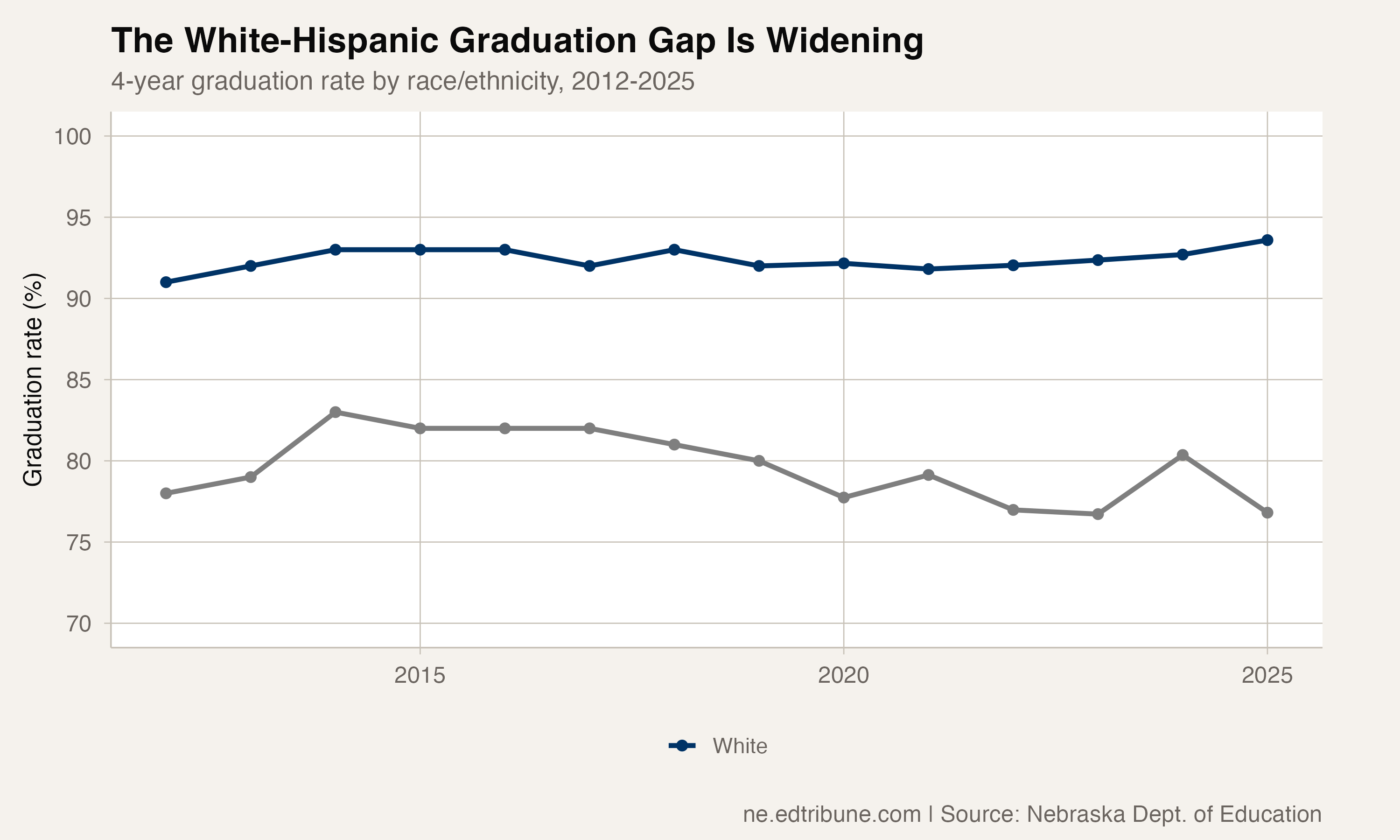
In 2012, when Nebraska first published four-year graduation rates by race, white students finished at 91% and Hispanic students at 78%. The 13-point gap was large but conceivably closeable.
Thirteen years later, the gap has not closed. It has widened. White students climbed to 93.6% in 2025 — their highest rate on record. Hispanic students fell to 76.8%, below their 2012 starting point. The spread now stands at 16.8 percentage points, and the trend line across 14 years of data has moved in one direction.
Two lines, one moving
The white graduation rate has been remarkably stable, sitting between 91% and 93.6% for the entire period. The trajectory is a gentle upward slope — small gains, year after year, with virtually no volatility. White students never dipped below 91%.
Hispanic students have followed a different path. After reaching 83% in 2014 — their best year on record — the rate drifted back to the low 80s, then the high 70s, then fell to 77% in 2022. A rebound to 80.4% in 2024 was erased by a drop to 76.8% in 2025, the second-lowest rate of the past decade and only a hair above the 2023 floor of 76.7%.
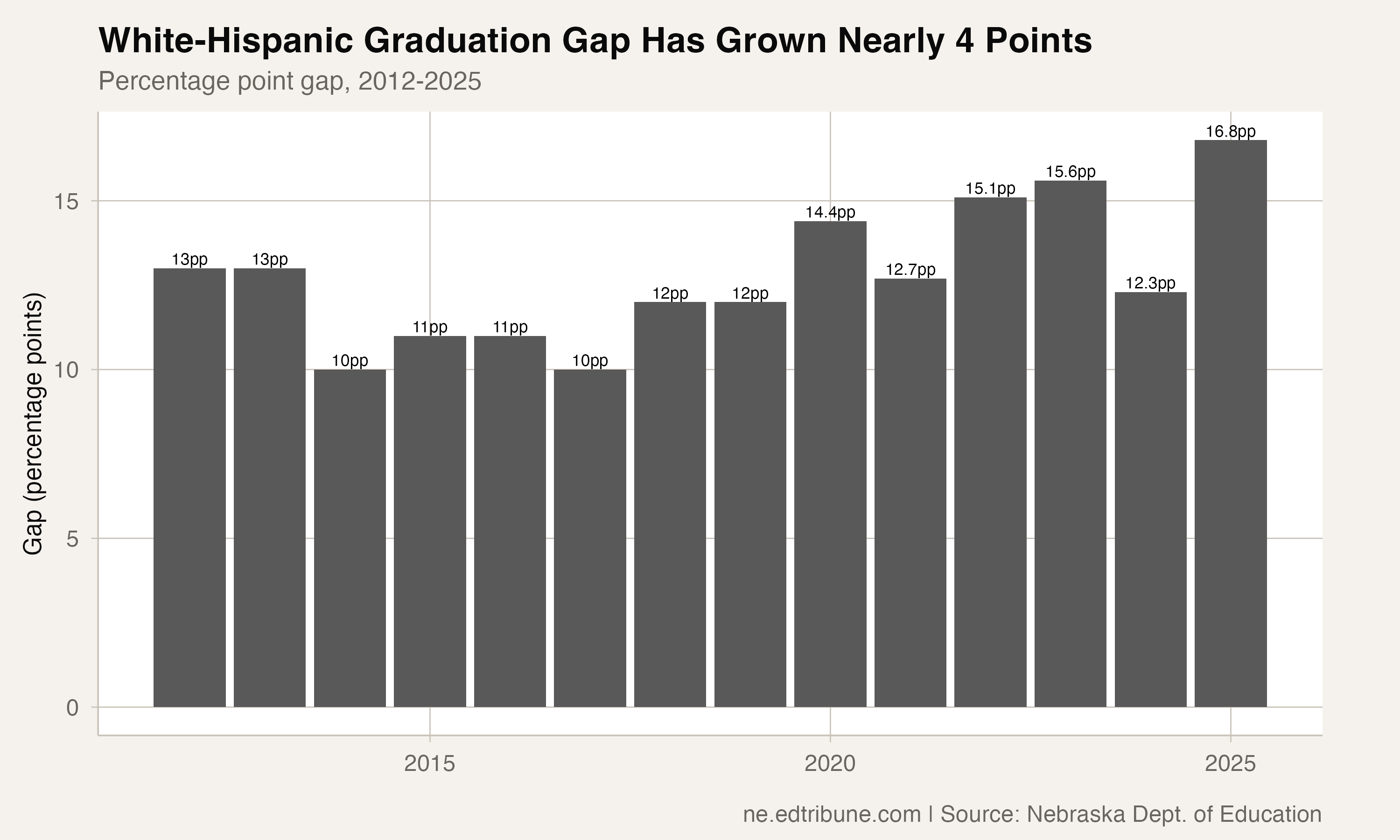
The gap peaked at 16.8 points in 2025, but the recent history has been a series of narrowings and widenings. In 2014, it was 10 points. By 2018, it had widened to 12 points. COVID pushed it to 14.5 in 2020. The 2024 recovery narrowed it to 12.3 points — but the 2025 reversal undid that progress in a single year.
A growing cohort, a declining rate
The Hispanic graduation cohort has nearly doubled from 2,917 students in 2012 to 5,613 in 2025 — a 92.4% increase. Hispanic students now make up 23.2% of the state's entire graduation cohort, up from 13.3% in 2012.
In absolute terms, that means Nebraska produced roughly 1,301 Hispanic non-graduates in 2025 compared to 641 in 2012. The state is graduating a higher percentage of its overall cohort than in 2012, but the number of Hispanic students who don't finish on time has doubled.
The cohort growth reflects the broader demographic shift in Nebraska. Hispanic enrollment across all grades has doubled over the past two decades, driven by meatpacking industry employment in towns like Grand Island↗ET, Lexington↗ET, Schuyler↗ET, and South Sioux City↗ET. Many of these students are themselves English learners — and the LEP graduation rate in Nebraska stands at just 52.2%.
What the meatpacking corridor reveals
The most compelling evidence that this gap is not demographic destiny comes from the five communities most shaped by meatpacking employment. All five serve heavily Hispanic student bodies. Their 2025 Hispanic graduation rates range from 70.4% to 89.8%.
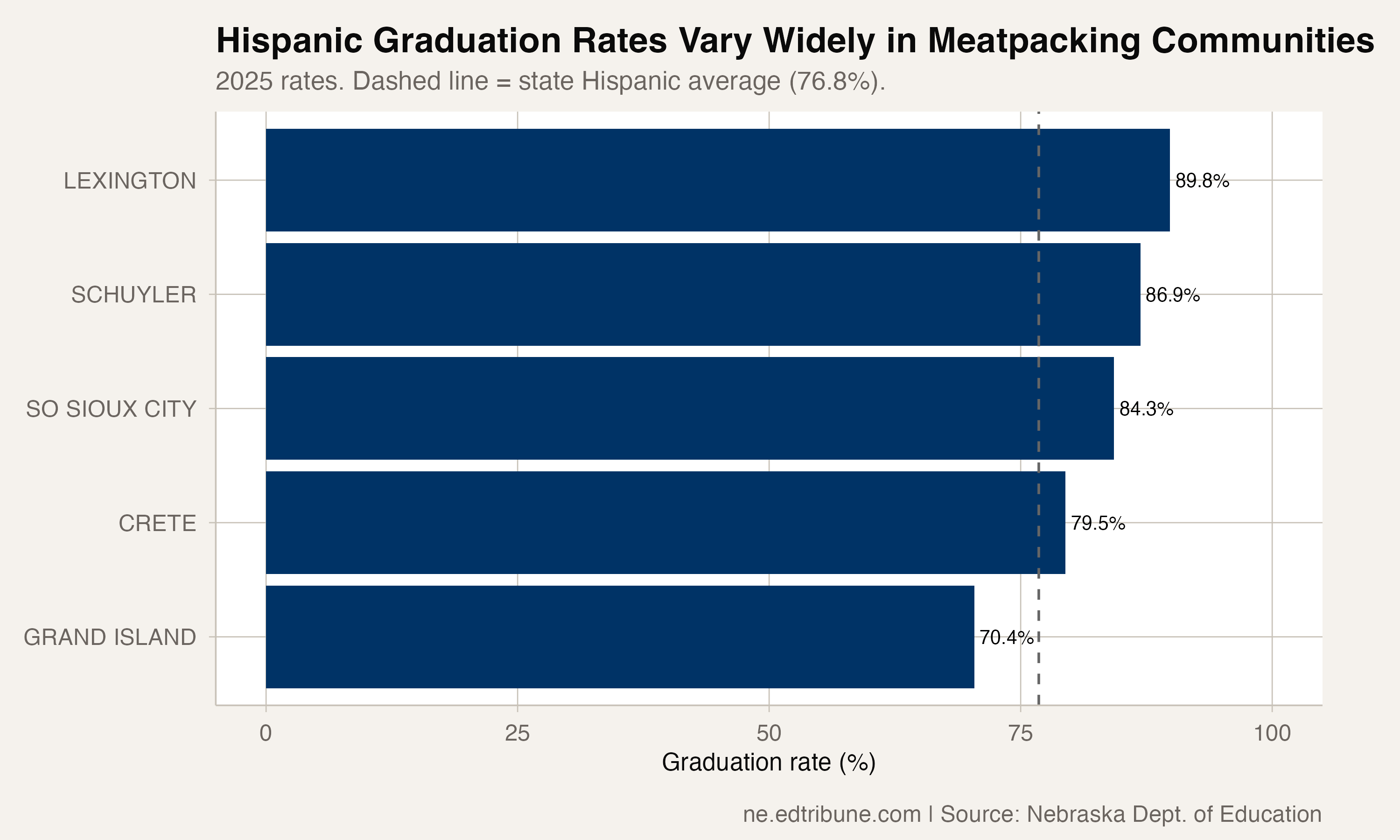
Lexington Public Schools leads the group at 89.8% with 177 Hispanic students in its cohort — actually exceeding the state average for all students. Schuyler Community Schools posted 86.9% with 144 students. South Sioux City came in at 84.3% with 197 students. Crete↗ET posted 79.5% with 112.
And then Grand Island, the largest of the group at 475 Hispanic students, posted 70.4%. The district attributes its overall rate decline in 2025 to an ELL enrollment policy change — a one-time "bubble year" as the final cohort of English learners enrolled as freshmen regardless of age hit their four-year window.
The variation across these communities is the point. Lexington and Schuyler graduate nearly nine in ten Hispanic students. Grand Island graduates seven in ten. The communities share demographic profiles, industry bases, and geographic position. The outcomes are different because the districts are different.
Where the statewide gap lives
Omaha Public Schools↗ET accounts for a disproportionate share of the statewide Hispanic graduation gap. The district's 1,695 Hispanic students — 30.2% of the statewide Hispanic cohort — graduated at just 65.1%. Lincoln Public Schools↗ET, with a significant Hispanic population of its own, posted 71.5% for its 547 Hispanic students.
Remove the two largest urban districts and the statewide Hispanic rate would almost certainly look better. But removing them would be misleading. OPS and LPS serve real students who live in Nebraska, and their graduation outcomes are Nebraska's graduation outcomes.
A gap that reflects more than schools
The graduation rate gap between white and Hispanic students is a lagging indicator of everything that happens before a student reaches high school. It reflects language acquisition trajectories that began in elementary school. It reflects family mobility patterns in meatpacking communities. It reflects school readiness gaps that compound year after year.
Nebraska requires 200 credit hours and 80% core curriculum for graduation. For a student navigating those requirements in a second language, the four-year window is tight. A five-year rate — which Nebraska does not publish — would likely show more Hispanic students eventually completing, especially English learners.
But the four-year rate is the one that matters for policy. And that rate says the gap that existed when Nebraska started counting has not only persisted but grown — even as the state graduated more students overall, even as equity became a stated priority, even as the Hispanic cohort doubled.
Detailed code that reproduces the analysis and figures in this article is available exclusively to EdTribune subscribers.
Discussion
Sign in to join the discussion.
Loading comments...