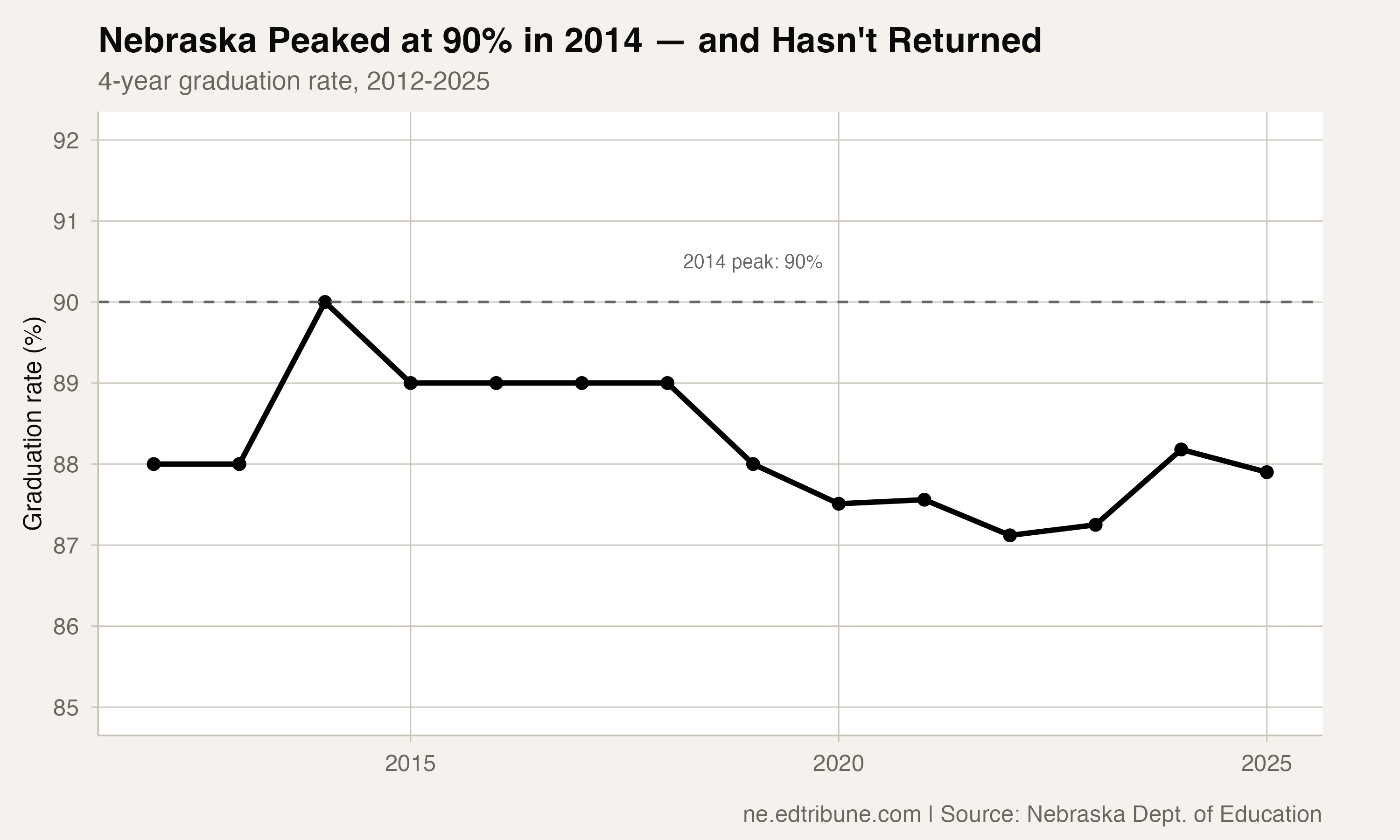
Nebraska crossed the 90% graduation threshold exactly once. In 2014, the four-year adjusted cohort graduation rate hit 90% — a round number that placed the state comfortably above the national average and suggested a system that was working for the vast majority of its students.
Eleven years later, the rate is 87.9%. The decline looks modest — 2.1 percentage points — but what the topline rate obscures is a cohort that has grown by 2,509 students over the same period. The state now produces 2,924 non-graduates per year, up from 2,165 at the 2014 peak. That is 760 additional students per year who do not earn a diploma within four years.
The plateau that isn't
The statewide graduation rate has occupied a narrow band between 87% and 90% for the entire 14 years of available data. In 2012 it was 88%. In 2025 it is 87.9%. A casual reading might conclude the state has been remarkably stable.
But the trajectory within that band tells a different story. After the 2014 peak, the rate drifted down through the late 2010s — 89% for several years, then 88% in 2019. COVID pushed it to 87.5% in 2020 and 87.6% in 2021. The trough came in 2022 at 87.1%. A recovery to 88.2% in 2024 gave hope that the state might recapture 90%, but the 2025 rate fell back to 87.9%.
The pattern is clear: each attempted recovery stalls short of the previous local high. The 2024 bounce of 88.2% was still below the 89% range that prevailed from 2015 to 2018. The system seems to have settled into a new equilibrium around 87.5-88%, roughly 2 points below its peak capacity.
More students, more non-graduates
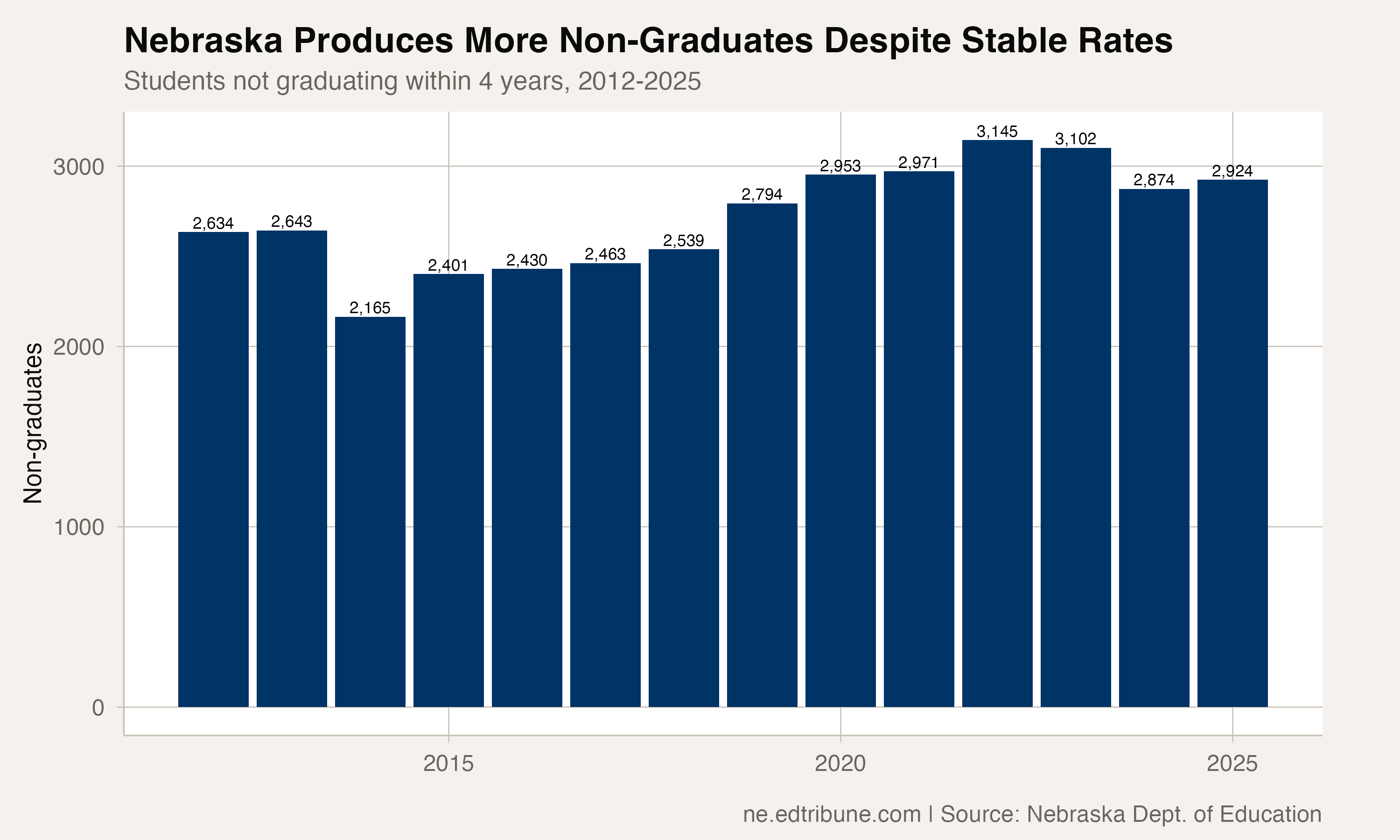
The raw numbers tell the less comfortable version of this story. In 2014, the 90% rate applied to a cohort of 21,658 students, producing 2,165 non-graduates. In 2025, the 87.9% rate applies to 24,167 students, producing 2,924 non-graduates.
The cohort has grown 11.6% since 2014. The number of non-graduates has grown 35.1%. The divergence between these two figures — cohort growing faster than the system's ability to graduate students — is the central tension in Nebraska's graduation data.
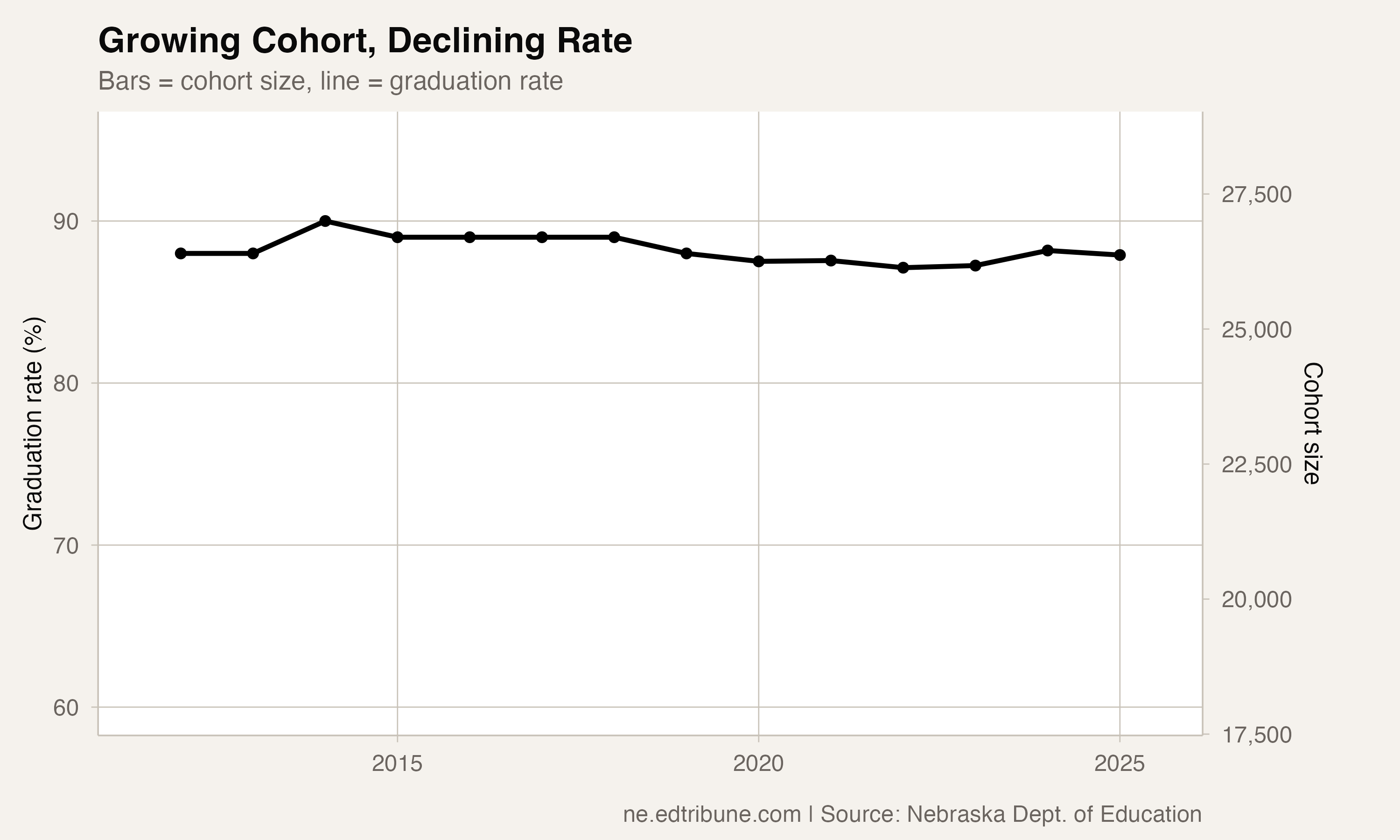
At the 2022 trough, the state produced 3,150 non-graduates from a cohort of 24,419. That remains the worst year in absolute terms. But 2025, with 2,924 non-graduates, is not meaningfully better — and it comes after what was supposed to be a recovery year.
What the subgroups reveal
Nebraska's 2025 subgroup data shows the statewide rate as an average of vastly different realities. White students graduate at 93.6%, pulling the average up. Hispanic students at 76.8% and Black students at 77.9% pull it down. English learners finish at 52.2%. Foster care youth at 55.3%. Homeless students at 62.3%. Special education students at 70.1%.
The state's overall rate is stable because the largest subgroup — white students, who still make up the majority of the cohort — has actually improved slightly over 14 years, from 91% to 93.6%. But the fastest-growing subgroups are also the lowest-performing. Hispanic students have nearly doubled from 2,917 to 5,613 in the cohort. English learners have more than doubled from 884 to 1,882.
As the composition of the cohort shifts — more Hispanic students, more English learners, more economically disadvantaged students — the statewide rate faces headwinds that incremental improvements in the white graduation rate cannot overcome.
Nebraska in national context
The state's 87.9% rate sits slightly above the most recently available national average of roughly 87%. Nebraska typically ranks in the low-to-mid 20s among states, a position that reflects above-average performance but not the kind of excellence the 2014 peak briefly suggested.
Nebraska requires 200 credit hours and 80% core curriculum for graduation — no state exit exam, no standardized test threshold. The requirements are straightforward by national standards. New mandates — personal finance starting 2023-24, computer science starting 2027-28 — add incremental load but are unlikely to meaningfully change the graduation calculus for students on the margin.
The state uses the AQuESTT accountability framework, which rates districts across multiple domains. Chronic absenteeism, which affects 21% of Nebraska students, is increasingly recognized as a key upstream indicator of graduation risk.
The arithmetic of recovery
To return to 90%, Nebraska would need to graduate roughly 21,750 of the current 24,167-student cohort — 513 more graduates than the 21,237 who finished in 2025. At current trajectory, that would require either shrinking the cohort (unlikely given demographic trends) or improving outcomes for the subgroups that have been pulling the rate down.
The state has demonstrated it can reach 90% — it did it once, in 2014, with a smaller and demographically different cohort. Whether it can reach 90% with the cohort it has now is a different question. The data through 2025 suggests the answer is: not yet.
Detailed code that reproduces the analysis and figures in this article is available exclusively to EdTribune subscribers.
Discussion
Sign in to join the discussion.
Loading comments...