Correction (July 26, 2026): An earlier version of this article stated that Omaha Public Schools did not respond to a request for comment. No outreach was sent to the district for this piece in advance of publication, so the line misrepresented Omaha Public Schools. The line has been removed. We regret the error.
The numbers land with a thud that ought to rattle windows in downtown Omaha: 22,485 students in Omaha Public Schools↗ET were chronically absent in 2024-25. That is 44.7 percent of the district -- nearly half of every child who walked through an OPS door last fall.
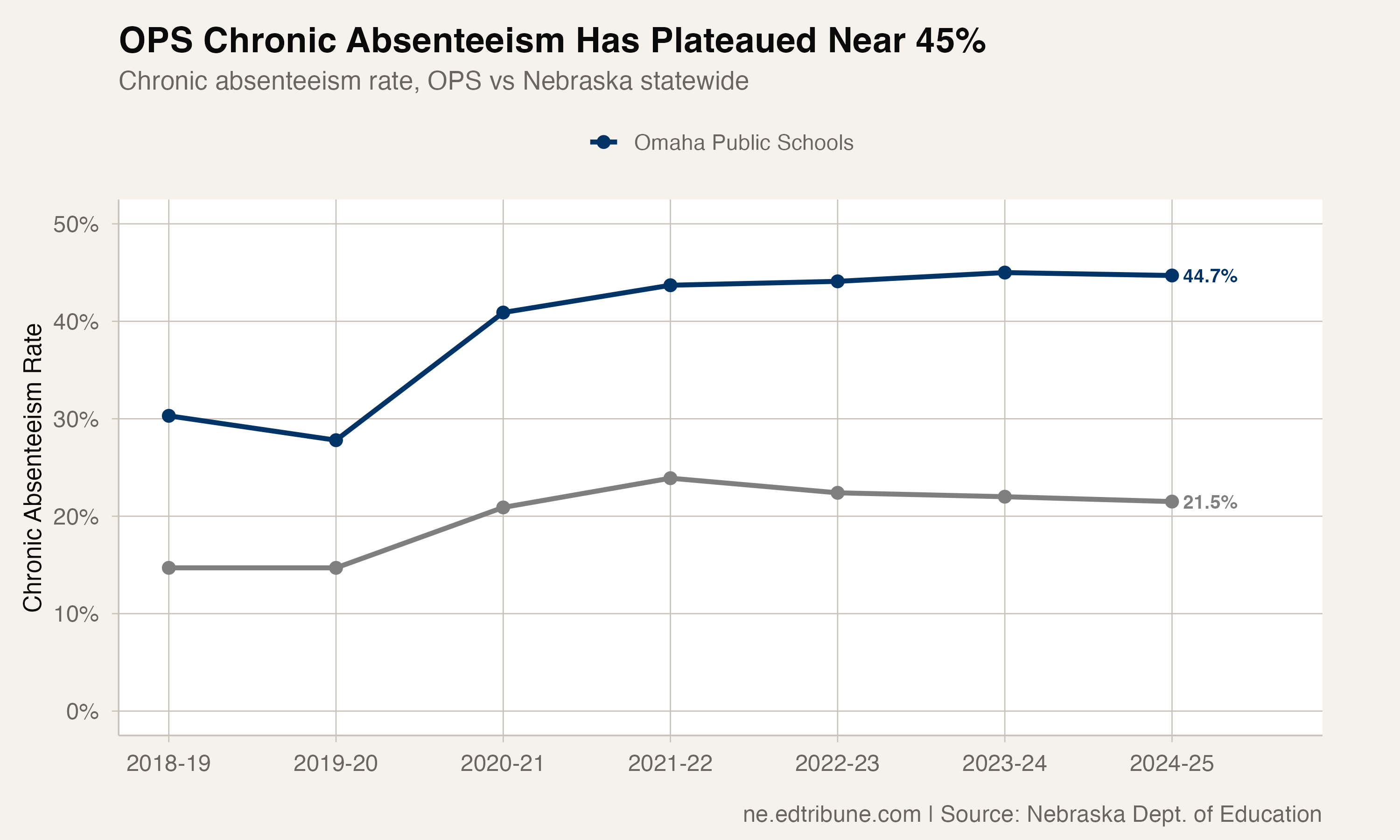
And the trend line offers no comfort. While Nebraska as a whole has inched its chronic absenteeism rate downward from a 2022 peak, OPS has flatlined at crisis altitude. The district posted 40.9 percent in 2020-21, 43.7 percent in 2021-22, 44.1 percent in 2022-23, 45.0 percent in 2023-24, and 44.7 percent in 2024-25 -- a four-year plateau that suggests the problem has calcified.
A district-sized problem inside a district
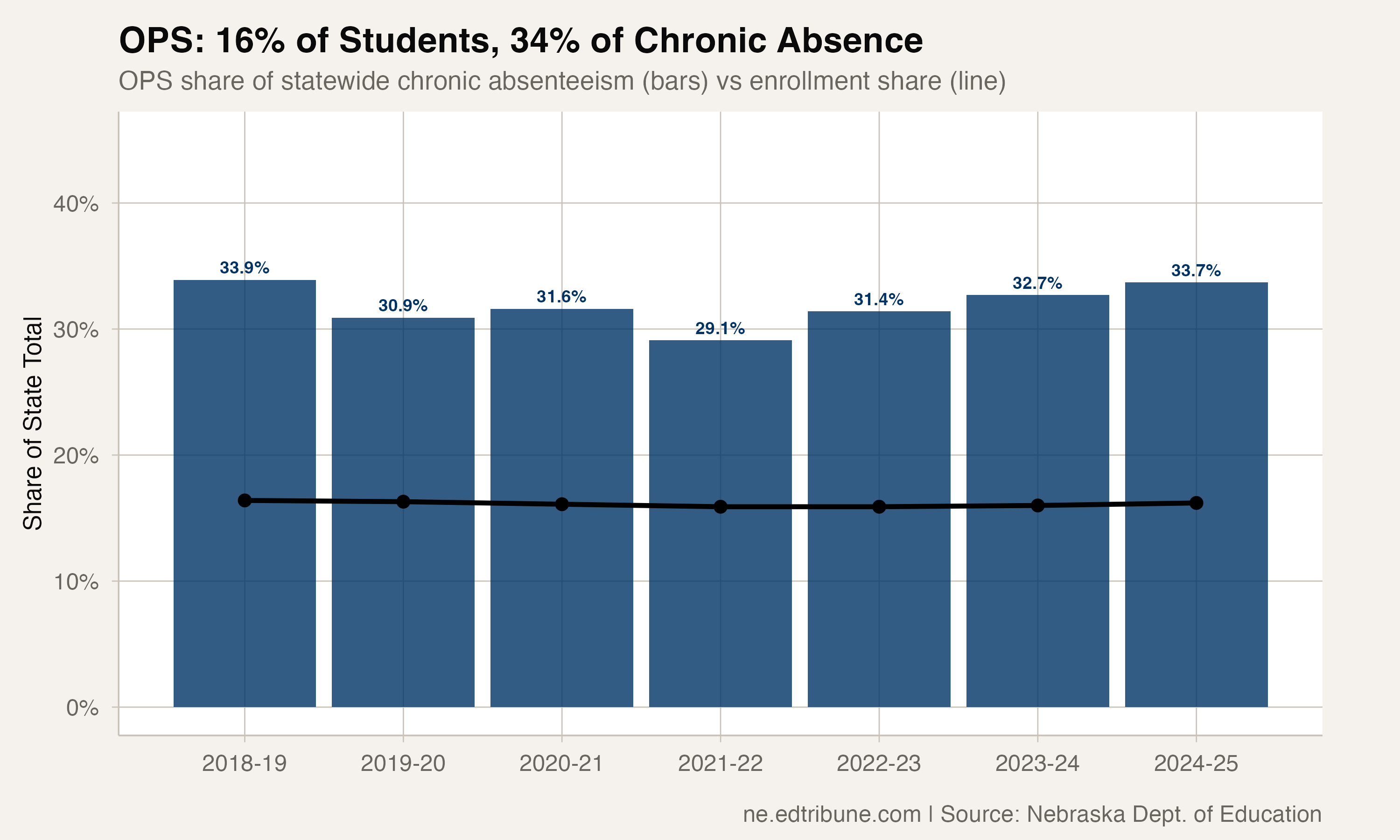
OPS enrolls 16.2 percent of Nebraska's students. It produces 33.7 percent of the state's chronically absent students -- more than double its enrollment share. The 22,485 OPS students who missed 10 percent or more of the school year outnumber the total enrollment of every Nebraska district except Lincoln.
Remove OPS from the statewide calculation and Nebraska's chronic absenteeism rate drops several percentage points. The state's attendance crisis is, to a striking degree, an Omaha crisis.
The high school catastrophe
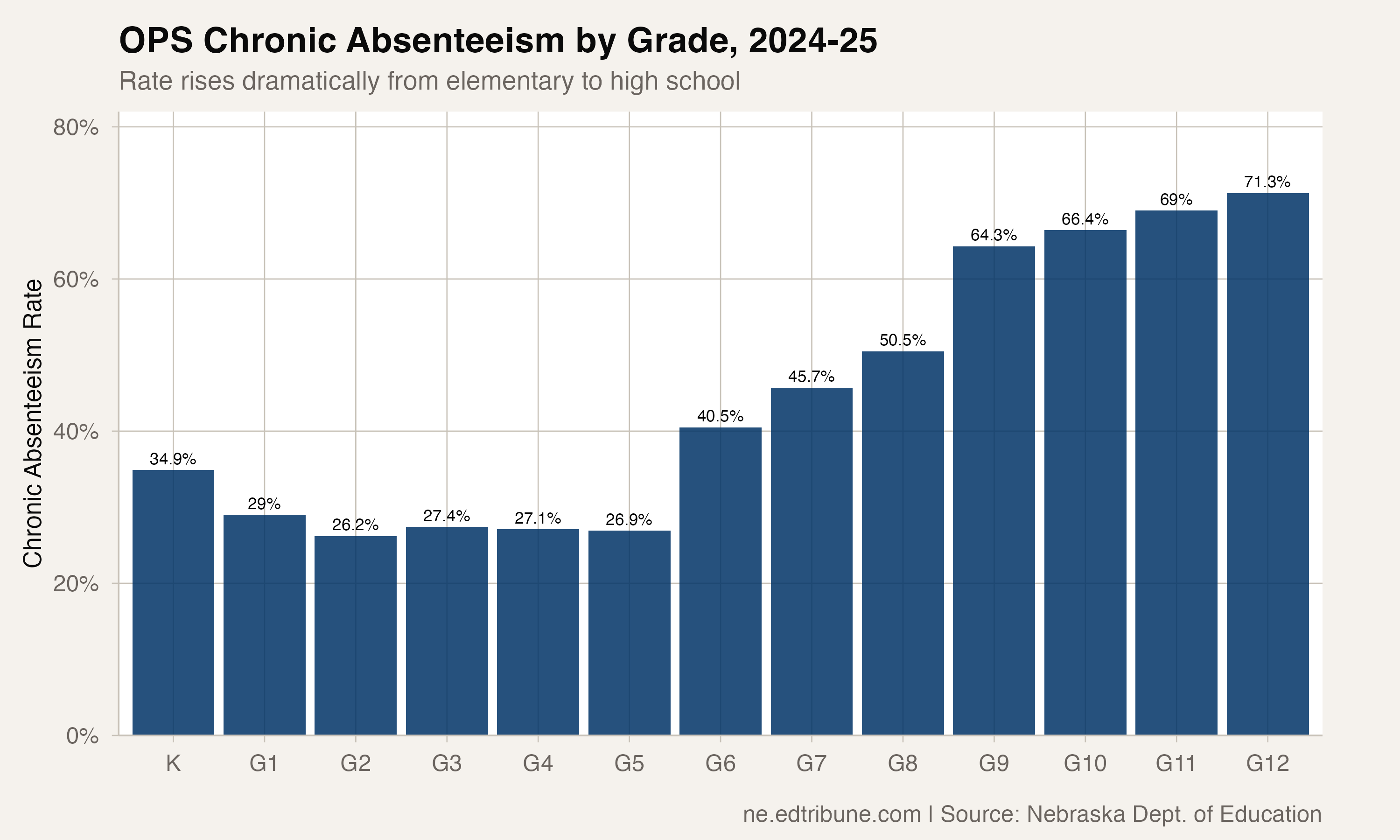
The grade-level data inside OPS tells the darker story. Among OPS seniors, 71.3 percent were chronically absent in 2024-25. Juniors: 69.0 percent. Sophomores: 66.4 percent. Freshmen: 64.3 percent.
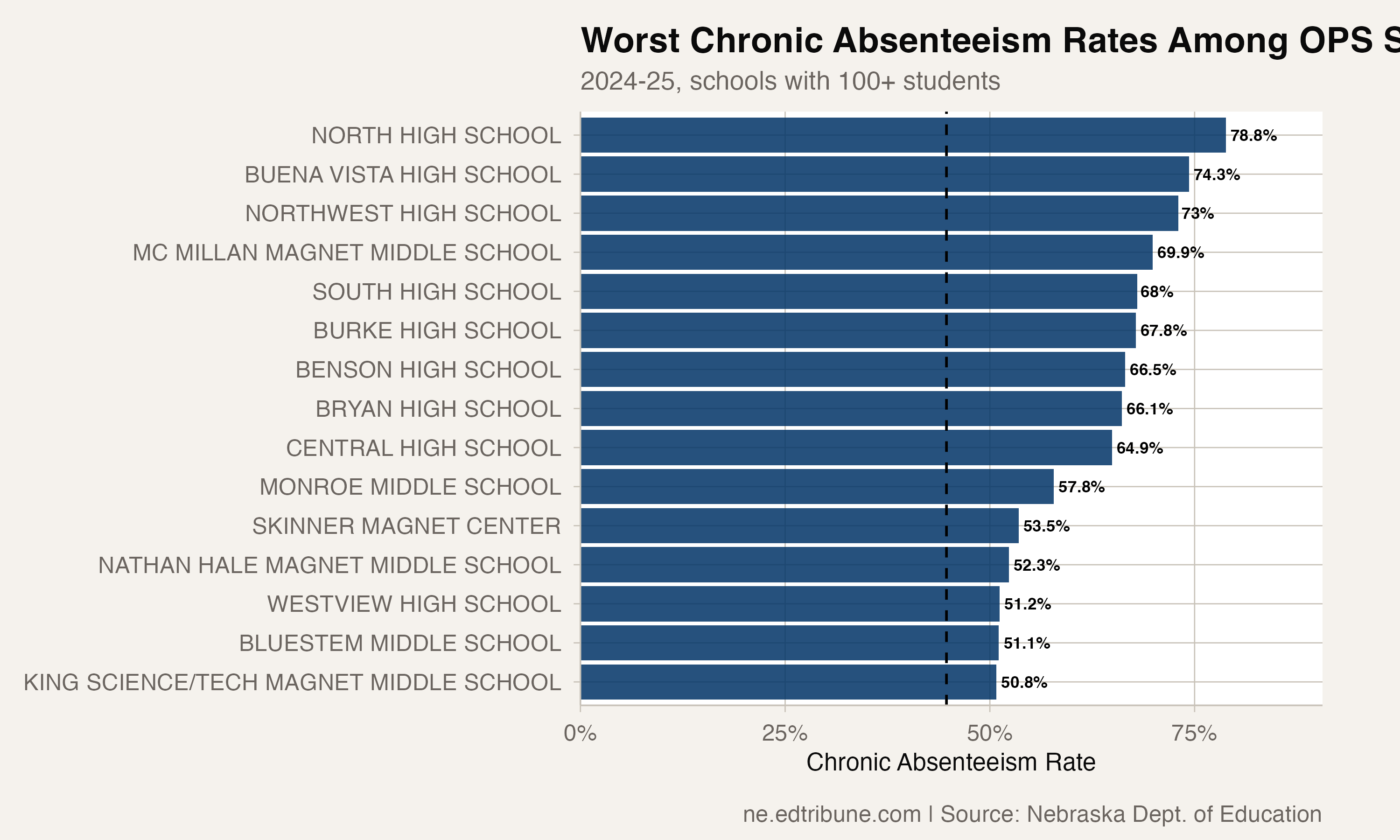
Those are not absenteeism rates. Those are attendance rates inverted. At North High School, 78.8 percent of 1,754 students were chronically absent. At Buena Vista High, 74.3 percent. At Northwest High, 73.0 percent. South High, one of OPS's largest high schools with 2,412 students, posted 68.0 percent.
Even OPS middle schools have crossed into territory most districts would consider emergency levels. McMillan Magnet Middle School hit 69.9 percent. Monroe Middle: 57.8 percent. Eighth grade across the district: 50.5 percent -- meaning more than half of OPS eighth-graders were chronically absent.
Four years on a ledge
The pre-COVID chronic absenteeism rate at OPS was 30.3 percent in 2018-19 -- already the highest among Nebraska's major districts. The pandemic pushed it to 40.9 percent. But unlike most districts, OPS never bent the curve back down. It just kept climbing: 43.7, 44.1, 45.0. The slight dip to 44.7 in 2024-25 is within the margin of normal fluctuation, not evidence of recovery.
The district has not been idle. OPS partnered with District Management Group on an "improvement science" approach to attendance, and Superintendent Matt Ray has emphasized data-driven, personalized outreach to absent students. In 2024-25, 51 of 98 OPS schools met attendance improvement goals -- evidence that school-level progress is possible even as the district-wide number refuses to budge.
But the scale of the challenge is staggering. OPS serves a student population where poverty, housing instability, transportation barriers, and mental health crises intersect at rates far higher than surrounding suburban districts. The 37.8 percentage-point gap between OPS (44.7 percent) and nearby Bennington (7.0 percent) is not merely a gap -- it is a chasm that maps onto one of the starkest socioeconomic divides in the Midwest.
The funding shadow
Nebraska uses Average Daily Membership as a component of the TEEOSA school funding formula, with per-pupil costs averaging $17,205 in 2023-24. Chronic absenteeism directly depresses ADM, creating a vicious cycle: students who miss school reduce the district's funding, which limits the resources available to bring them back.
For OPS, the math is punishing. With 22,485 chronically absent students -- each missing at least 10 percent of the school year, and many missing far more -- the ADM reduction translates into millions in forgone state aid at precisely the moment the district needs more resources, not fewer.
Detailed code that reproduces the analysis and figures in this article is available exclusively to EdTribune subscribers.
Discussion
Sign in to join the discussion.
Loading comments...