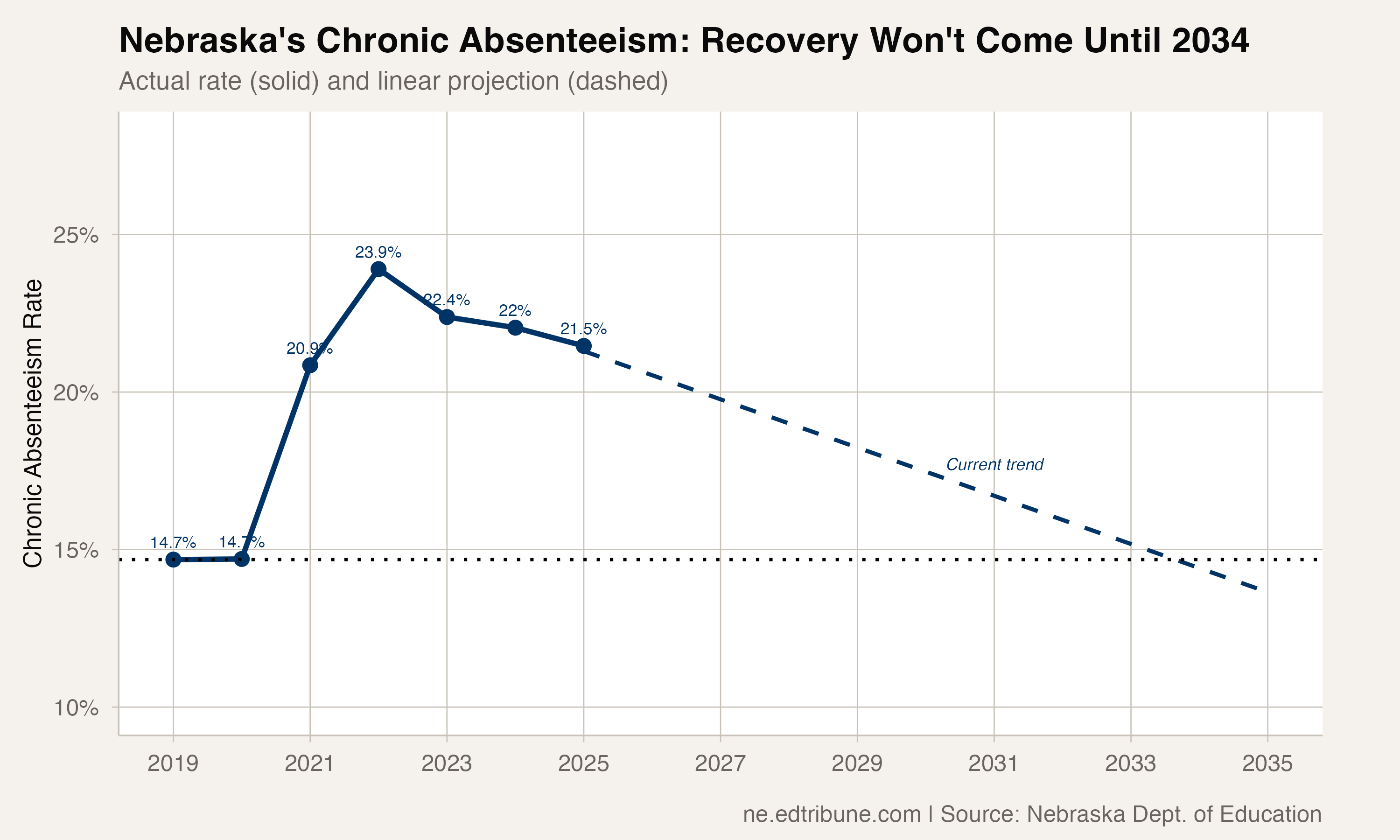
Nebraska's chronic absenteeism rate peaked at 23.9 percent in 2021-22, when 73,669 students missed at least 10 percent of the school year. Three years later, the number is 66,696 students and the rate is 21.5 percent. Progress, but progress measured in inches against a crisis measured in miles.
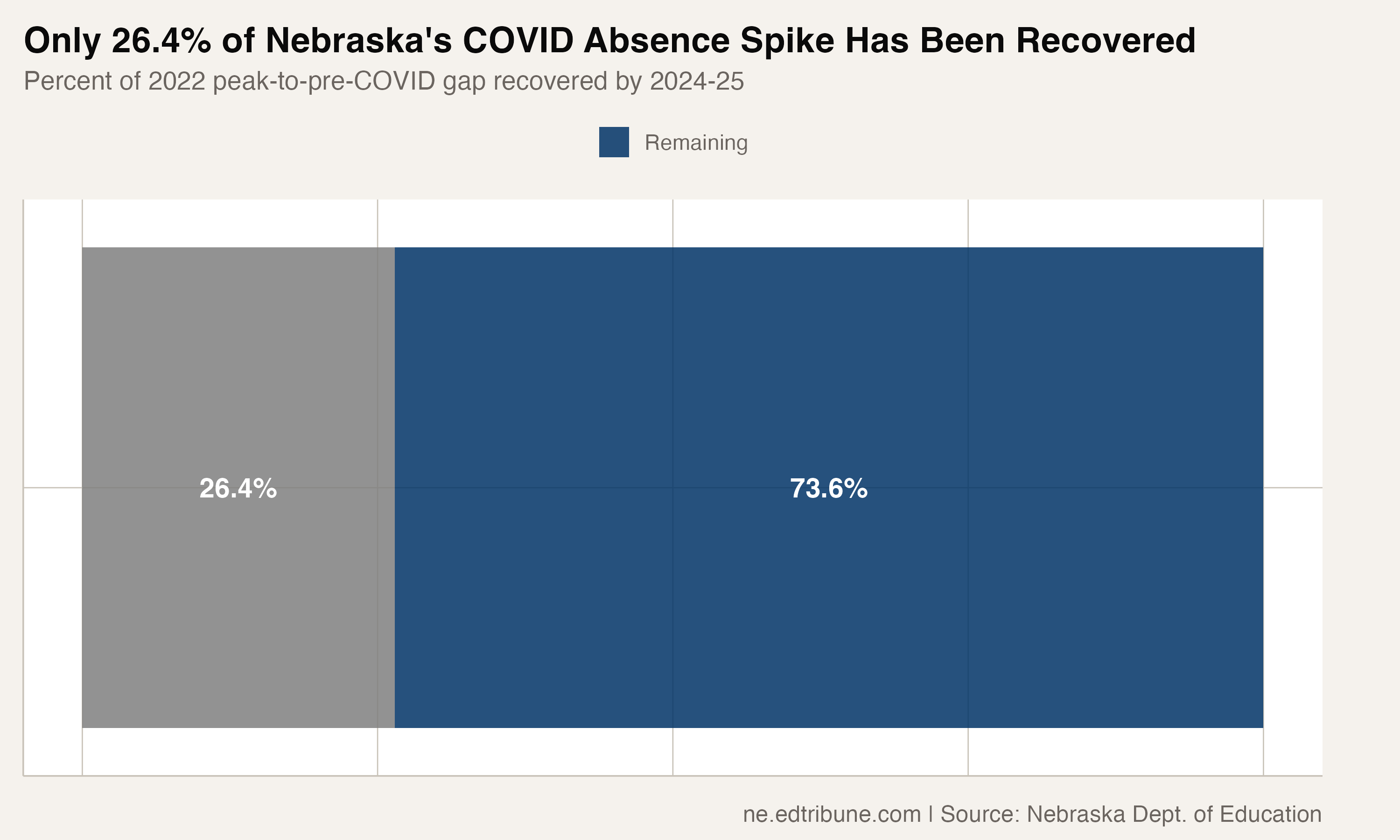
Before COVID, 14.7 percent of Nebraska students were chronically absent -- a rate that was itself not great, but that now looks like a lost paradise. The pandemic added 9.2 percentage points to that baseline. Three years of recovery have clawed back 2.4 of them. That is a recovery rate of 26.4 percent.
At the current pace of improvement -- roughly 0.77 percentage points per year -- Nebraska will not return to its pre-COVID chronic absenteeism level until 2034. Nine more years.
The math of slow healing
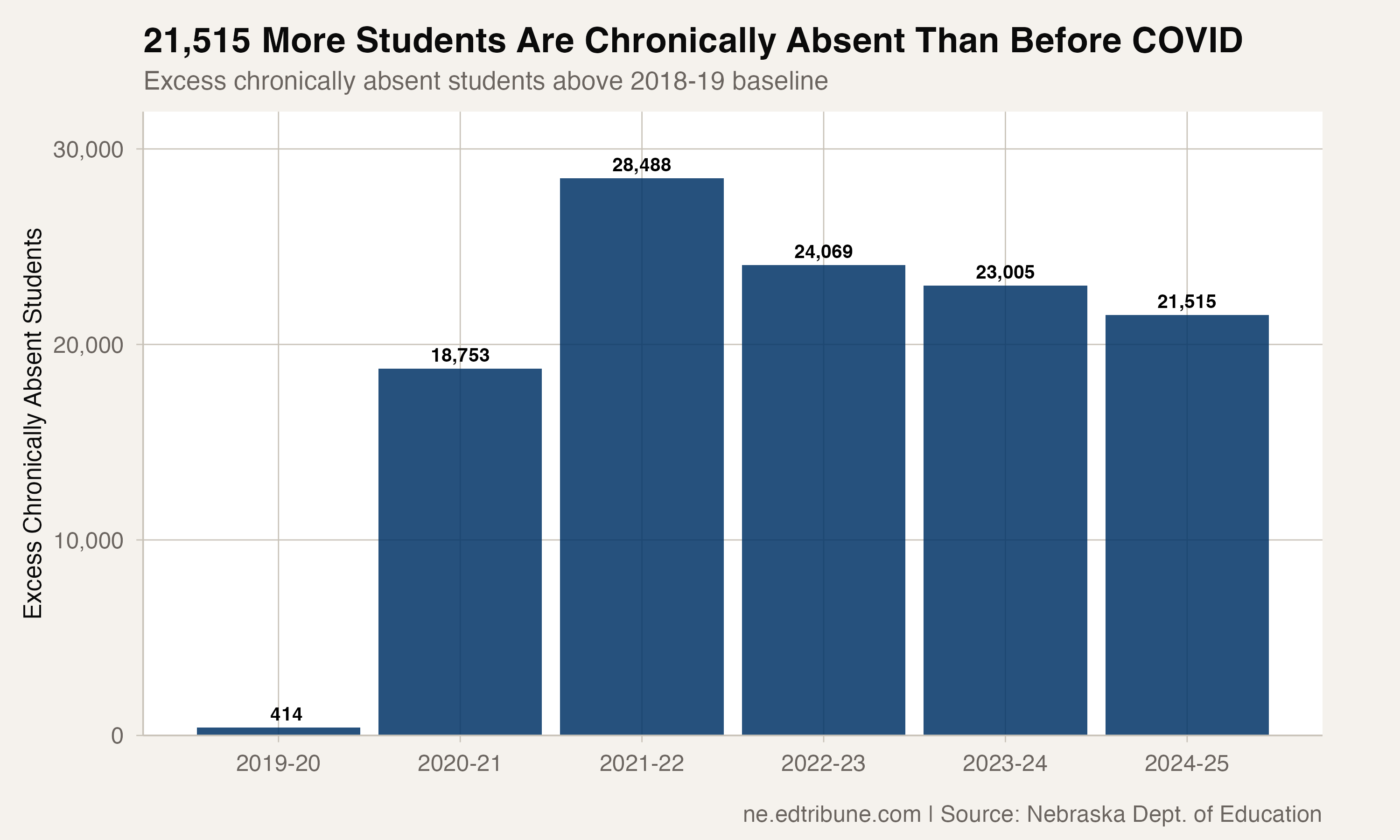
The arithmetic is unforgiving. In 2018-19, Nebraska had 45,181 chronically absent students. In 2024-25, it had 66,696 -- an excess of 21,515 students above the pre-COVID baseline. Those 21,515 students represent classrooms full of children who were reliably present before the pandemic and are not now.
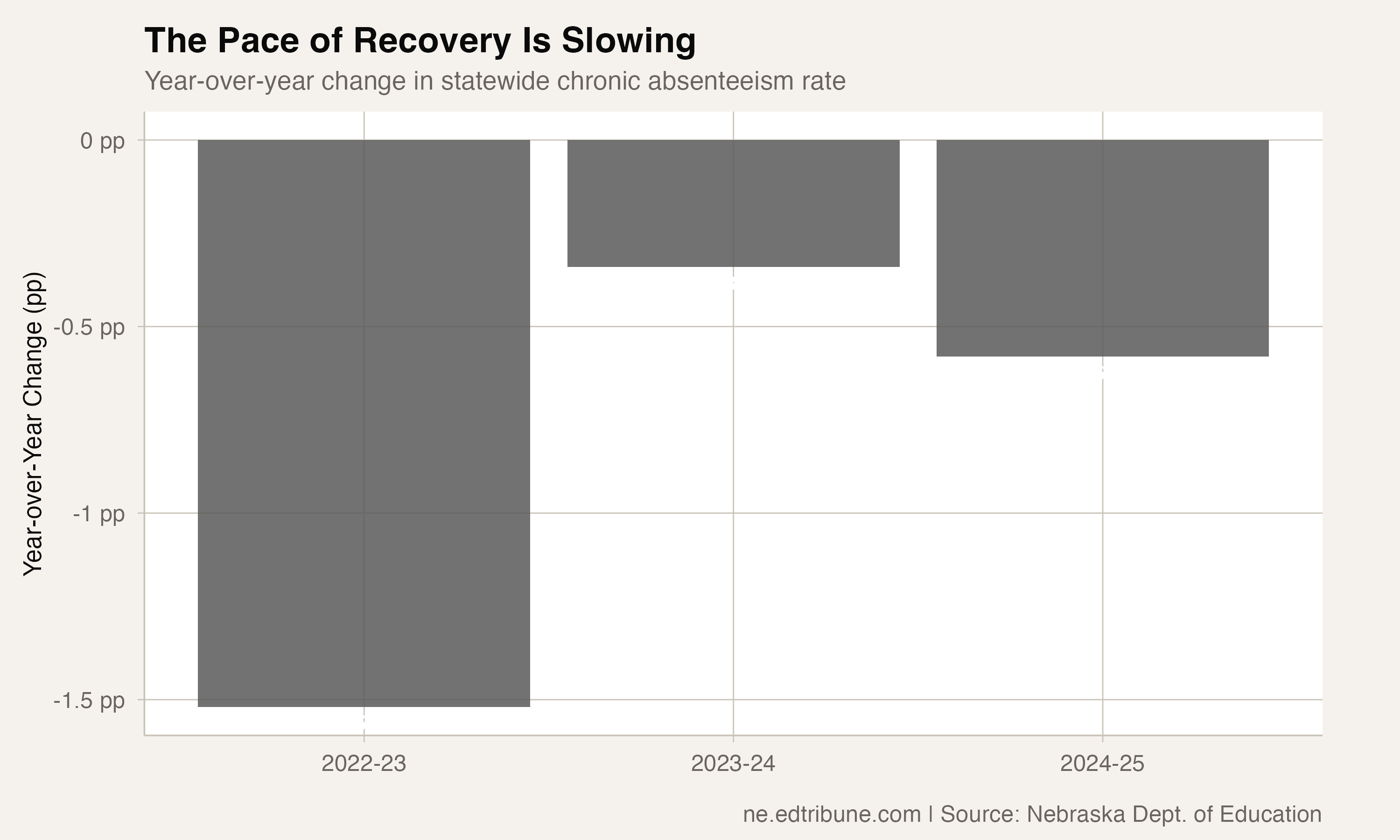
The excess peaked at 28,488 in 2021-22 and has come down each year since: to 24,069, then 23,005, then 21,515. But the pace of reduction is slowing. The first year of recovery (2022-23) saw a 1.5 percentage-point decline. The second year: 0.4 points. The third year: 0.5 points.
The pledge Nebraska cannot keep
Nebraska is one of 14 states that signed a national pledge to cut chronic absenteeism in half by 2030. For Nebraska, that would mean reaching roughly 12 percent -- below even the pre-COVID level of 14.7 percent. The pledge was aspirational, and the aspiration is now colliding with reality.
At the current rate of improvement, Nebraska's chronic rate would be approximately 17.5 percent by 2030 -- better than the 2023-24 rate, but nearly six points above the halving target. To actually reach 12 percent by 2030, the state would need to improve by 1.9 percentage points per year -- about 2.5 times faster than the current pace.
The pledge is not being kept. No state official has said so publicly. The target remains on paper, aging quietly into irrelevance while the actual numbers barely move.
Diminishing returns
The year-over-year improvements of -1.5, -0.4, and -0.5 percentage points tell a story of diminishing returns. The easy gains -- students who were temporarily displaced by COVID and returned when normalcy resumed -- have already been captured. What remains is harder: students whose family circumstances have genuinely shifted, adolescents who have adopted new norms around attendance, communities where the social contract around daily school presence has frayed.
The national conversation on chronic absenteeism has centered on whether the post-COVID spike represents a temporary disruption or a permanent structural change. Nebraska's data increasingly suggests the latter. A disruption that is still present three years after the disrupting event ended, and that is fading at a rate that would require nine more years to fully resolve, is no longer temporary. It is the new baseline.
21,515 students
The aggregate numbers can obscure the human scale. Nebraska had 21,515 more chronically absent students in 2023-24 than it did before the pandemic. Each one represents a child who is missing at minimum 18 school days per year -- and in many cases far more -- in a system designed around daily presence.
The per-pupil cost in Nebraska was $17,205 in 2023-24, calculated using Average Daily Membership. Chronic absenteeism depresses ADM, which depresses funding, which limits the resources available to bring students back -- a fiscal death spiral that compounds the educational one.
Nebraska's trajectory is not the worst in the country. Many states are further from recovery. But the combination of slow progress, a decelerating improvement rate, and an unreachable national pledge creates a picture that state leaders will need to confront honestly: the attendance crisis is not resolving itself, and current interventions are not bending the curve fast enough.
Detailed code that reproduces the analysis and figures in this article is available exclusively to EdTribune subscribers.
Discussion
Sign in to join the discussion.
Loading comments...