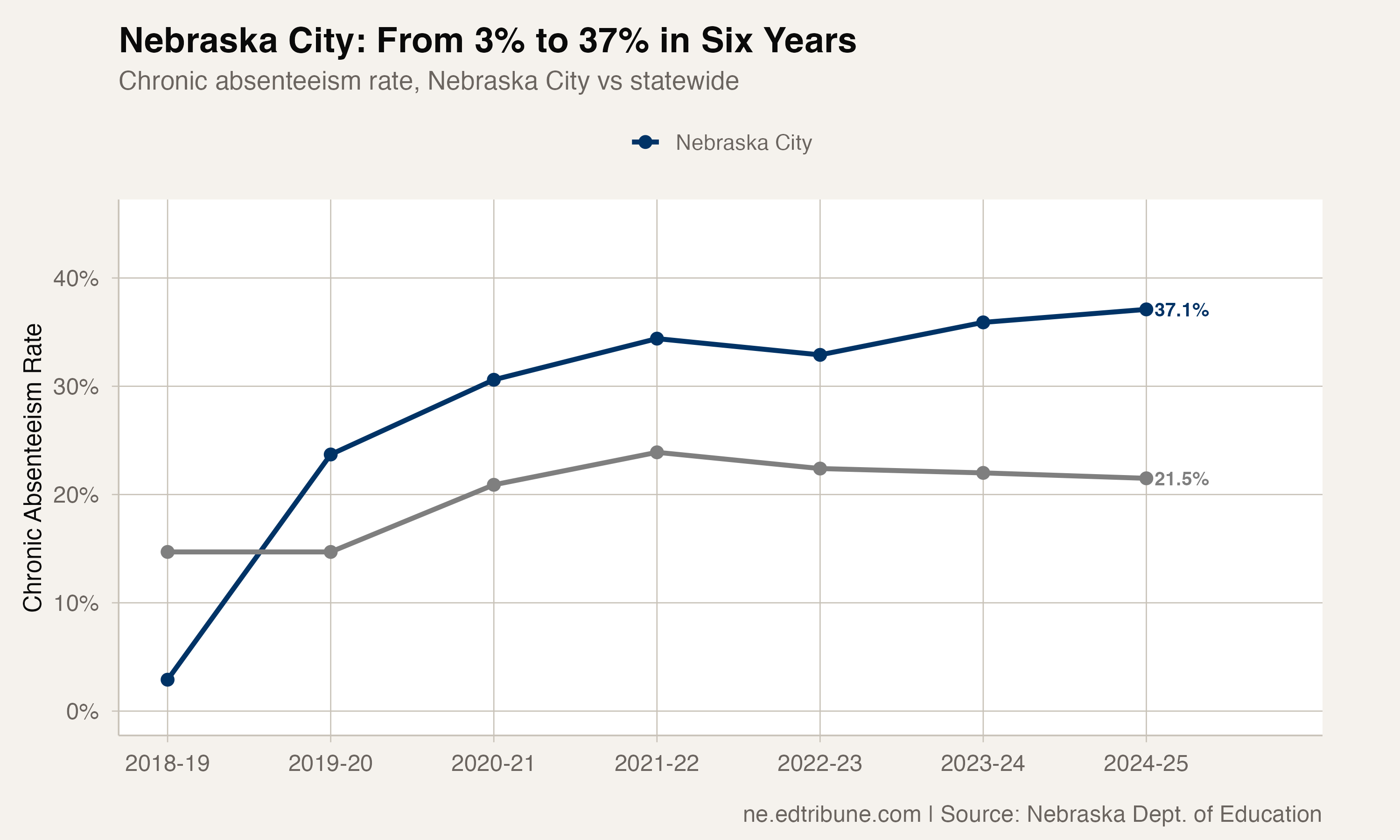
In 2018-19, Nebraska City Public Schools↗ET had a chronic absenteeism rate of 2.9 percent. Forty students out of 1,373 missed 10 percent or more of the school year. It was one of the lowest rates in Nebraska -- the kind of number that suggests a community where showing up for school is simply what people do.
Six years later, the rate is 37.1 percent. Four hundred eighty-nine students out of 1,319. The district did not change in size. It changed in something else entirely.
The 34.2 percentage-point increase is the largest of any district with 500 or more students in Nebraska. The second-largest increase belongs to Omaha Public Schools at 14.4 points. Nebraska City's deterioration is more than twice as severe as Omaha's -- in a district one-fortieth the size.
The year-by-year collapse
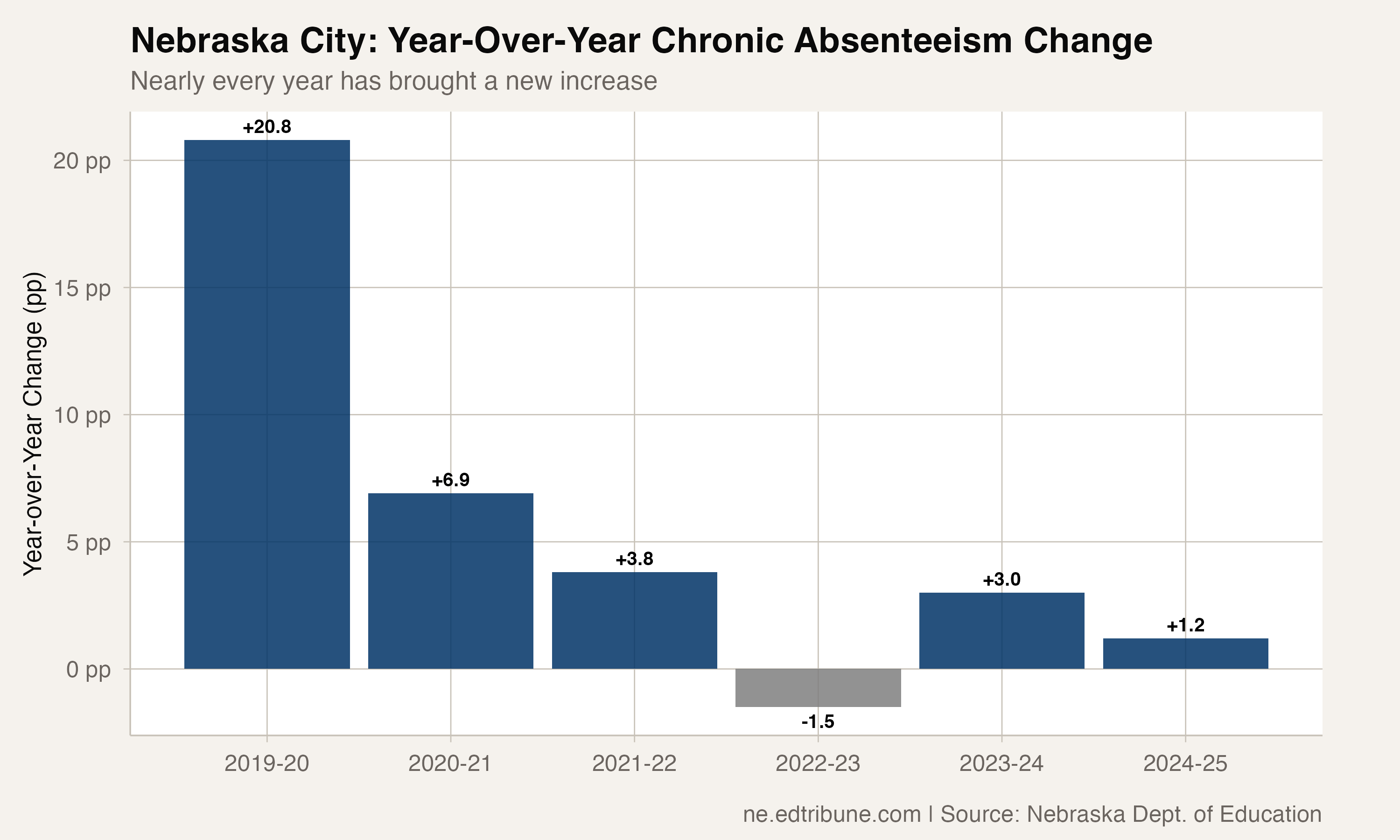
The timeline removes any possibility of explaining this as a simple COVID blip. In 2019-20, the rate jumped from 2.9 percent to 23.7 percent -- a 20.8 percentage-point increase in a single year. COVID clearly triggered something. But the rate did not come back down. It kept climbing: 30.6 percent in 2020-21, 34.4 percent in 2021-22.
There was a brief dip to 32.9 percent in 2022-23 -- the only year in which the rate declined. Then it resumed its ascent: 35.9 percent in 2023-24, 37.1 percent in 2024-25.
Whatever the pandemic disrupted in Nebraska City's attendance culture, the disruption has not healed. It has become the new normal, and the new normal is getting worse.
The York contrast
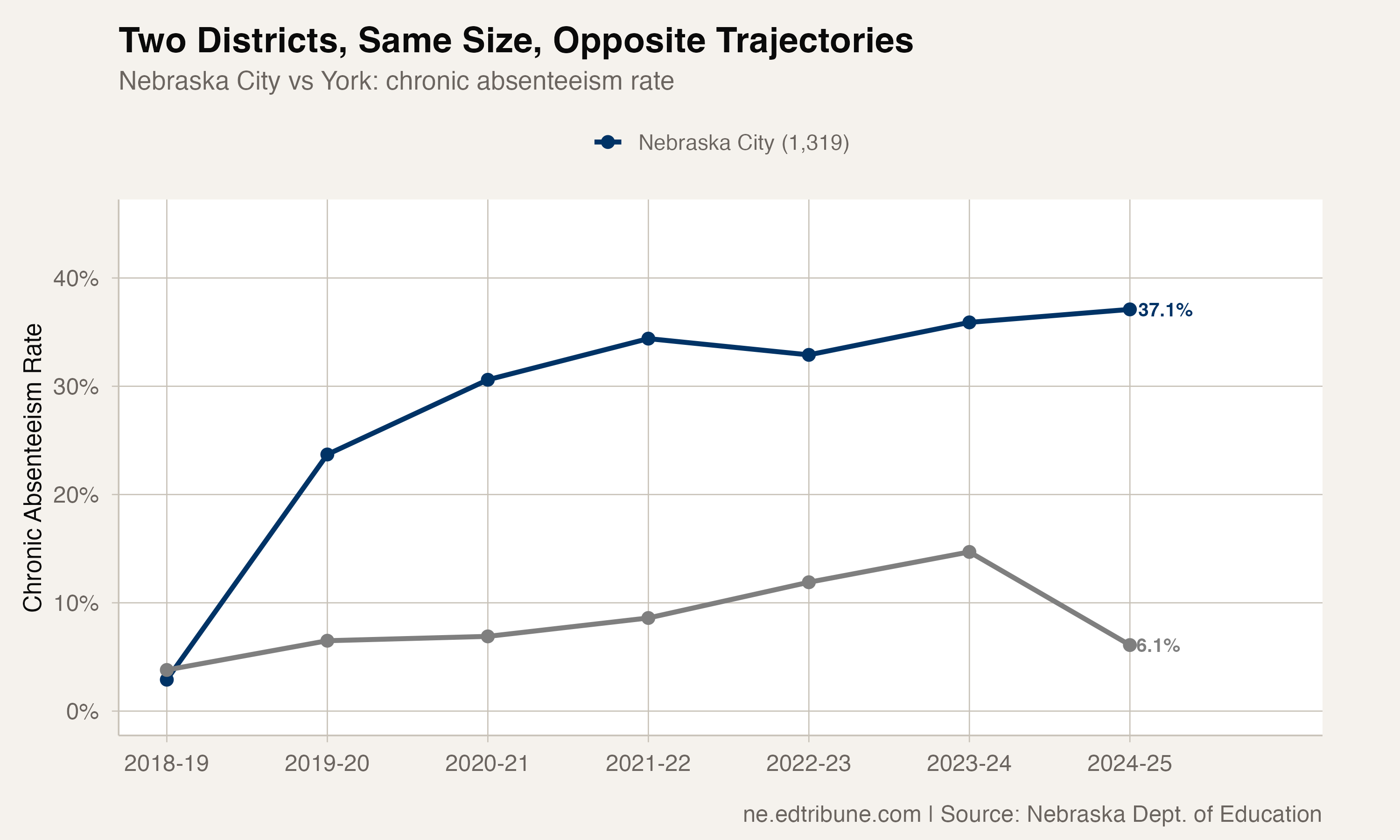
York Public Schools provides the starkest comparison. York enrolls 1,420 students -- 101 more than Nebraska City. Both are outstate Nebraska communities, neither a metro suburb, neither a reservation or border town. In 2018-19, their chronic rates were nearly identical: Nebraska City at 2.9 percent, York at 3.8 percent.
By 2024-25, Nebraska City had reached 37.1 percent. York was at 6.1 percent. The gap between two nearly identical districts -- same size, same geography, same pre-COVID baseline -- was 31 points.
York's rate did spike during COVID, reaching 14.7 percent in 2023-24. But then it snapped back to 6.1 percent in 2024-25, a dramatic recovery. Nebraska City's rate has never snapped back. Whatever York did differently -- or whatever Nebraska City did not do -- produced a divergence that is now wider than the gap between the best- and worst-performing Omaha metro suburbs.
Among similarly sized districts
Nebraska has 12 districts with enrollments between 1,000 and 1,500 students. Nebraska City's 37.1 percent chronic rate is not just the highest among them -- it is more than 12 points above the second-highest (McCook at 24.5 percent) and more than six times higher than the lowest (York at 6.1 percent, Sidney at 6.5 percent).
The range within this size class -- from 6.1 percent to 37.1 percent -- demolishes any argument that chronic absenteeism is simply a function of district size. These are all small enough for administrators to know most families by name. Some have solved the attendance problem. One has not.
The question no spreadsheet answers
Nebraska's absence data does not include demographic breakdowns, which means the analysis cannot determine whether the spike concentrated among particular racial or economic groups within Nebraska City. It also cannot isolate school-level patterns within the district. The data shows what happened; it does not explain why.
What is clear is that the 2018-19 rate of 2.9 percent was not anomalous. Nebraska City's rate was low because very few students were chronically absent. When 40 students out of 1,373 miss significant school time, the community has either a very strong attendance culture or a very narrow set of struggling families. When 489 of 1,319 miss significant time, something foundational has changed.
Detailed code that reproduces the analysis and figures in this article is available exclusively to EdTribune subscribers.
Discussion
Sign in to join the discussion.
Loading comments...