In Thurston County, in the northeastern corner of Nebraska, three school districts serve communities on the Omaha and Winnebago reservations. Their chronic absenteeism rates exist in a different universe from the rest of the state.
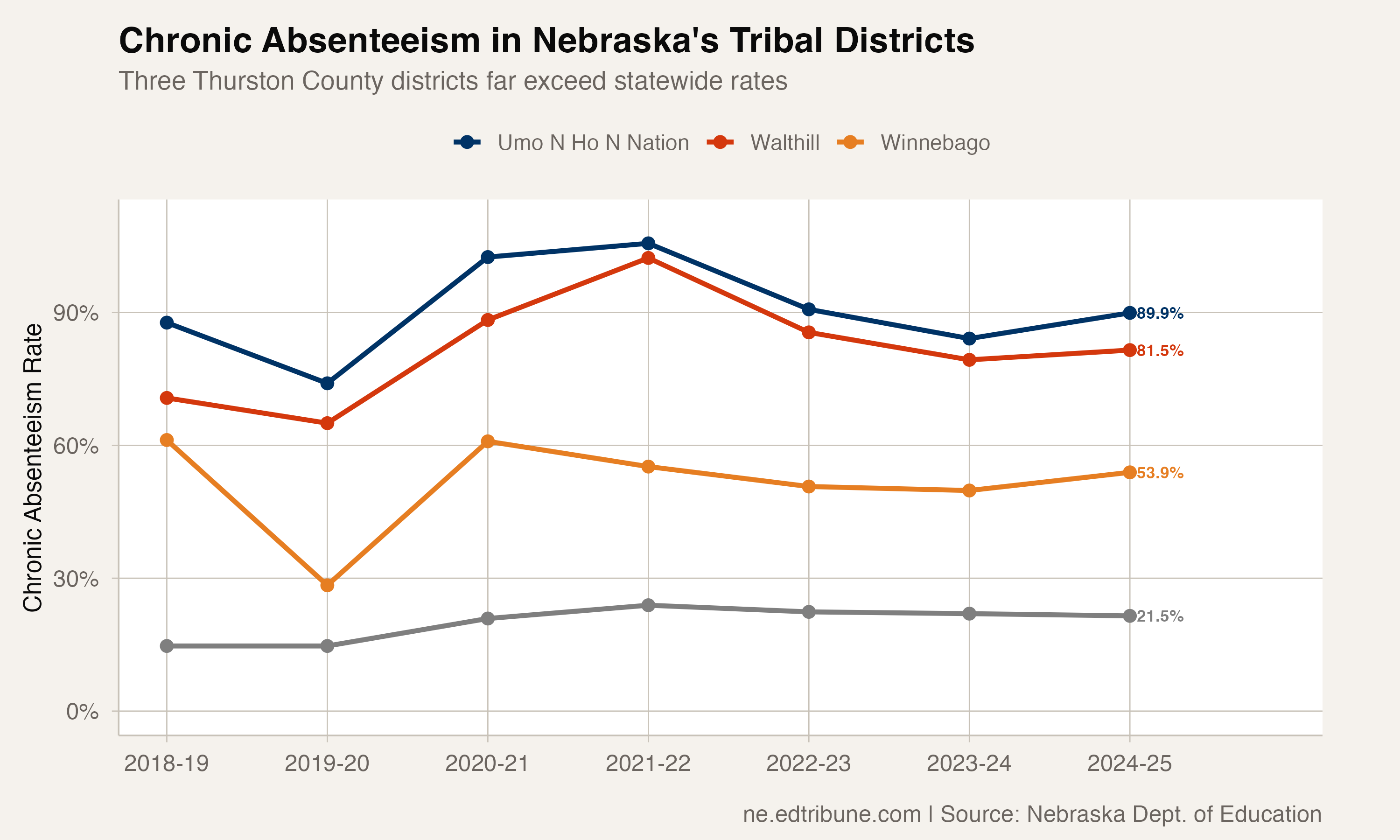
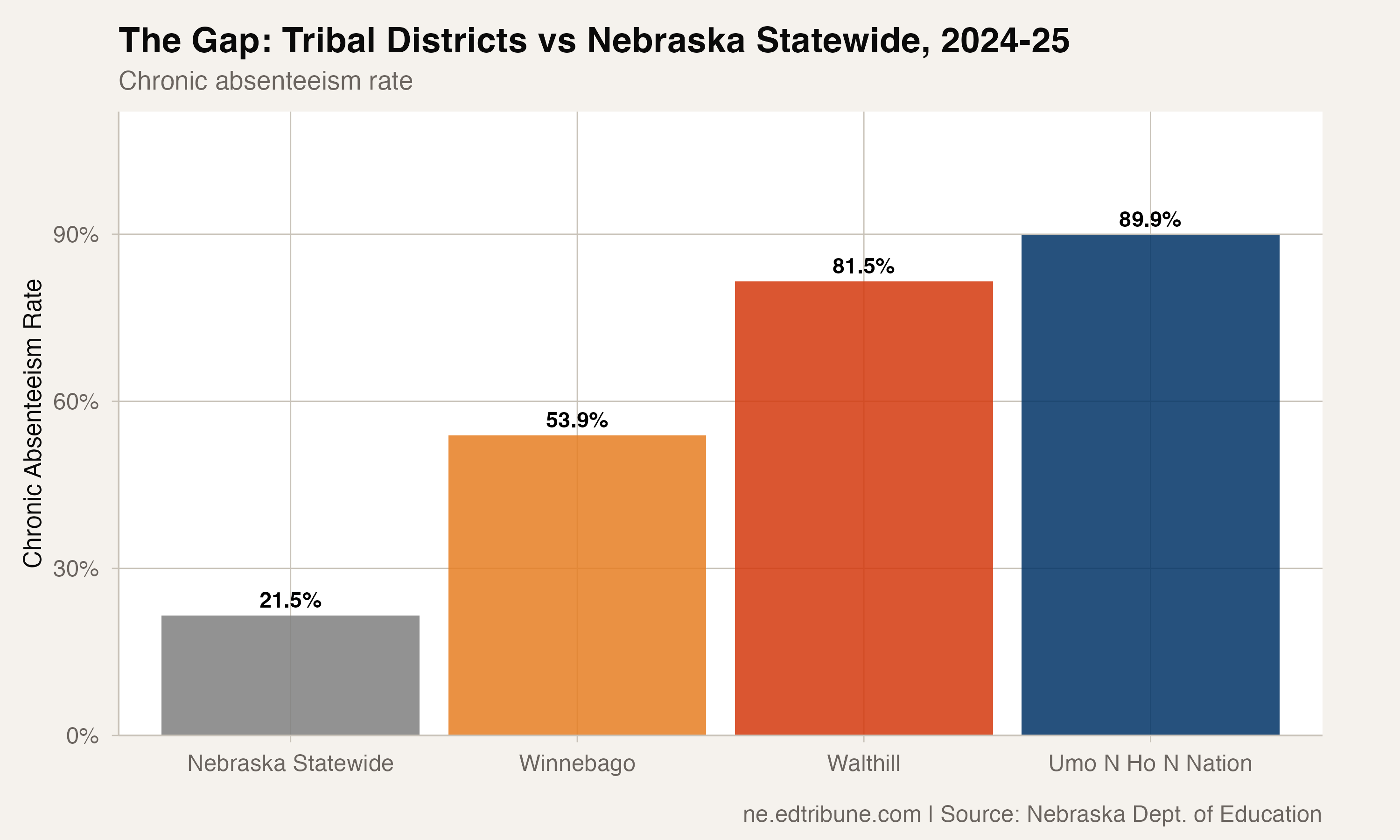
At Umo N Ho N Nation Public Schools↗ET, 89.9 percent of 513 students were chronically absent in 2024-25. Nine in ten children missed at least 10 percent of the school year. At Walthill Public Schools, the rate was 81.5 percent. At Winnebago Public Schools, 53.9 percent.
Nebraska's statewide chronic absenteeism rate is 21.5 percent. Even Omaha Public Schools, the district that dominates every statewide attendance conversation, posts 44.7 percent. The tribal districts are in another category entirely.
The numbers behind the crisis
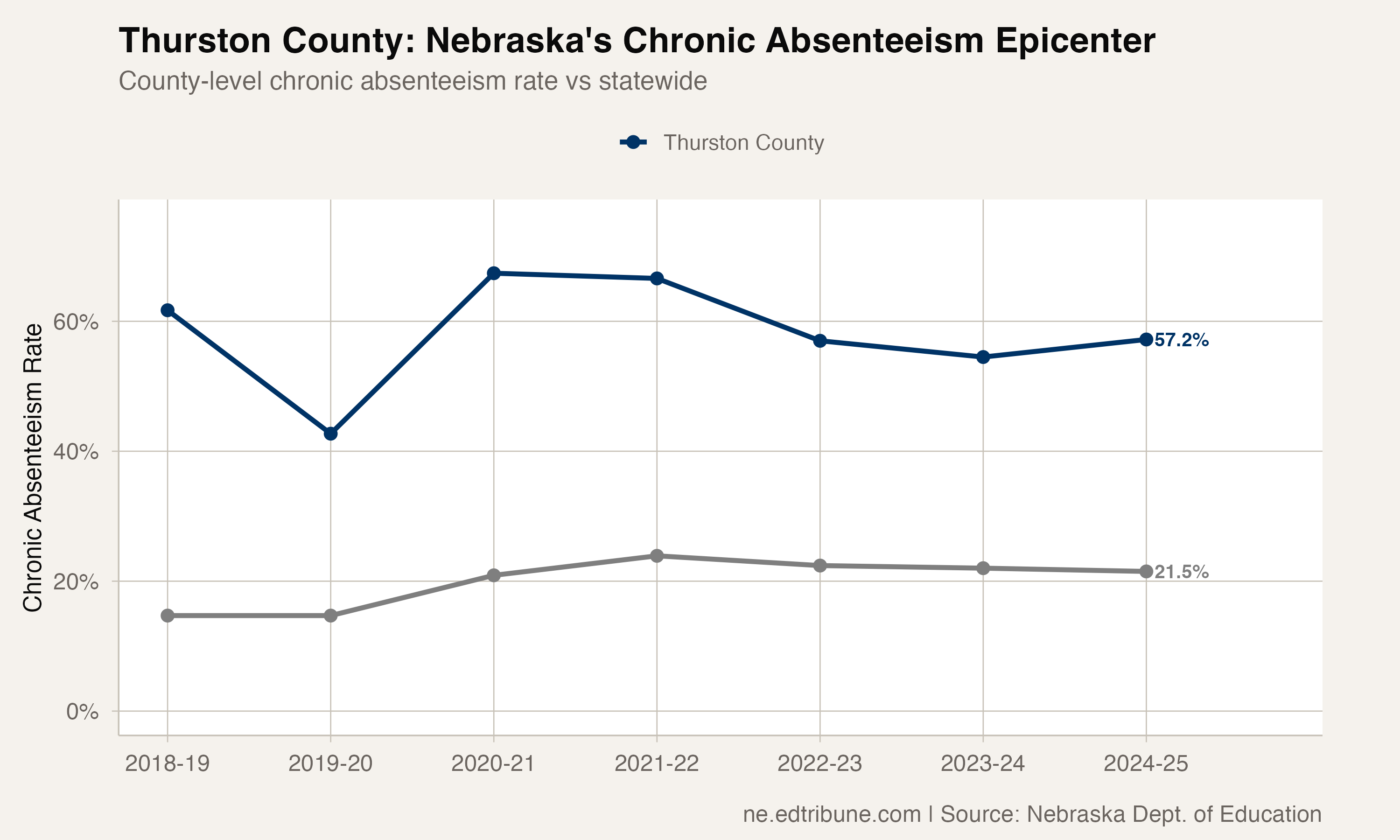
These are not small-sample anomalies. Umo N Ho N Nation enrolls 513 students. Walthill enrolls 275. Winnebago enrolls 577. Together, the three districts serve 1,365 students in Thurston County, which has a combined chronic absenteeism rate of 57.2 percent.
At Umo N Ho N Nation, the rate has not dropped below 74 percent in any year of available data. In 2020-21 and 2021-22, the computed rate actually exceeded 100 percent -- a mathematical artifact of membership counting methodology, but one that reflects a school where virtually every enrolled student is chronically absent.
Walthill has followed a similar trajectory: 70.7 percent in 2018-19, a spike to over 100 percent in 2021-22, and a partial retreat to 81.5 percent. Winnebago is the relative bright spot -- a phrase that requires qualification when applied to a 53.9 percent chronic rate -- having dropped from its 2020-21 peak of 60.9 percent. In 2019-20, Winnebago posted an outlier low of 28.4 percent, suggesting that dramatic improvement is possible, though the rate has since returned to the 50-percent range.
Beyond the numbers
Nebraska's chronic absenteeism data does not include racial or ethnic breakdowns. The state reports only total student counts by district. That means the data cannot directly answer the question of whether Native American students elsewhere in Nebraska face similar attendance challenges, or whether the crisis is specific to these reservation communities.
What web-sourced state data does show -- though it cannot be verified from the package used for this analysis -- is that statewide chronic absenteeism among Native American students is approximately 43 percent, compared to roughly 15 percent among white students. The gap is enormous, and it predates COVID.
The tribal districts' chronic absenteeism rates are not a COVID story. Umo N Ho N Nation was at 87.7 percent in 2018-19, before the pandemic existed. The pandemic made things worse -- pushing rates past the 100 percent computational threshold -- but the underlying pattern was already catastrophic.
The context the data cannot capture
The factors driving chronic absenteeism in reservation communities are well-documented by researchers and tribal education leaders, even if they do not appear in NDE spreadsheets: intergenerational poverty, housing instability, limited access to transportation across geographically dispersed reservation land, health care gaps, the lasting effects of historical trauma on family systems, and the tension between a school system built on Western norms and communities with different cultural frameworks for education.
None of these factors excuse the crisis. But they contextualize it. A district where 9 in 10 students are chronically absent is not experiencing a truancy problem that can be solved with better attendance messaging. It is experiencing a systemic failure that reaches far beyond the school walls.
Thurston County's 57.2 percent county-wide chronic rate is the highest of any Nebraska county. The next-highest county in the state does not come close. These three districts are, by every available measure, the most extreme chronic absenteeism crisis in Nebraska -- and one of the most extreme in the country.
Detailed code that reproduces the analysis and figures in this article is available exclusively to EdTribune subscribers.
Discussion
Sign in to join the discussion.
Loading comments...