Correction (May 29, 2026): An earlier version of this article stated that Omaha Public Schools and Bennington Public Schools did not respond to requests for comment. No outreach was sent to either district for this piece in advance of publication, so the line misrepresented both districts. The line has been removed. We regret the error.
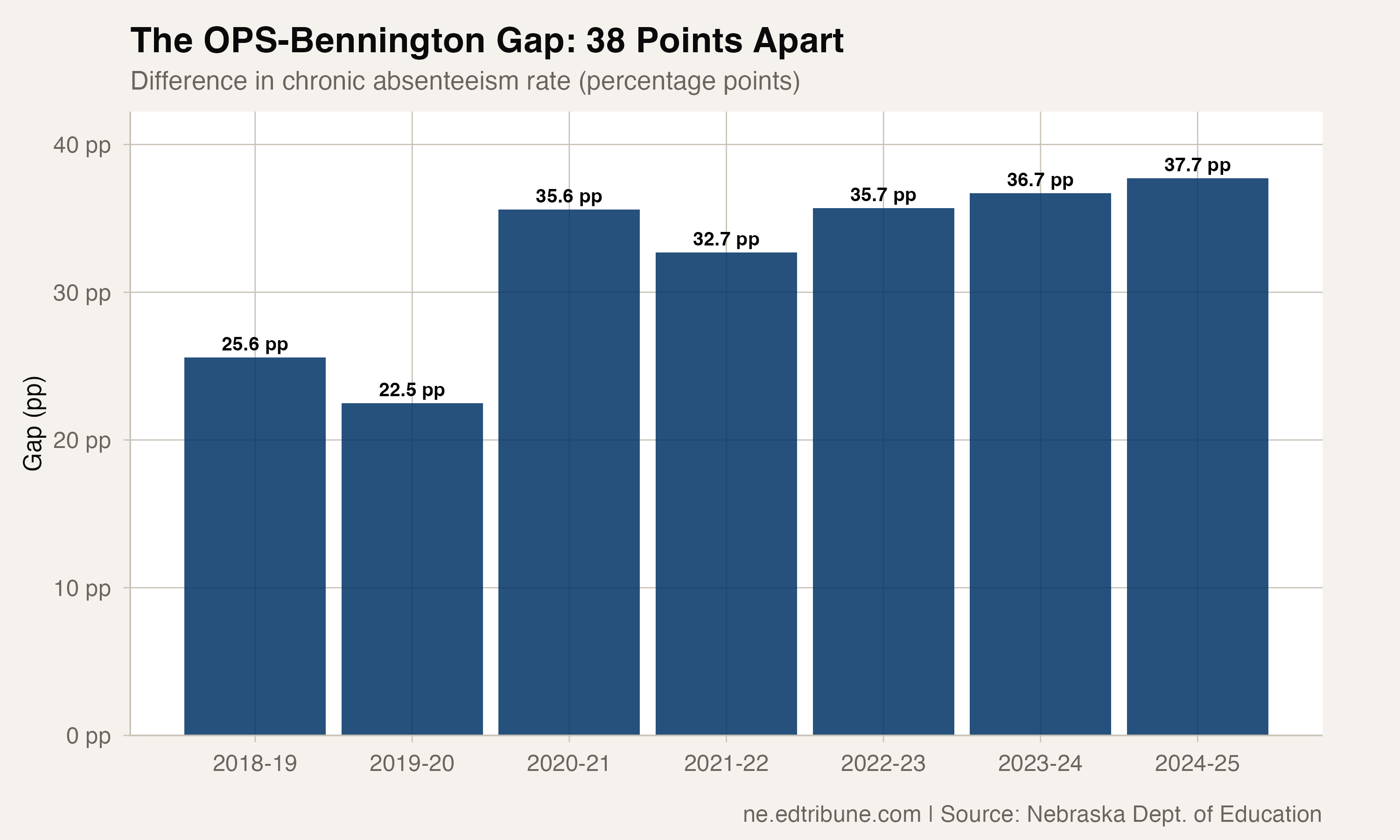
Drive north from Bennington on Highway 133 and you cross into Omaha Public Schools↗ET territory in about 15 minutes. In those 15 minutes, you travel from a district where 7.0 percent of students are chronically absent to one where 44.7 percent are. The gap is 37.7 percentage points -- wider than most states' entire chronic absenteeism rate.
The Omaha metropolitan area contains nine school districts that share highways, shopping centers, and media markets. What they do not share is an attendance crisis.
The nine districts
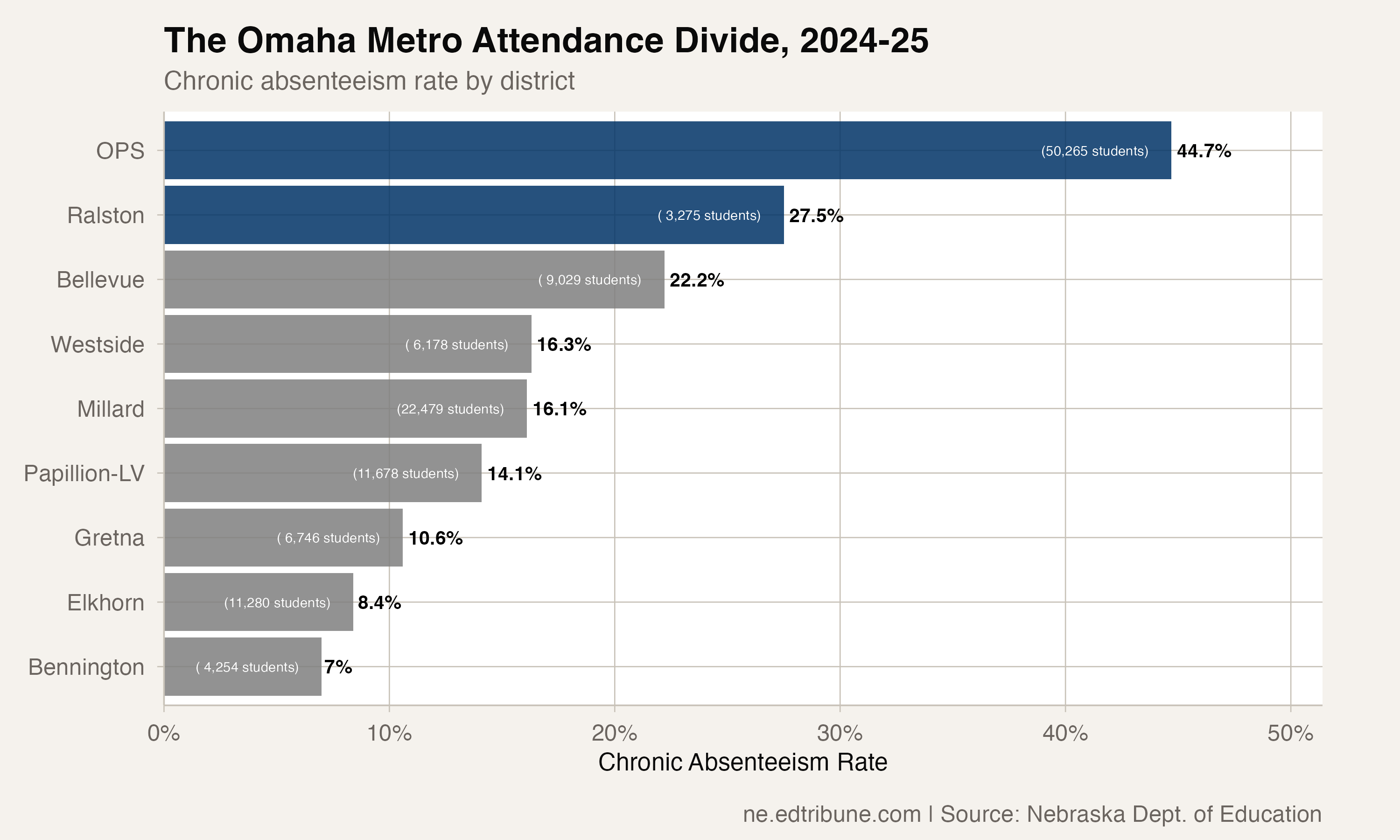
The 2024-25 data arranges the Omaha metro's nine districts into three tiers, as cleanly as if someone had drawn the lines on purpose.
At the bottom: Bennington (7.0 percent, 4,254 students) and Elkhorn (8.4 percent, 11,280 students). These are fast-growing suburban districts where chronic absenteeism is a minor concern. Gretna (10.6 percent, 6,746 students) sits just above them.
In the middle: Papillion-La Vista (14.1 percent, 11,678 students), Millard (16.1 percent, 22,479 students), and Westside (16.3 percent, 6,178 students). These are established suburban districts with rates near or below the state average of 21.5 percent.
At the top: Bellevue (22.2 percent, 9,029 students), Ralston (27.5 percent, 3,275 students), and OPS (44.7 percent, 50,265 students). These districts -- older, more urban, serving higher concentrations of poverty -- carry the metro area's attendance burden.
The pattern is not subtle. It is a gradient that tracks almost perfectly with poverty concentration, housing age, and distance from the suburban growth frontier.
The gap that grew
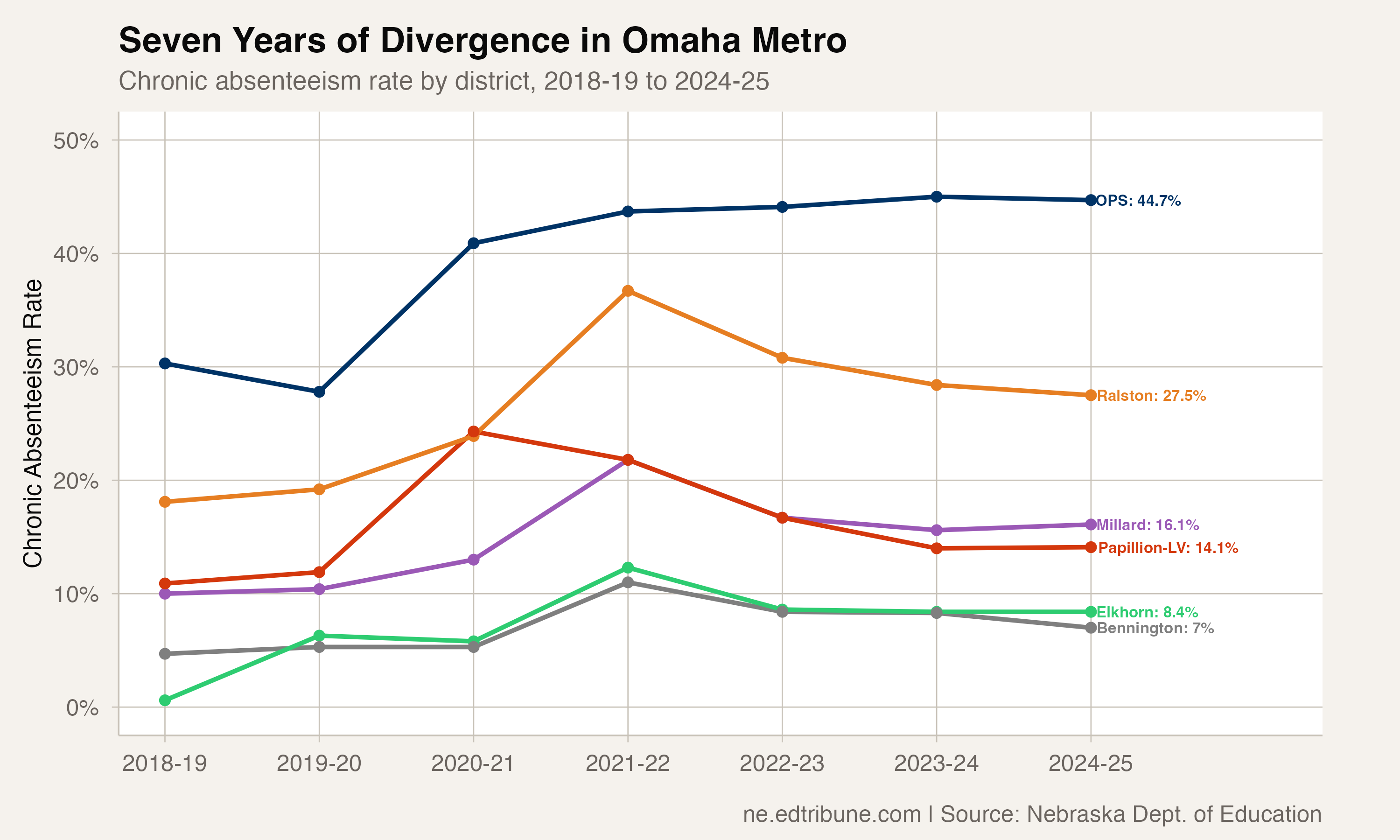
Before COVID, the divide was already present but narrower. In 2018-19, OPS had a chronic rate of 30.3 percent while Bennington was at 4.7 percent -- a 25.6-point gap. The pandemic exploded the disparity. OPS surged to 43.7 percent in 2021-22 while Bennington peaked at just 11.0 percent. The gap widened to over 30 points and has stayed there since.
What happened in between tells the real story. Bennington recovered from its modest COVID spike within two years: from 11.0 percent back to 7.0 percent. OPS never recovered at all. The 2024-25 rate of 44.7 percent is essentially unchanged from the 2021-22 rate of 43.7 percent. The suburban districts bounced back. The urban core did not.
Ralston: the middle story
Ralston Public Schools -- 3,275 students squeezed between OPS and Millard -- offers a window into the dynamics at the boundary. At 27.5 percent, Ralston sits closer to OPS than to its suburban neighbors, despite being geographically embedded in the suburban ring. Its rate peaked at 36.7 percent in 2021-22 and has improved meaningfully since, but remains elevated.
Ralston's trajectory suggests that proximity to the suburban growth corridor is not enough. The district's demographics -- its poverty rate, its housing stock, its student mobility -- align it more closely with OPS than with Elkhorn or Bennington, and its attendance data reflects that alignment.
Two educational realities, 15 minutes apart
The 37.7-point OPS-Bennington gap is not merely a statistical curiosity. It measures the distance between two educational realities that exist side by side in the same metropolitan area.
In Bennington, the median student attends school regularly. The chronically absent 7 percent are an exception that the system can address individually -- a counselor call, a parent meeting, a check on home circumstances.
In OPS, nearly half of all students are chronically absent. The system cannot intervene individually with 22,485 students. The crisis is not a collection of individual cases; it is a condition of the institution.
The Omaha metro divide strips away the comfortable explanations. This is not about rural isolation or urban density in the abstract. These are neighboring communities, served by the same county health systems, policed by overlapping jurisdictions, connected by the same interstate. The divide is about the concentration of poverty, the sorting of families by income into distinct school districts, and the stark reality that school attendance follows the same fault lines as everything else in metropolitan America.
No district is an island
Omaha's nine-district metro structure means that families can -- and do -- sort themselves by choosing where to live. The suburban districts' low chronic rates are not entirely a product of superior programming; they also reflect self-selection by families with the resources to choose stable housing in growing communities. OPS's high rate is not entirely a product of institutional failure; it also reflects the concentration of every socioeconomic challenge that makes regular attendance harder.
None of this is new. But the post-COVID data has made the divide more extreme and more durable than it was before the pandemic. Whether the metro area's attendance crisis is treated as an OPS problem or a regional problem will determine whether 22,485 chronically absent students remain a statistic that neighboring districts can politely ignore.
Detailed code that reproduces the analysis and figures in this article is available exclusively to EdTribune subscribers.
Discussion
Sign in to join the discussion.
Loading comments...