Correction (September 30, 2026): An earlier version of this article understated every chronic absenteeism rate in it. Its figures were added up from district reports, and Nebraska withholds most districts' grade-level counts of chronically absent students for privacy while still reporting their enrollment, so thousands of chronically absent students were left out. This version uses the statewide counts the Nebraska Department of Education publishes for each grade. In 2024-25, 37.2% of seniors (9,259 students) were chronically absent, not 34.5% (8,593), and the kindergarten and third-grade rates were 16.7% and 12.5%. The school-level and grade-by-grade recovery figures also changed, and ninth grade, not tenth, has recovered least from its COVID peak. The central finding is unchanged.
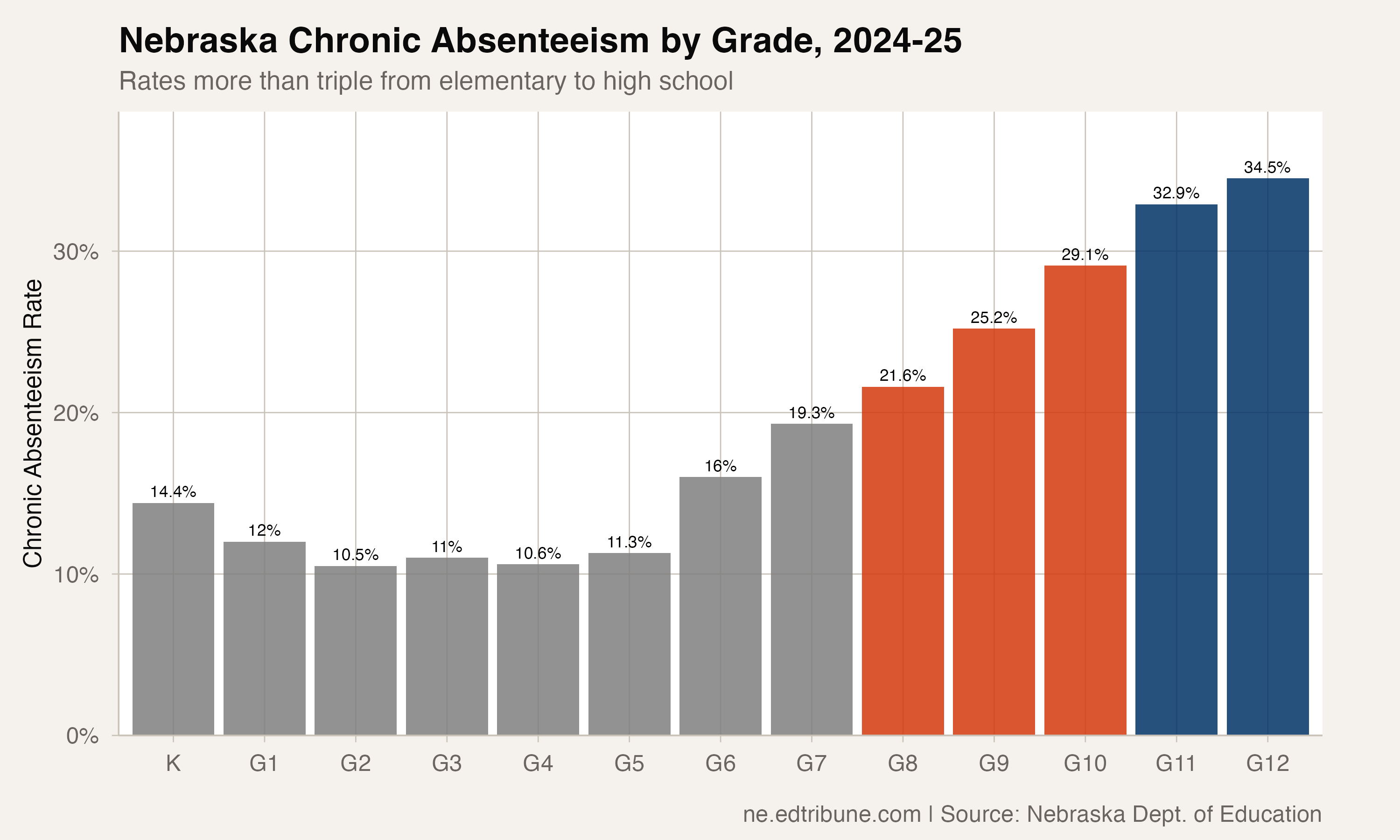
By the time a Nebraska student reaches senior year, the odds are better than one in three that they will be chronically absent. Among kindergartners, it is about one in six. Among third-graders, one in eight.
In 2024-25, 37.2 percent of Nebraska's 24,898 seniors missed at least a tenth of the school year, the standard definition of chronic absence. That is 9,259 students whose final year of public education was defined as much by the days they were not in the building as by the days they were. The kindergarten rate was 16.7 percent. Third grade: 12.5 percent. The staircase from elementary to high school is not gradual. It is steep, and since COVID, it has gotten steeper.
The gap that widened
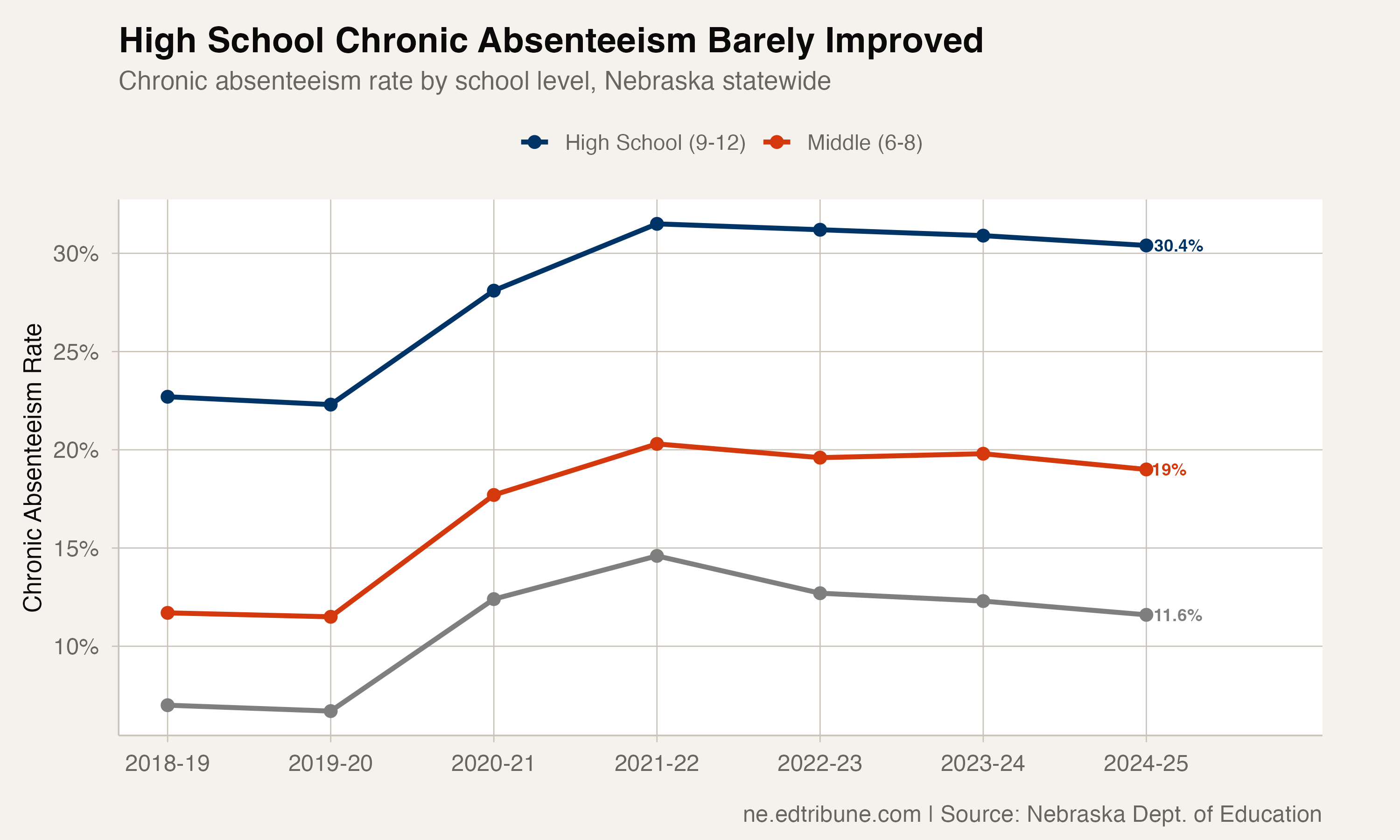
Before the pandemic, the divide between high school and elementary chronic absenteeism was already wide. In 2018-19, high school grades (9-12) had a combined chronic rate of 25.1 percent while elementary grades (K-5) came in at 8.8 percent, a 16.3 percentage-point gap.
By 2024-25, that gap had widened to 19.4 points. Elementary grades have come a fair way back from their COVID peak, falling from 17.0 percent in 2021-22 to 13.5 percent, which undoes about 43 percent of the rise. High schools have come back far less. The combined 9-12 rate went from a peak of 34.5 percent to 32.9 percent, recovering 17 percent of the increase.
Middle school sits in between: 21.0 percent in 2024-25, down from a 23.0 percent peak but still well above the pre-COVID 13.9 percent.
Grade by grade, the recovery that wasn't
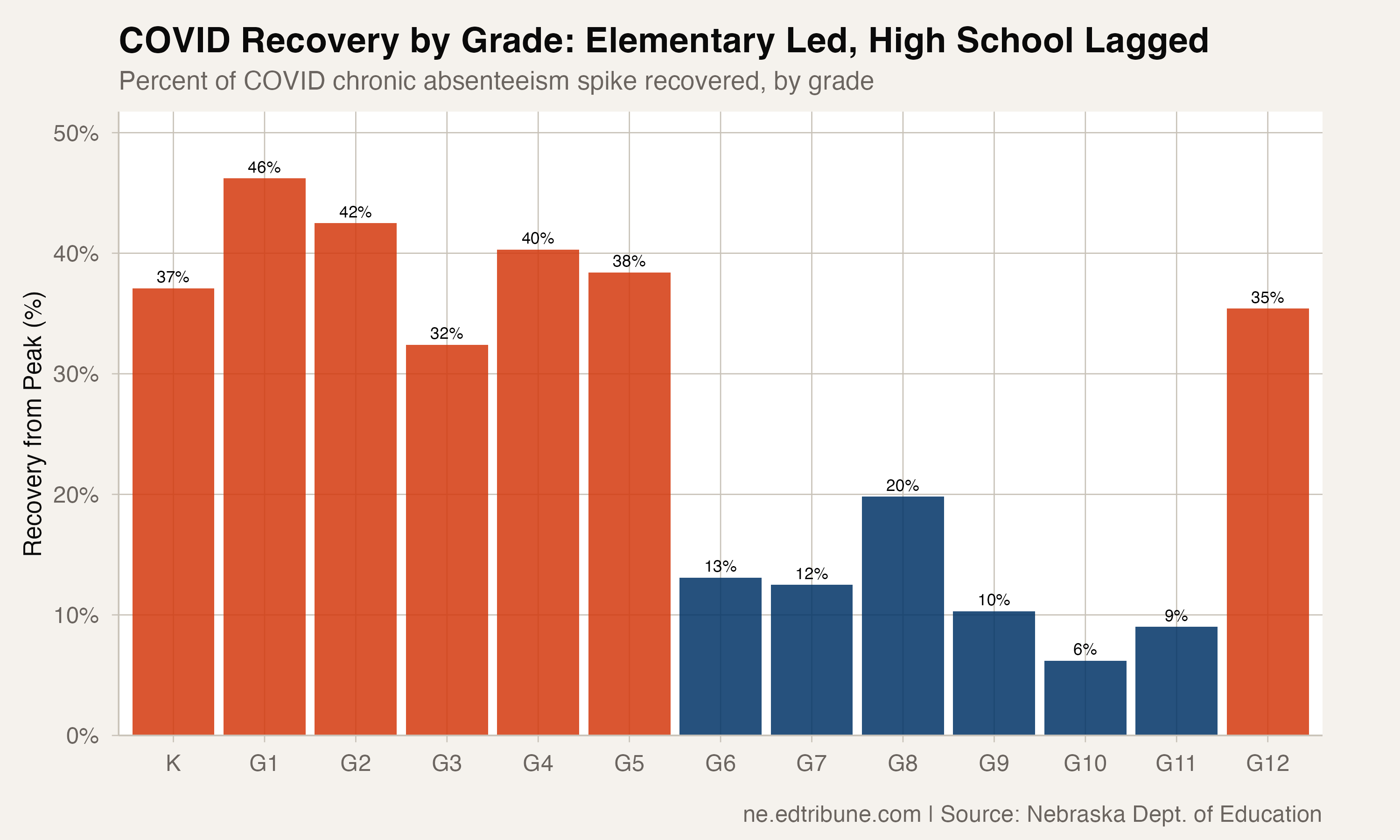
Broken out by grade, the recovery is lopsided. First grade has recovered 49.2 percent of its COVID rise and fourth grade 40.4 percent. Neither is a full return, but both are real progress.
Past elementary school the numbers drop off. Sixth grade has recovered 19.2 percent of its rise and seventh grade 22.0 percent. Then come the three grades that have barely moved: tenth and eleventh grade have each recovered 11.0 percent, and ninth grade just 10.5 percent, the weakest of any grade in Nebraska. Ninth grade did not peak until 2022-23, at 28.7 percent, and in 2024-25 it stood at 27.7 percent.
Seniors are a partial exception. The 12th-grade rate has recovered about 37 percent of its rise, close to the kindergarten pace, though from a far higher starting point. The stall is concentrated in grades 9 through 11.
9,259 seniors
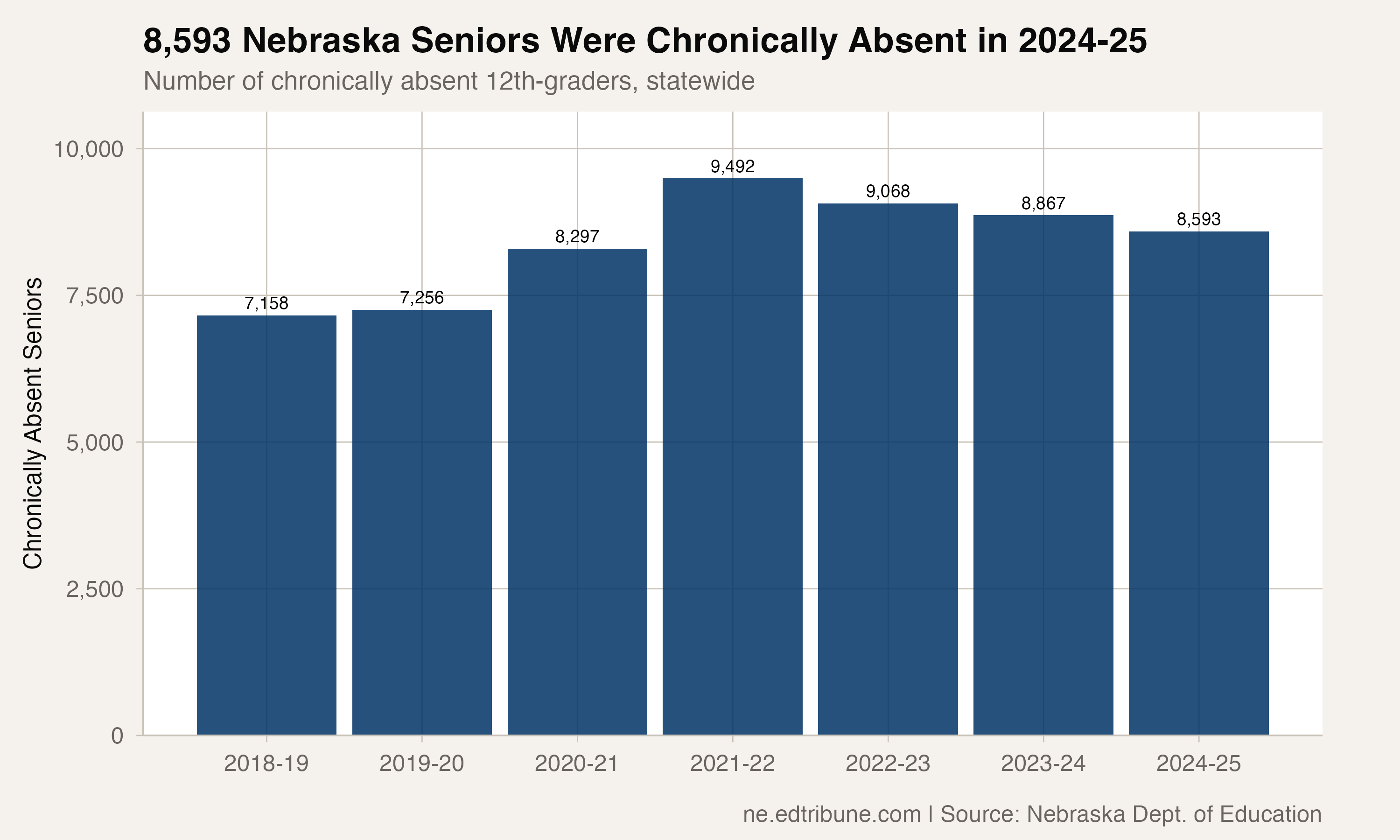
The raw count puts the rate in human terms. In 2018-19, Nebraska had 7,715 chronically absent seniors. By 2021-22, the number had surged to 10,263. It has come down since, to 9,259 in 2024-25, but remains 1,544 above the pre-COVID level.
Senior-year chronic absenteeism carries particular weight because it comes at the threshold of whatever comes next. For college-bound students, it means incomplete preparation. For students entering the workforce, it means a year's worth of missed practice at the basic discipline of showing up. For neither group is missing a tenth or more of the school year a neutral event.
The autonomy cliff
The pattern is not unique to Nebraska. Nationally, chronic absenteeism rises with grade level. But the post-COVID widening of that gradient points to something specific about how the pandemic reshaped adolescent attendance norms.
Elementary students, whose attendance is largely controlled by parents, have moved back toward pre-COVID patterns. High schoolers, whose attendance is increasingly a matter of personal decision-making, have moved much less. The 5th-to-6th grade transition, where chronic rates jump from 13.2 percent to 18.0 percent, marks the boundary where parental control gives way to student autonomy, and where post-COVID disengagement appears to have taken root.
Nebraska has committed to cutting chronic absenteeism statewide as part of a 14-state national pledge to halve it within five years. The elementary grades are trending in the right direction. The early high school grades are not. Until the state figures out how to reach adolescents who have decided, or whose circumstances have decided for them, that regular attendance is optional, the statewide numbers will remain stuck.
Detailed code that reproduces the analysis and figures in this article is available exclusively to EdTribune subscribers.
Discussion
Sign in to join the discussion.
Loading comments...