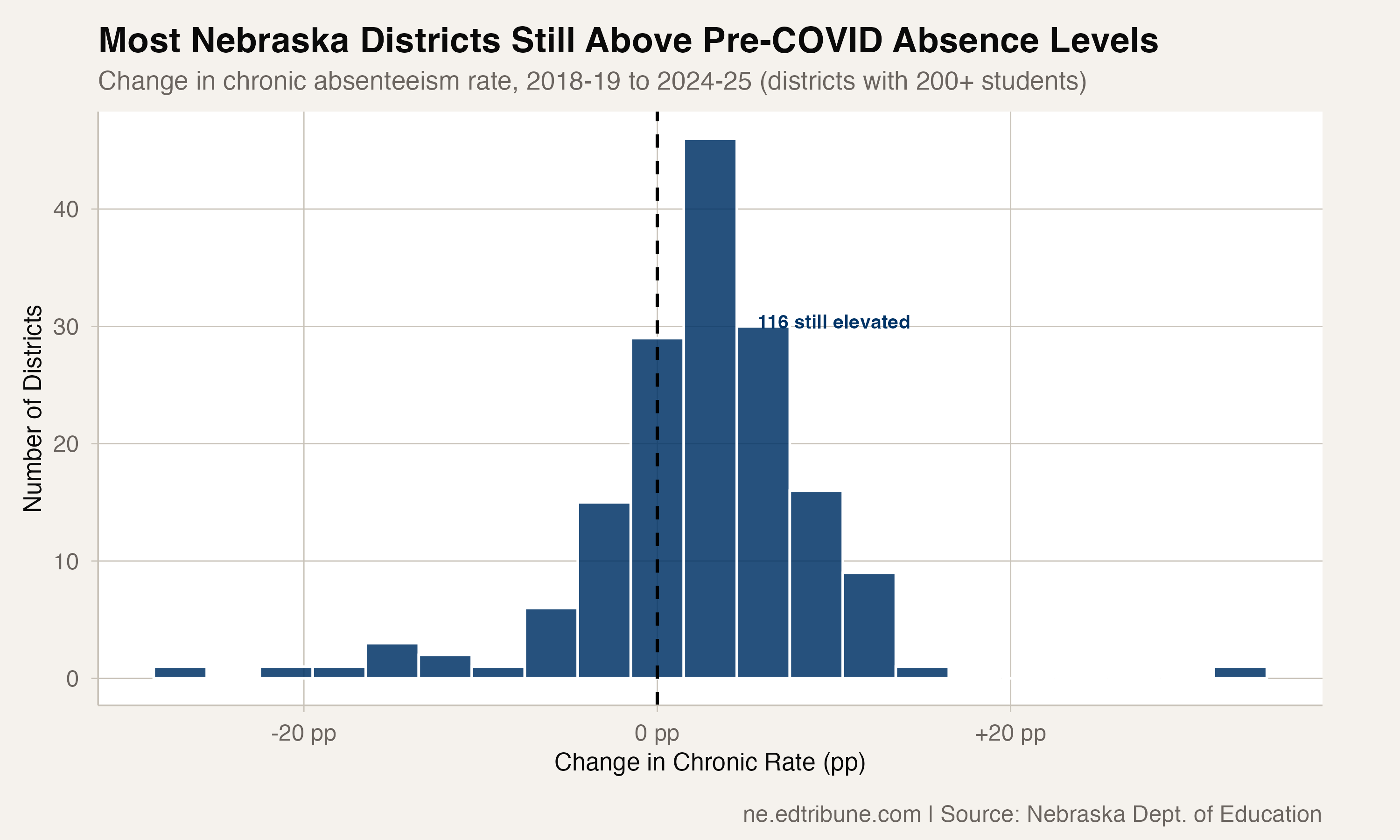
Of 162 Nebraska school districts with enough data and enrollment to measure, 46 have returned to their pre-COVID chronic absenteeism levels. That is 28.4 percent. The other 116 -- nearly three in four -- are still running higher chronic rates in 2024-25 than they did in 2018-19, six school years after the pandemic first disrupted attendance patterns.
The recovery failure is not concentrated in one corner of the state. It spans every size category, every region, every type of community. But the pattern within the data is unmistakable: size matters, and it matters in the wrong direction.
Zero for twelve
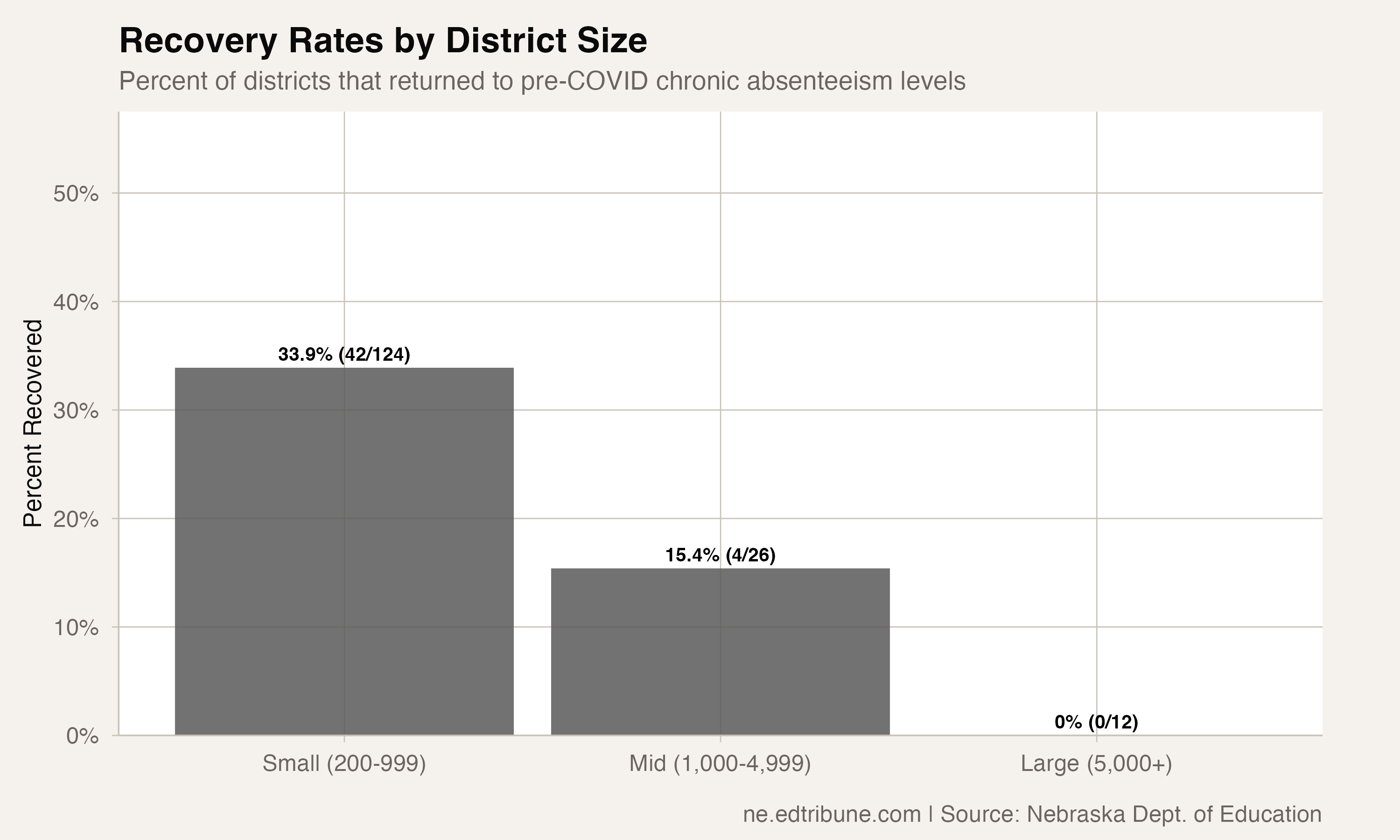
Among Nebraska's 12 largest districts -- those with 5,000 or more students -- not a single one has recovered to pre-COVID chronic absenteeism levels. Zero for twelve. Omaha Public Schools is 14.4 percentage points above its pre-COVID rate. Lincoln Public Schools is 13.2 points above. Millard is 6.1 points above. The list goes on, and no district breaks through.
Among mid-sized districts (1,000 to 4,999 students), the recovery rate is 15.4 percent -- four of 26. Among smaller districts (200 to 999 students), it rises to 33.9 percent -- 42 of 124.
The pattern is consistent with what the rest of the data shows: smaller districts, where relationships are closer and interventions can be more personal, have had more success returning to pre-COVID attendance norms. Larger districts, where chronic absenteeism has become a systemic condition rather than a collection of individual cases, have not.
The worst deterioration
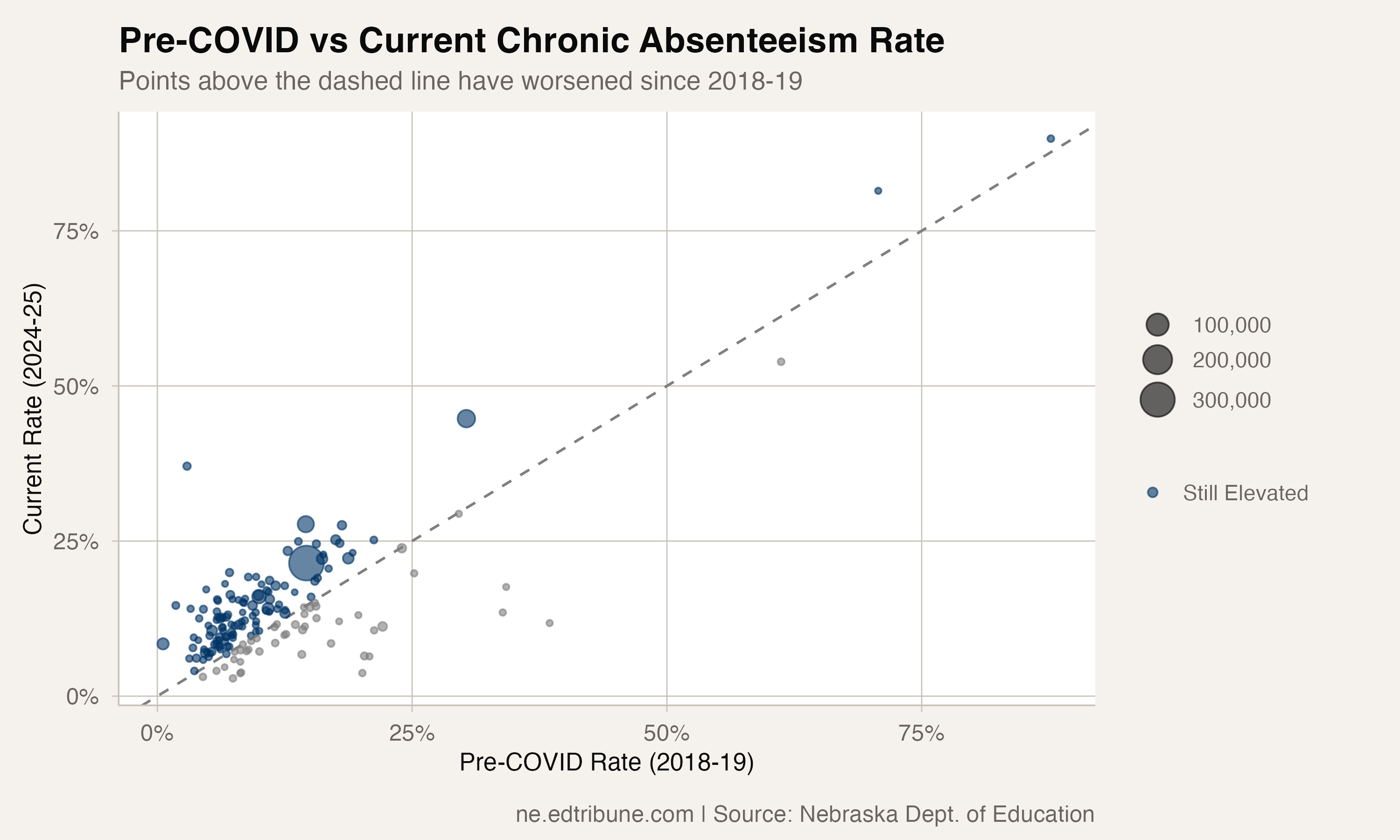
Nebraska City Public Schools leads the state in worsening: a 34.2 percentage-point increase from a 2.9 percent pre-COVID rate to 37.1 percent. Behind it, Omaha Public Schools (+14.4 points) and Lincoln Public Schools (+13.2 points) account for the largest absolute numbers of additional chronically absent students.
Plattsmouth (+12.8 points), Cozad (+12.8 points), and Fairbury (+11.1 points) round out the top six -- all smaller communities where a double-digit increase represents a fundamental change in the district's attendance culture.
The recoverers
The 46 districts that have recovered deserve attention. Sidney Public Schools stands out: from a 20.3 percent pre-COVID rate to just 6.5 percent, a 13.8-point improvement that puts it well below its 2018-19 level. South Sioux City Community Schools recovered from 22.1 percent to 11.2 percent, a 10.9-point improvement in a district of 3,579 students.
Malcolm, Holdrege, Hershey, Seward -- the recoverers tend to be smaller districts that implemented targeted interventions and had the institutional relationships to make them stick. Winnebago Public Schools is the rare tribal district that recovered, dropping from 61.2 percent to 53.9 percent -- still catastrophically high, but below its pre-COVID level.
The new permanent
A 28.4 percent recovery rate, six years after the precipitating event, is not a recovery in progress. It is a permanent elevation in chronic absenteeism. The districts that were going to bounce back on their own have already done so. The 116 that have not recovered by now are facing something structural -- changed family circumstances, shifted cultural norms around attendance, or institutional challenges that pre-COVID interventions cannot address.
Nebraska has committed to cutting chronic absenteeism as part of a 14-state national pledge. The 28.4 percent district-level recovery rate suggests that the commitment is not yet matched by the results. Until the state's largest districts -- which enroll the most students and contribute the most to statewide totals -- find a path to recovery, the aggregate numbers will remain stuck.
Detailed code that reproduces the analysis and figures in this article is available exclusively to EdTribune subscribers.
Discussion
Sign in to join the discussion.
Loading comments...