Correction (2026-09-07): An earlier version of this article said Alliance Public Schools did not respond to a request for comment. That was true on the publication date, but the district's leadership team wrote to The NEEdTribune on August 20, 2026, and the line has been removed. Their account of how the district cut chronic absenteeism has been added below.
Alliance Public Schools↗ET sits 380 miles west of Omaha in the Nebraska panhandle. It enrolls 1,232 students. And it has achieved something that most of Nebraska's larger, better-resourced districts have not: a dramatic, sustained reduction in chronic absenteeism.
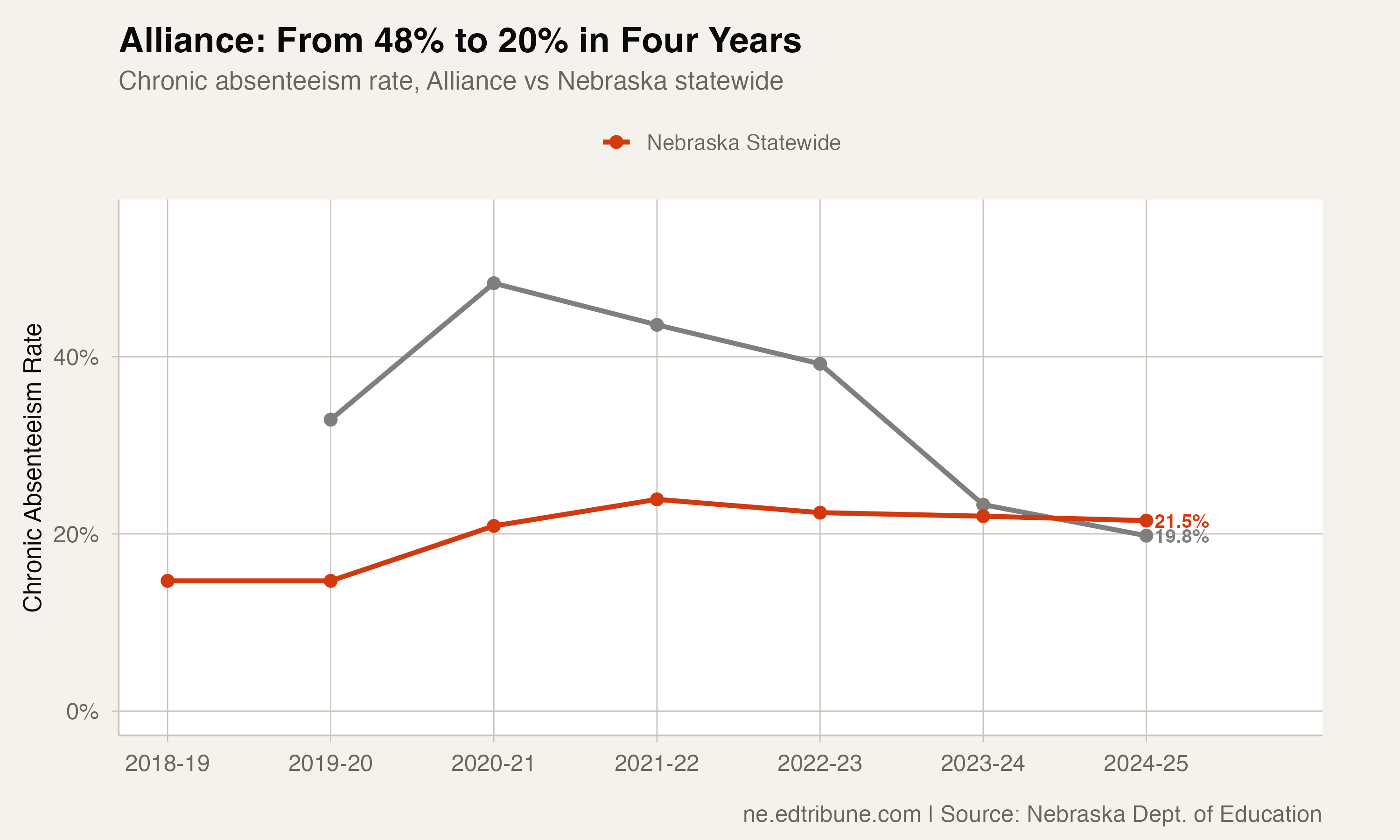
In 2020-21, Alliance's chronic absenteeism rate hit 48.3 percent -- nearly half of all students missing at least 10 percent of the school year. By 2024-25, it had fallen to 19.8 percent. That is a 28.5 percentage-point improvement over four consecutive years, the largest decline of any district with 500 or more students in the state.
Four years, every year better
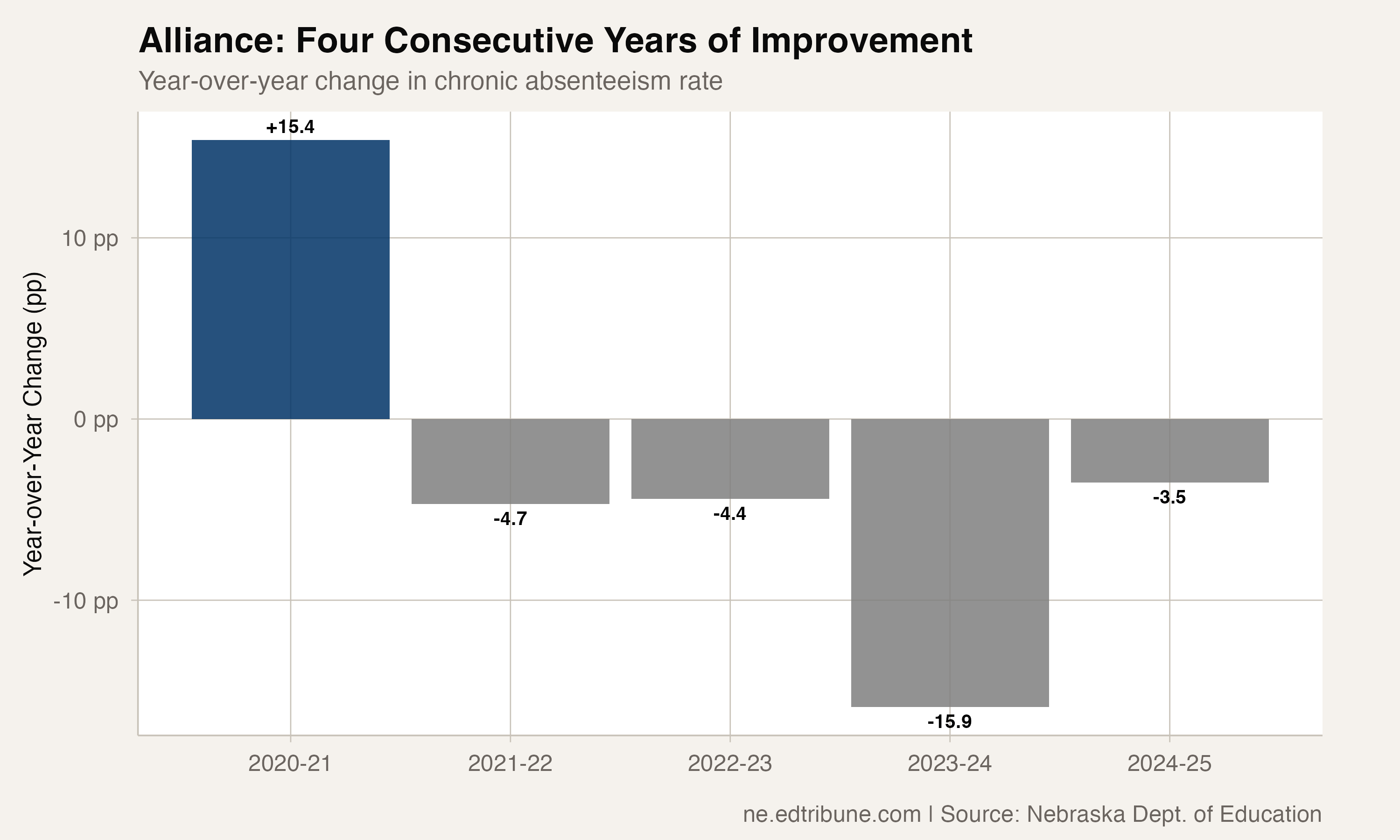
The improvement was not a one-year correction that flattered the trend line. It came in steady, annual increments: from 48.3 percent to 43.6 percent (2021-22), to 39.2 percent (2022-23), then a dramatic drop to 23.3 percent (2023-24), and a further decline to 19.8 percent (2024-25).
The 2023-24 improvement of 15.9 percentage points in a single year stands out. Something changed fundamentally in Alliance that year. The Nebraska Department of Education recognized the district's approach: an assistant principal took personal responsibility for building positive relationships with students, created a mentorship program ensuring every student had a trusted adult in the building, and launched positive attendance messaging throughout the school.
Where Alliance stands now
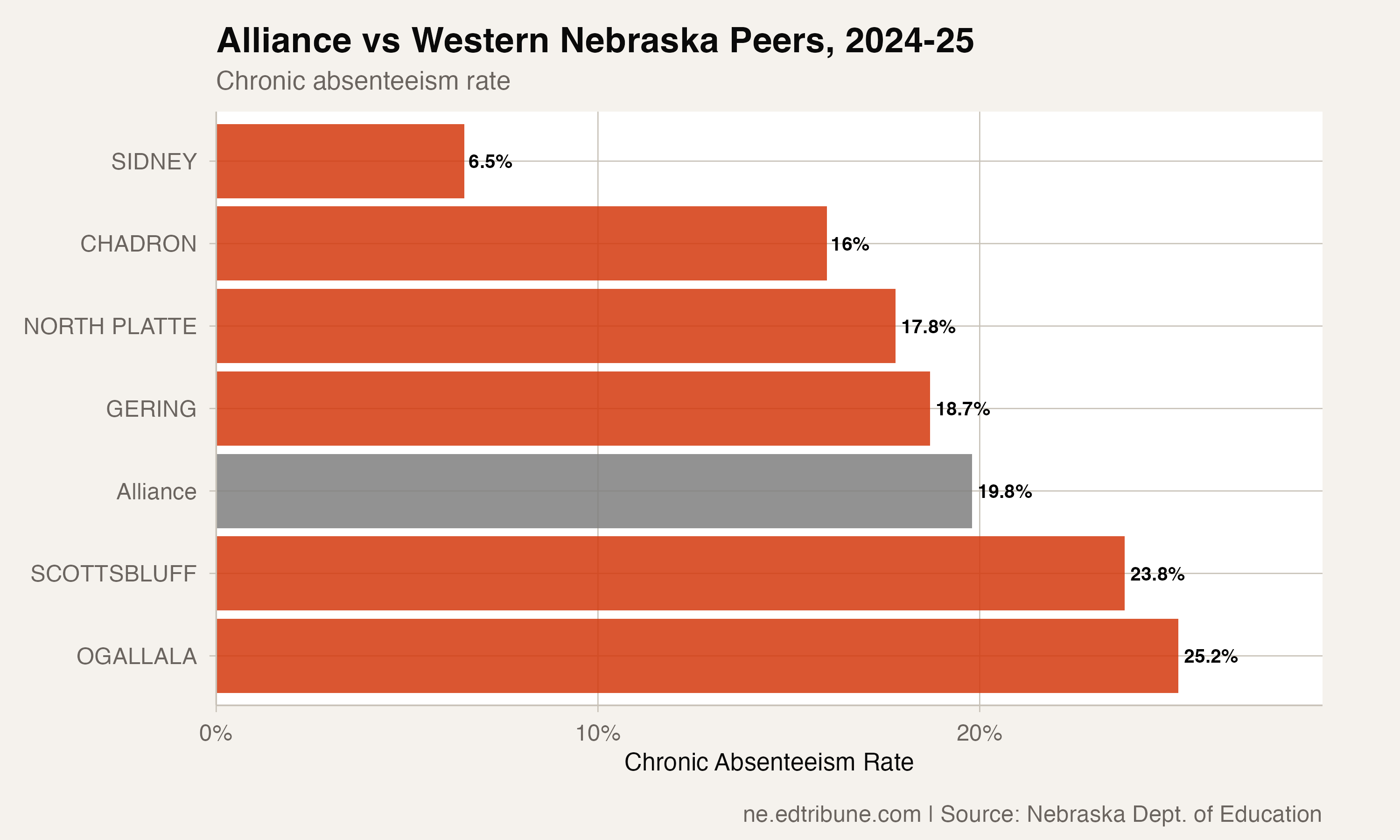
At 19.8 percent, Alliance is now below the statewide average of 21.5 percent -- a position that would have been difficult to imagine four years ago when it was one of the worst-performing districts in the state. Among western Nebraska peers, Alliance sits in the middle of the pack: below Ogallala (25.2 percent) and Scottsbluff (23.8 percent) but above Chadron (16.0 percent) and Sidney (6.5 percent).
The district's data for 2018-19 is unavailable (chronic absence counts are suppressed), so a direct comparison to pre-COVID levels is not possible. But the 2019-20 rate of 32.9 percent -- already elevated before COVID hit -- suggests that Alliance's current 19.8 percent may represent the lowest chronic absenteeism the district has experienced in the modern data window.
What makes Alliance instructive
Alliance is not the only Nebraska district that has achieved a dramatic turnaround. South Sioux City Community Schools dropped from 37.6 percent to 11.2 percent (a 26.4-point improvement). Sidney Public Schools went from 30.7 percent to 6.5 percent (24.2 points). Chase County Schools fell from 41.5 percent to 13.8 percent (27.7 points).
What these districts share, beyond the numbers, is scale: they are all mid-sized or small communities. The top ten improvers in Nebraska are all districts with fewer than 4,000 students. None of Nebraska's large urban or suburban districts appear on the list.
That pattern raises a question: is turnaround possible at the scale of Omaha (50,265 students, 44.7 percent) or Lincoln (40,365 students, 27.7 percent)? The relationship-based, every-student-known approach that worked at Alliance may be harder to replicate in a district with 50 times as many students. But the Alliance example proves that the problem is not intractable -- it is a matter of whether the ingredients that work at 1,200 students can be adapted for 50,000.
After this article published, Alliance's district leadership team wrote to The NEEdTribune to describe how the turnaround happened. The district produced monthly attendance newsletters, posted them on social media and distributed them to businesses around town. It asked the Alliance City Council to declare September "Attendance Awareness Month" for the city, which the council did in September 2023 and again in September 2024. Perfect-attendance students were recognized at halftime of a football game, and each building ran its own attendance challenges through the year. Alongside the public campaign, the leadership team says it worked to build stronger school-parent relationships, to get to the root of why individual students were missing school, and to connect those families with the resources they needed.
"Our staff throughout the district were amazing and jumped on board with our efforts, we couldn't have done it without them," the leadership team wrote in an email, crediting the school board, the superintendent, parents and the Nebraska Department of Education alongside district staff. "We realize we still have work in front of us, we are proud of how far we have come, and will continue to work on addressing chronic absenteeism in our district."
Detailed code that reproduces the analysis and figures in this article is available exclusively to EdTribune subscribers.
Discussion
Sign in to join the discussion.
Loading comments...