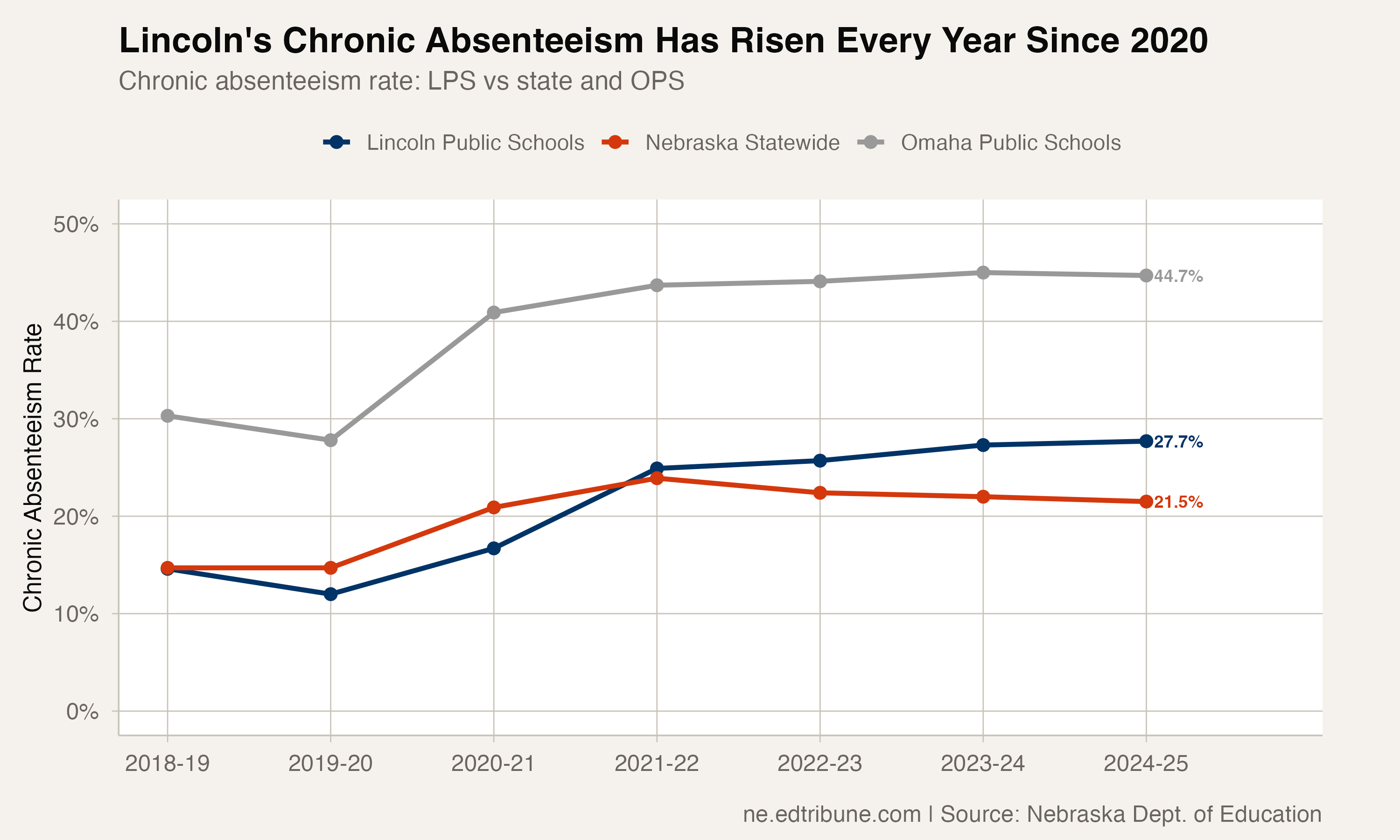
Every other major school district in Nebraska peaked in 2022 and started the slow crawl back toward normal. Lincoln Public Schools↗ET has done the opposite.
In 2019-20, LPS had a chronic absenteeism rate of 12.0 percent -- below the state average, unremarkable, the kind of number that doesn't make news. Then, year by year, the line started climbing and never stopped: 16.7 percent in 2020-21, 24.9 percent in 2021-22, 25.7 percent in 2022-23, 27.3 percent in 2023-24, and 27.7 percent in 2024-25.
Five consecutive years of worsening. The only major district in Nebraska -- the only one with more than 5,000 students -- where chronic absenteeism has risen every single year since the pandemic began.
The numbers behind the streak
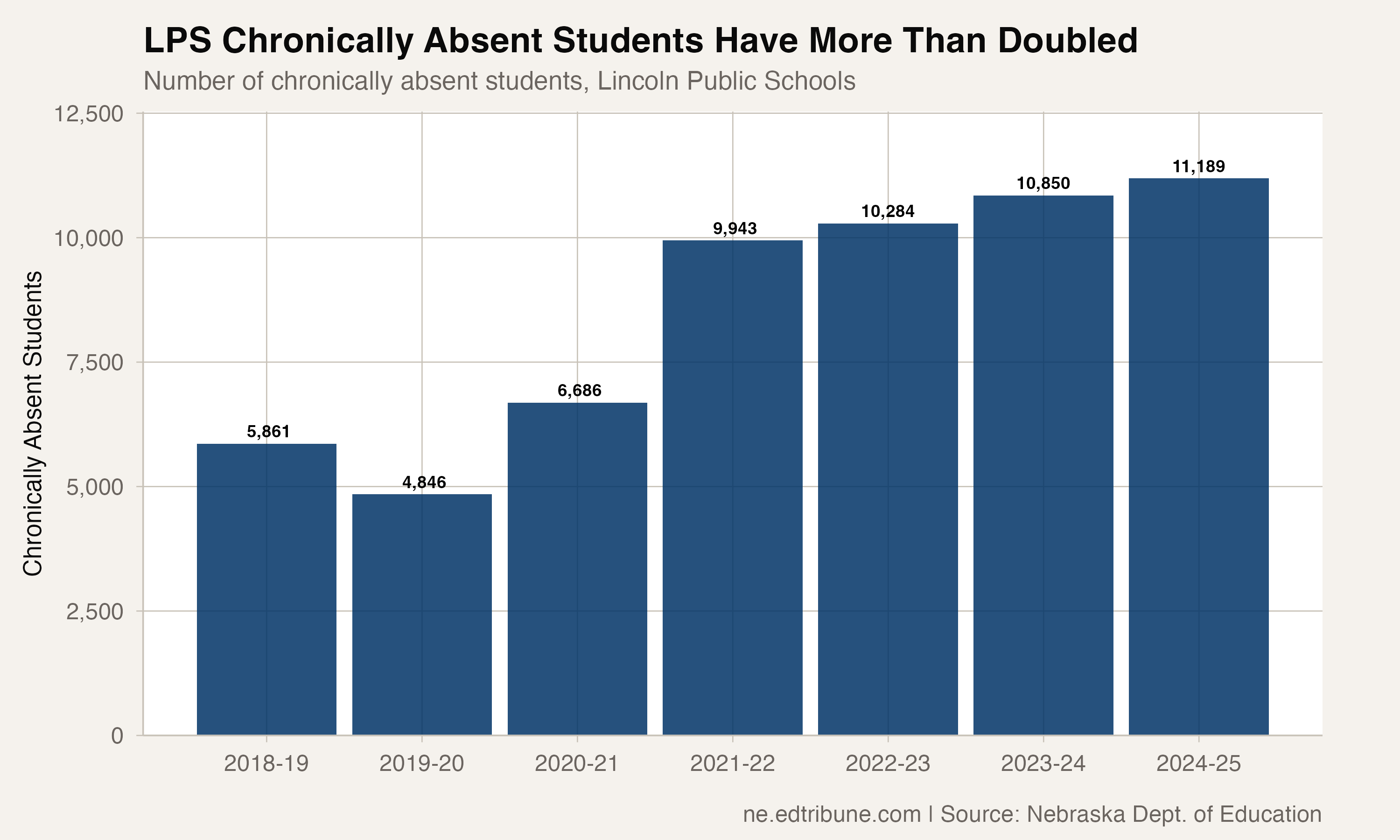
The raw count is perhaps more unsettling than the rate. In 2019-20, 4,846 LPS students were chronically absent. By 2024-25, that number had reached 11,189 -- a 131 percent increase. The district gained 132 students over that period. It gained 6,343 chronically absent students.
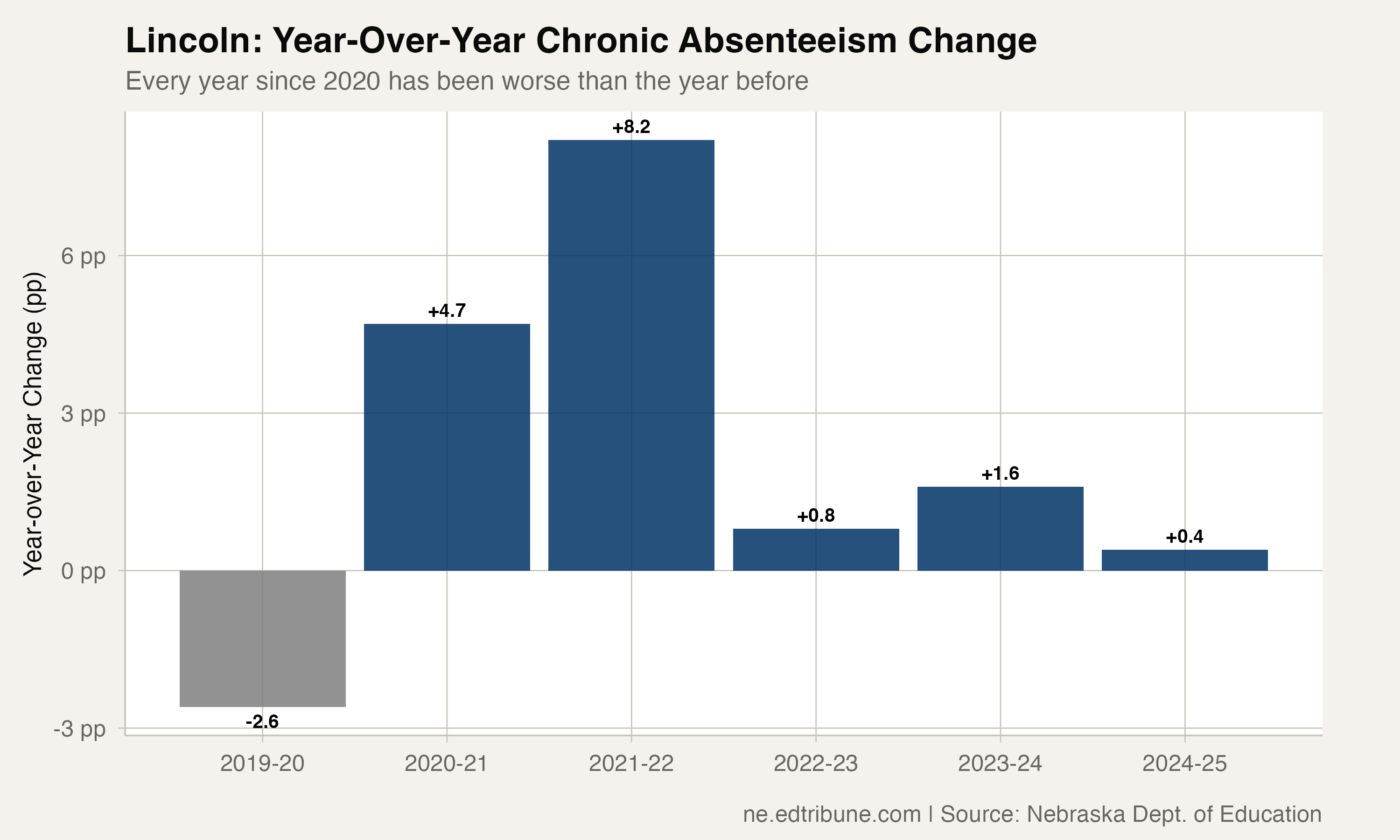
LPS now has more chronically absent students than many Nebraska districts have total students. And unlike OPS, where the rate plateaued after a sharp COVID spike, Lincoln's trajectory shows no sign of flattening. Each year's increase has been smaller than the previous -- 4.7 percentage points in 2020-21, then 8.2, then 0.8, then 1.6, then 0.4 -- but the direction has not reversed.
Where it gets worse inside the building
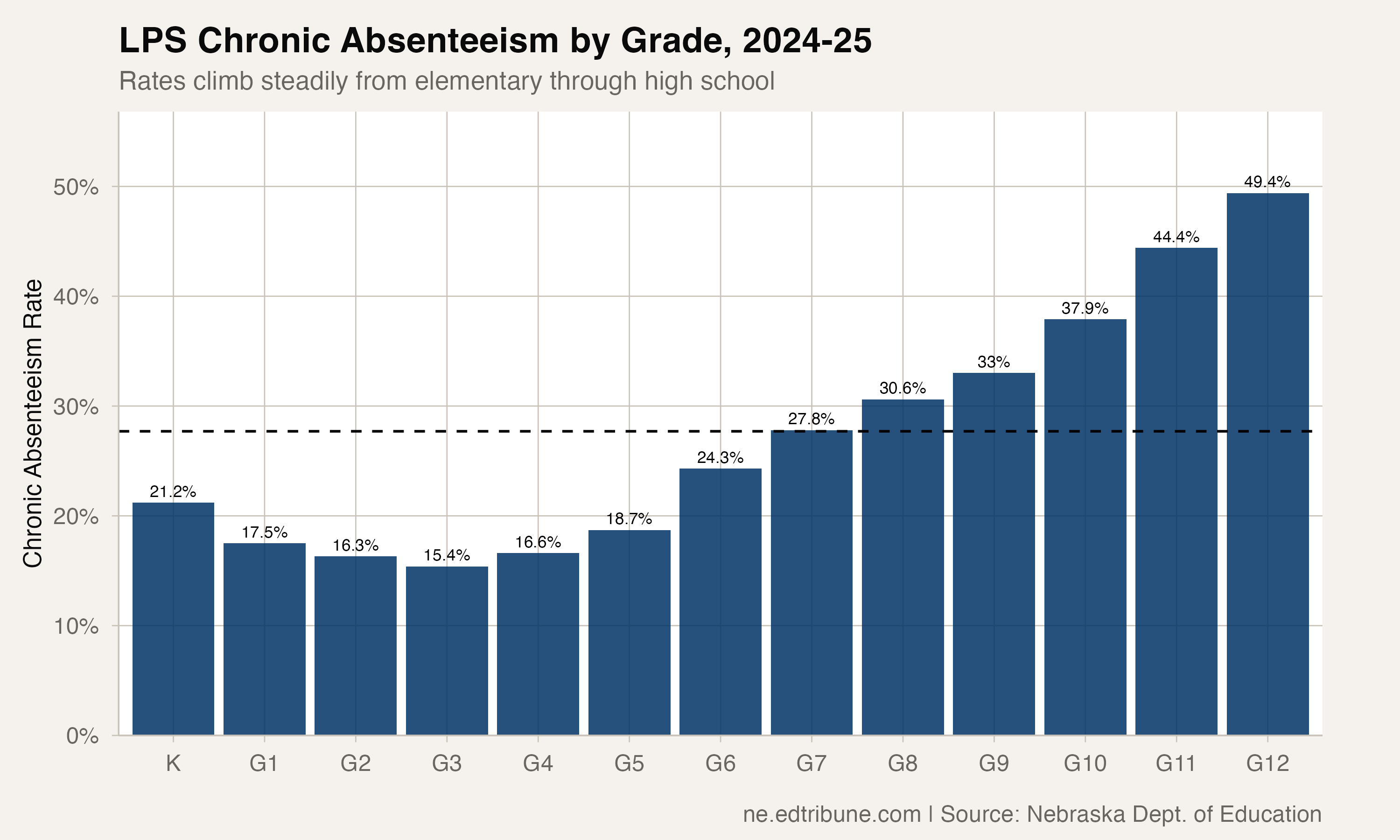
The grade-level data inside LPS reveals a district splitting in two. Elementary grades show elevated but manageable chronic absenteeism -- first grade at 17.5 percent, third grade at 15.4 percent. But something breaks starting in sixth grade (24.3 percent), accelerates through middle school (30.6 percent in eighth grade), and reaches crisis levels by high school.
Among LPS seniors, 49.4 percent were chronically absent in 2024-25 -- nearly half the class. Juniors were at 44.4 percent. Sophomores at 37.9 percent. Lincoln Northeast High School led at 54.9 percent, followed by Lincoln High at 51.2 percent and North Star at 47.4 percent.
These are rates that were unprecedented in Lincoln a decade ago. This is a district with a reputation as a well-run, stable school system -- 40,365 students, the state's second-largest, the anchor of Lancaster County. Yet its high school attendance patterns now look more like those of a district in crisis than a district in recovery.
What makes Lincoln different
The contrast with the state is stark. Nebraska's chronic absenteeism rate peaked at 23.9 percent in 2021-22 and has declined each year since, reaching 21.5 percent in 2024-25. Lincoln peaked in... 2024-25. The state is recovering, slowly. Lincoln is still getting worse.
Even the comparison with Omaha is instructive. OPS has a far higher rate (44.7 percent), but it has at least stabilized -- the four-year plateau is grim, but it is a plateau. Lincoln has not found its floor.
The gap between OPS and LPS has barely budged -- 15.8 percentage points in 2019-20, 17.0 in 2024-25 -- but that stability is misleading. LPS started 2019-20 well below the state average (12.0 percent vs 14.7 percent). It ended 2024-25 more than six points above it.
News reports confirm that LPS has invested in interventions -- the district employs 50 social workers and licensed therapists, and officials have acknowledged that chronic absenteeism "continues to rise." But the investments have not yet bent the curve.
The question Lincoln must answer
Chronic absenteeism is not a weather pattern that blows through and dissipates. Five years of consecutive worsening in a district of this size points to something structural -- whether it is shifts in family stability, transportation access, mental health crises among adolescents, or a post-pandemic cultural change in how families and students think about daily attendance.
The 35,000 Nebraska adolescents who experience major depressive episodes annually, and the 24,000 with serious suicidal thoughts, are not evenly distributed. The degree to which mental health challenges concentrate in larger, more diverse urban districts like Lincoln is a question the data cannot answer directly -- but the grade-level pattern, with rates climbing steadily from elementary through high school, fits the profile of a crisis driven by adolescent disengagement rather than younger-child logistics.
Detailed code that reproduces the analysis and figures in this article is available exclusively to EdTribune subscribers.
Discussion
Sign in to join the discussion.
Loading comments...