Correction (2026-05-29): An earlier version of this article cited a statewide enrollment decline of 2,226 students and a Nebraska total of 418 districts. The Nebraska Department of Education file we drew from pools public school districts with non-public and state-operated entities, and our data package was treating all of them as public school districts. The corrected statewide figures are a 2026 decline of 1,988 students and 244 public school districts. All LPS-specific numbers (the 334-student decline, the 41,967 total, the kindergarten and 12th grade counts, and the racial composition figures) were not affected. Thanks to a reader for flagging this.
Lincoln Public Schools↗ET grew every single year from 2006 through 2020. Fifteen consecutive years. The district added 9,988 students over that stretch, a 30.8% increase that outpaced both Omaha and the state. In a region where most school districts were treading water, Lincoln was the growth story.
In 2025-26, that story changed. LPS enrolled 41,967 students, down 334 from its all-time high of 42,301 the year before. A 0.8% decline.
The district has now lost students in two of the last three years, and the math underneath the topline suggests the drop is structural, not random.
A growth engine that ran for two decades
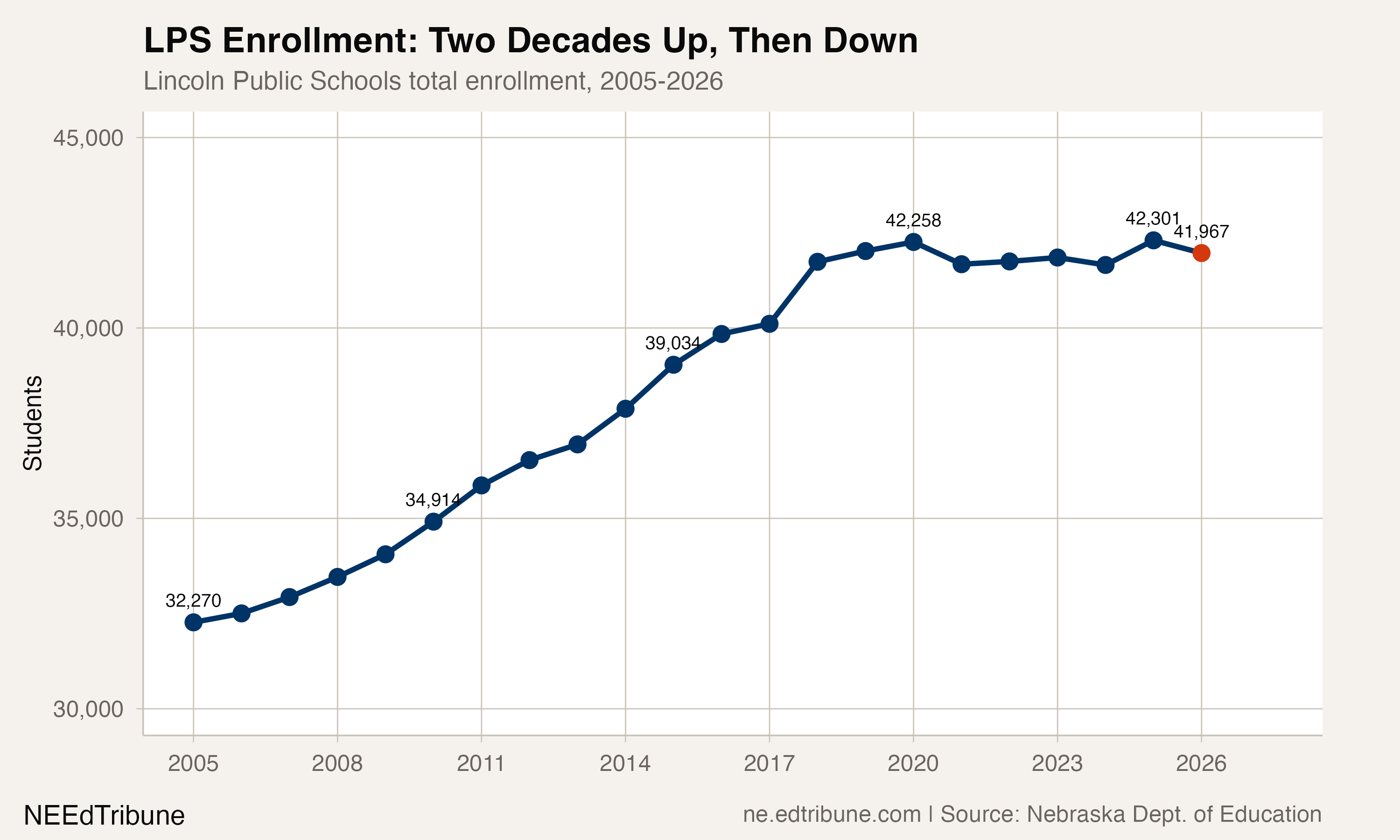
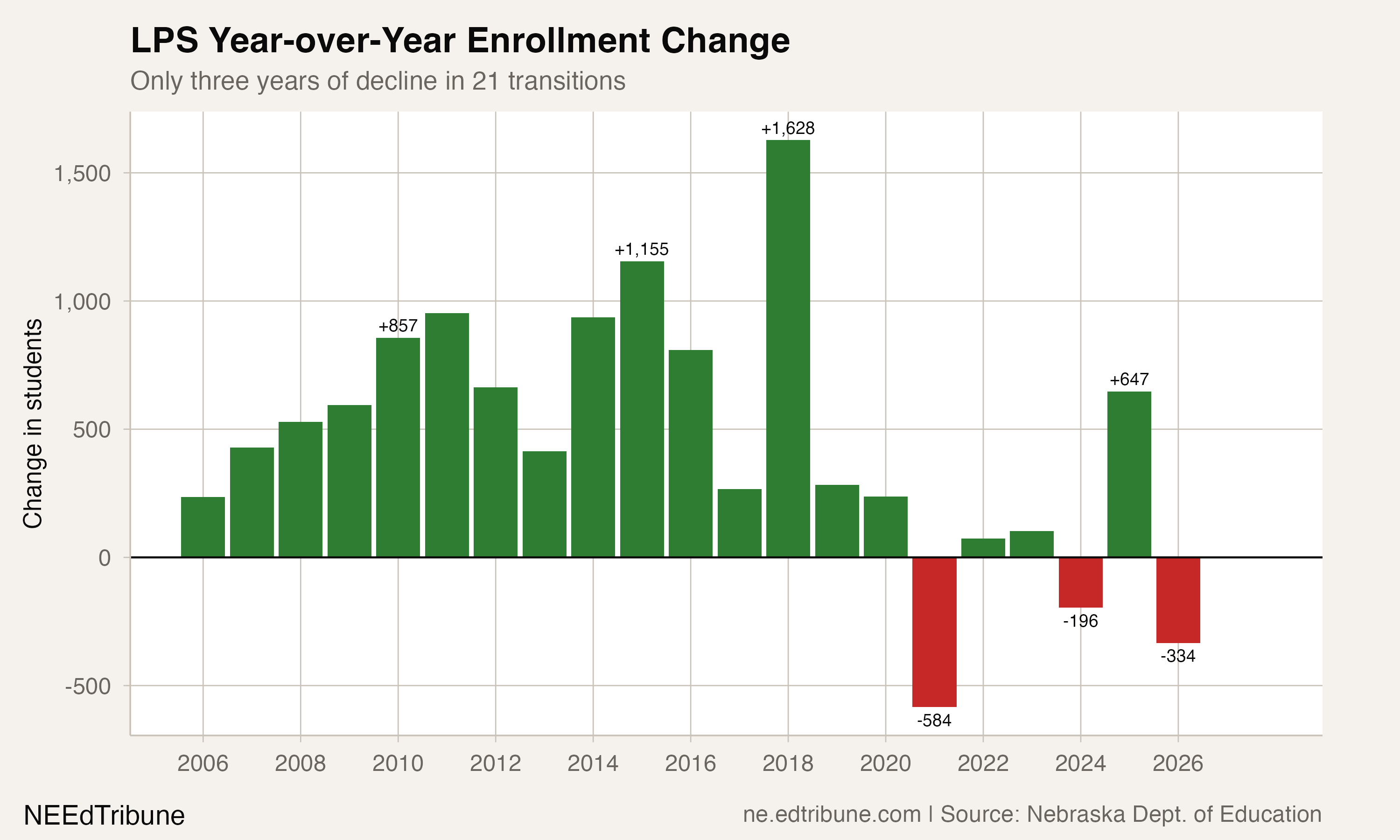
Between 2005 and 2020, LPS grew from 32,270 to 42,258. The gains were steady: the district added students in all 15 of those year-over-year transitions, averaging 665 per year. The biggest single jump came in 2017-18, when LPS added 1,628 students, a 4.1% surge.
That run put LPS on a different trajectory than Nebraska's other large district. Indexed to 2005, LPS grew 30.0% through 2026; Omaha Public Schools grew 11.9% over the same period. The state as a whole grew about 15%.
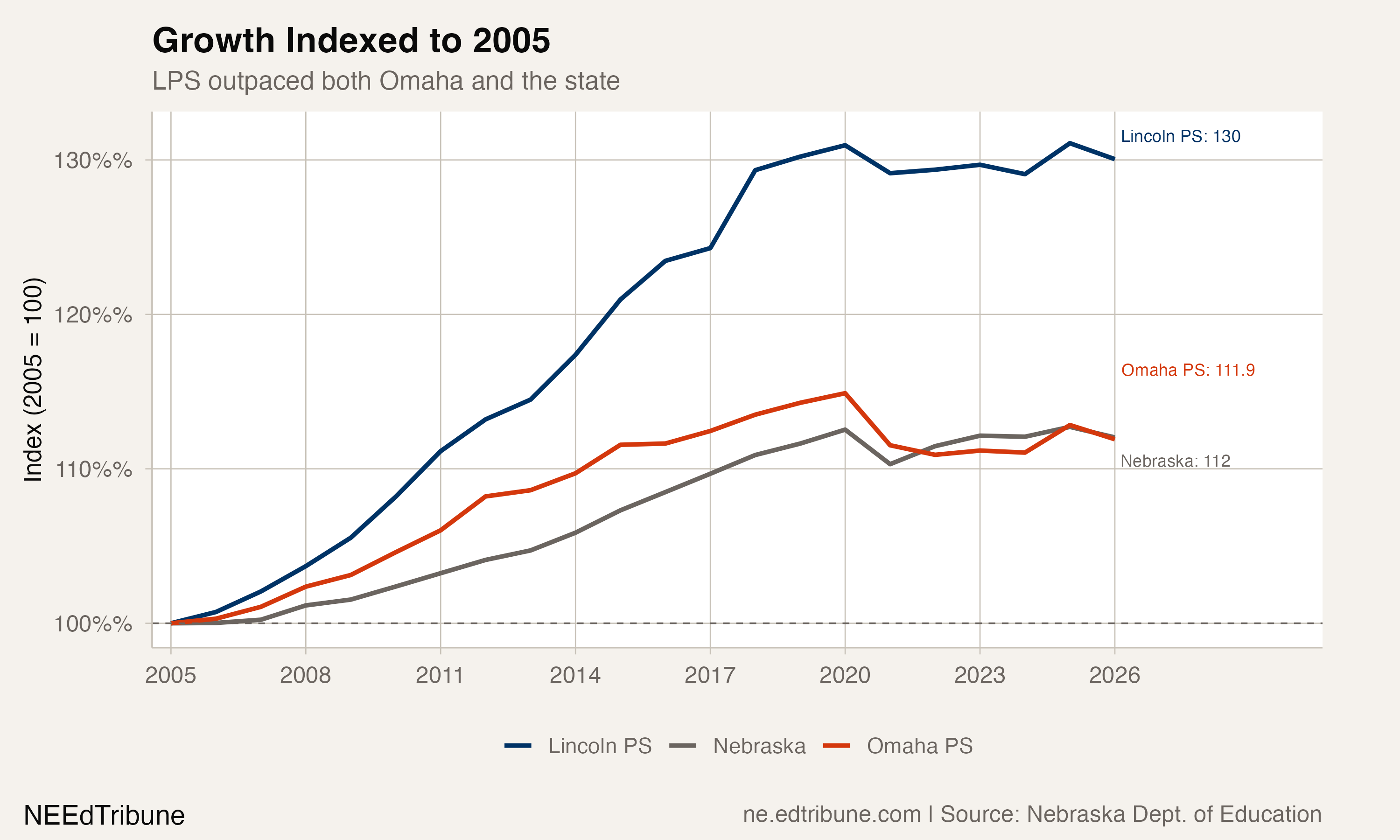
Even COVID only briefly interrupted the pattern. LPS lost 584 students in 2020-21, then clawed back to a new peak of 42,301 in 2024-25, a recovery powered by a 647-student gain that year. But the post-pandemic path was uneven: a small loss in 2023-24 (-196) broke up the recovery before that final surge. The 2025-26 loss of 334 students makes it two declines in three years, a rhythm LPS has never experienced outside the pandemic.
Fewer kindergartners, more graduates
The arithmetic behind the decline is straightforward: LPS is graduating more students than it is enrolling.
In 2025-26, the district's 12th grade class numbered 3,476. Its kindergarten class: 2,672. That 804-student gap means LPS is losing the equivalent of a mid-sized elementary school's worth of students every year through the pipeline alone.
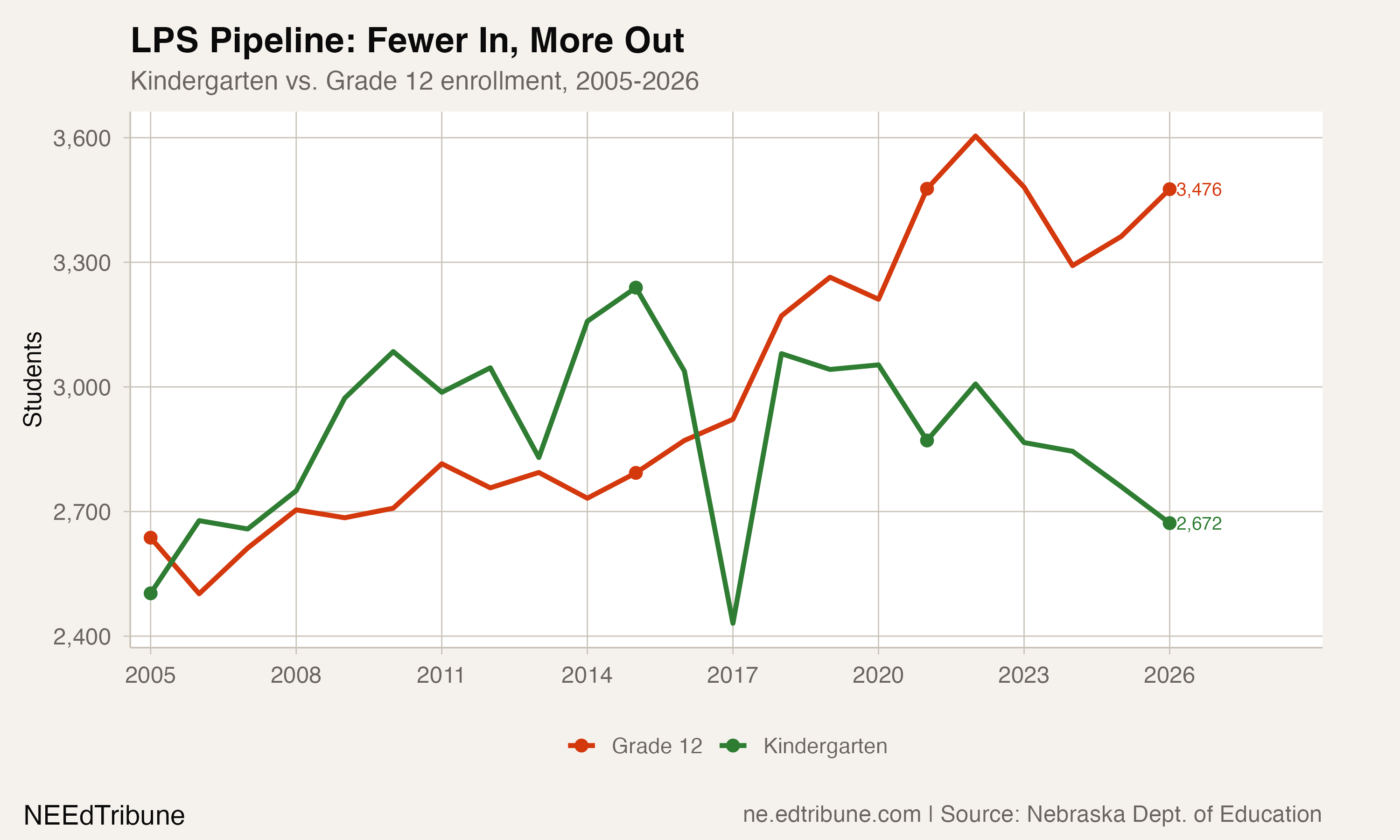
The kindergarten line has been falling for a decade. LPS enrolled 3,239 kindergartners in 2014-15, its peak. By 2025-26, that number had dropped to 2,672, a 17.5% decline. Meanwhile, 12th grade enrollment rose from 2,793 to 3,476 over the same period, a 24.5% increase.
Mike Gillotti, LPS Associate Superintendent for Educational Services, told KLIN radio that the decline reflected cohort mechanics, not a broader problem.
"Larger grade-level cohorts are in the upper grades and graduating out, while smaller grade-level cohorts are entering at the elementary grade levels." — KLIN, Nov 2025
The district characterized the dip as routine fluctuation. Elementary enrollment fell by 420 students; middle schools were essentially flat, and high schools grew by 80, according to LPS.
The demographic crosscurrent
The topline enrollment masks a sharper shift underneath. LPS looks very different than it did 20 years ago.
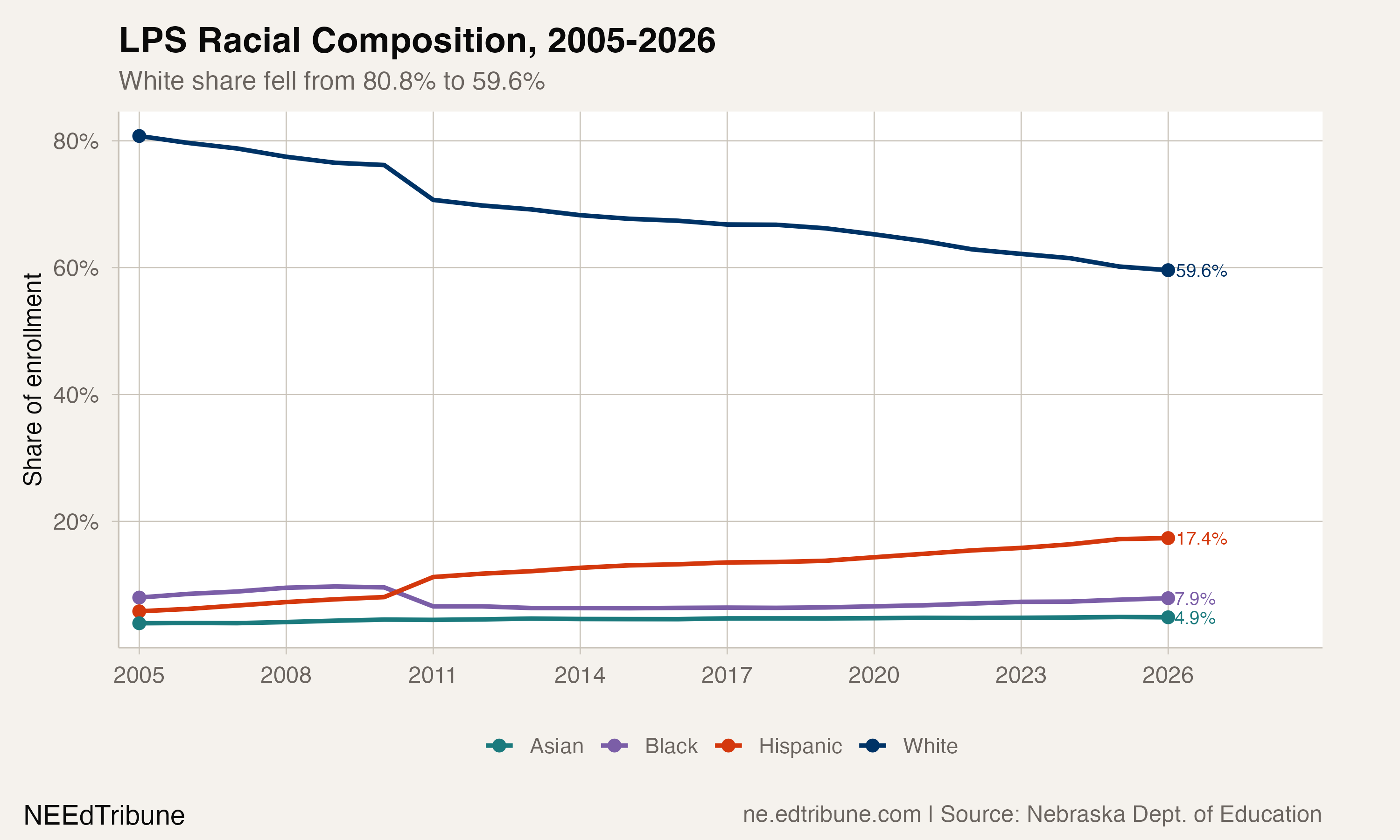
In 2004-05, white students made up 80.8% of LPS enrollment. In 2025-26, that share fell below 60% for the first time, landing at 59.6%. The decline has been steady: white enrollment peaked at 27,865 in 2017-18 and has dropped every year since, an eight-year streak that has erased 2,853 students.
The 2025-26 loss was disproportionately white. Of the 334-student net decline, white enrollment dropped by 443 students. Black enrollment grew by 76, Hispanic by 11.
Hispanic enrollment has been LPS's primary growth engine for two decades. The district enrolled 1,875 Hispanic students in 2004-05, a small base, and 7,284 in 2025-26. That 5,409-student gain represents 288.5% growth. Hispanic students now represent 17.4% of the district, up from 5.8%. But the 2025-26 gain of just 11 Hispanic students was the smallest in the dataset, suggesting that growth source may be decelerating.
Students of color now make up 40.4% of LPS enrollment, up from 19.2% in 2005. At the current rate of change, white students could fall below 50% of the district within a decade.
Why Lincoln is not immune
For years, Lincoln's enrollment growth insulated it from the budget pressures facing districts across Nebraska. In 2025-26, the state lost 1,988 students across its 244 public school districts, with declines outnumbering gains. LPS and Omaha Public Schools, which lost 429 students, both declined simultaneously for the first time since the pandemic.
LPS's growth rested on two pillars: Lincoln's population expansion and Hispanic enrollment gains. Both show signs of slowing. The kindergarten pipeline suggests that smaller birth cohorts are already flowing through: the children entering kindergarten in fall 2025 were born in 2019-20. National birth rates fell sharply during that period, and Nebraska was not exempt from that trend.
The school choice landscape adds uncertainty. Nebraska voters repealed the state's private school scholarship program with 57% of the vote in 2024, but the state has since opted into the federal Educational Choice for Children Act, which takes effect in January 2027. Whether that program draws meaningful enrollment from LPS is an open question. Lincoln has a sizable parochial school network, and even a small share of families using federal scholarships could accelerate the decline in a district where the margin between growth and contraction has narrowed to a few hundred students.
The question ahead
LPS remains 30.0% larger than it was in 2005. It is still Nebraska's second-largest district, enrolling about 13% of the state's public school students. The 2025-26 loss does not erase two decades of growth.
But the pipeline math is unambiguous. LPS has 804 more seniors than kindergartners. The district added just 11 Hispanic students in 2026, down from 500 to 800 per year through the 2010s. The federal school choice program takes effect in January 2027, and Lincoln's parochial school network is large enough to absorb families at the margin. LPS spent 15 years building schools for a district that grew every year. It may spend the next 15 learning to run one that doesn't.
Detailed code that reproduces the analysis and figures in this article is available exclusively to EdTribune subscribers.
Discussion
Sign in to join the discussion.
Loading comments...