Correction (2026-05-29): An earlier version of this article said statewide Hispanic enrollment grew from 9.9% to 21.6% between 2005 and 2026, and white enrollment fell from 79.8% to 62.4%. The Nebraska Department of Education file we drew from pools public school districts with non-public and state-operated entities, and our data package was treating all of them as public school districts. The corrected statewide shares are 10.8% to 23.0% Hispanic and 78.5% to 60.8% white. Fremont's district-level numbers, the 2025 crossover, and the long-run trend in Fremont are unchanged. Thanks to a reader for flagging this.
In 2010, voters in Fremont, Nebraska passed an ordinance designed to drive out undocumented immigrants. The measure required renters to sign declarations of legal presence and employers to use the E-Verify system. The vote was 57% to 43%. At the time, Fremont Public Schools↗ET was 77.7% white and 19.8% Hispanic.
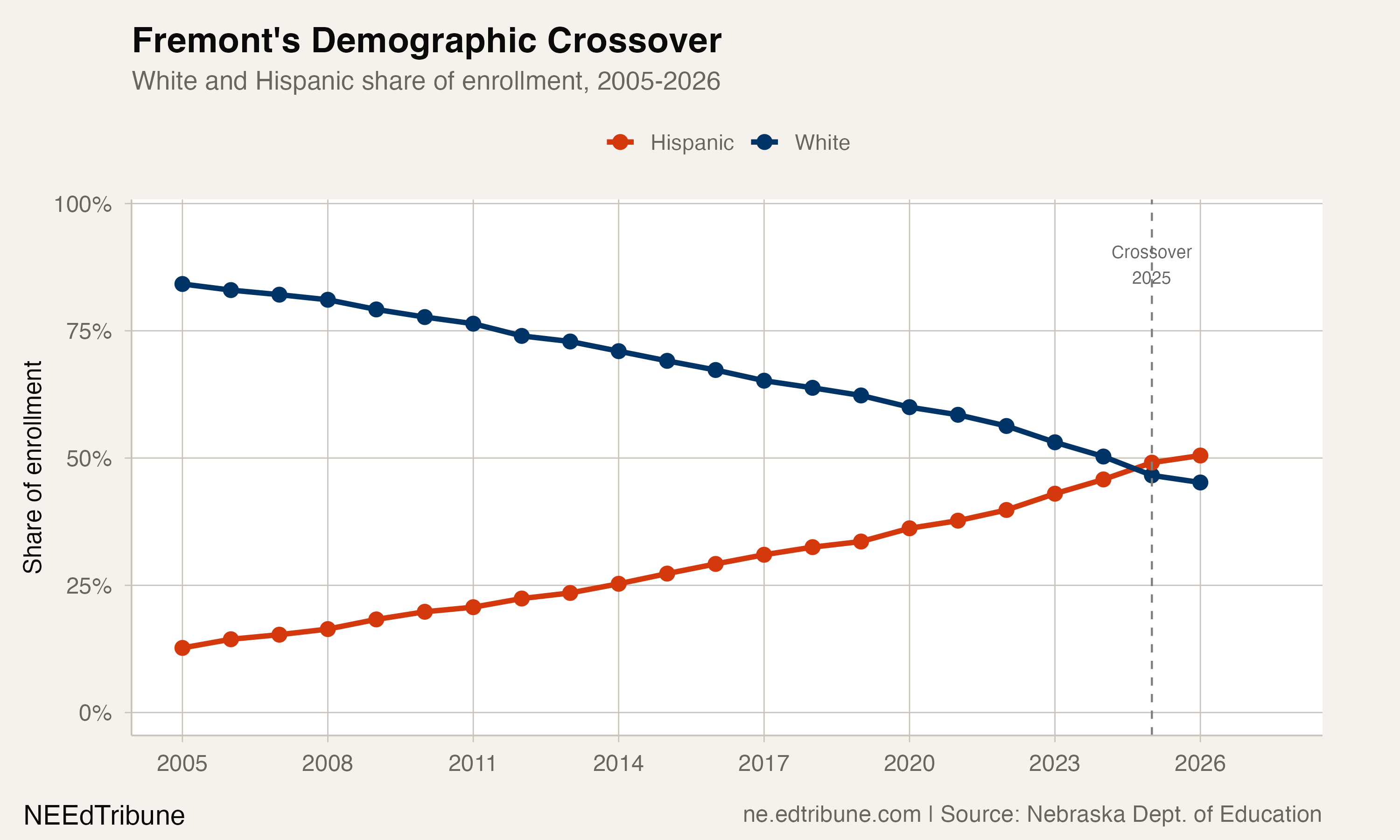
Fifteen years later, Hispanic students make up 50.5% of the district. White students are at 45.2%. The ordinance is still on the books. The crossover happened anyway.
The numbers behind the X
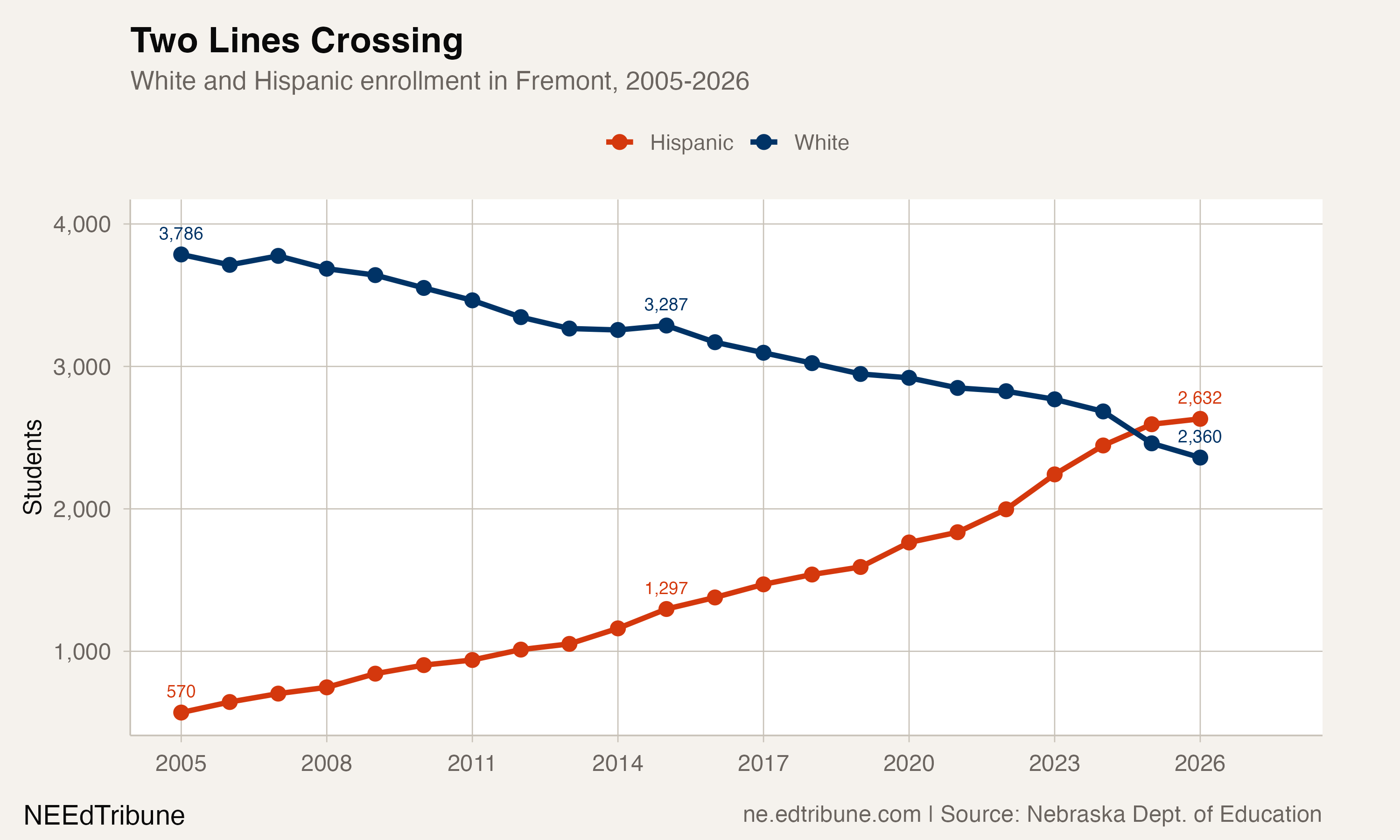
The crossover came in 2024-25, when Hispanic enrollment reached 2,594 students and white enrollment fell to 2,460. By 2025-26, the gap widened: 2,632 Hispanic students to 2,360 white. In percentage terms, Hispanic students went from 49.1% to 50.5% while white students dropped from 46.6% to 45.2%.
The transformation was not sudden. It was a 21-year compression. In 2004-05, Fremont enrolled 3,786 white students and 570 Hispanic students, a ratio of more than six to one. White enrollment has since fallen by 1,426, while Hispanic enrollment has grown by 2,062. The district added 718 students over that span, a 16.0% gain. Fremont is not shrinking. Its composition is changing.
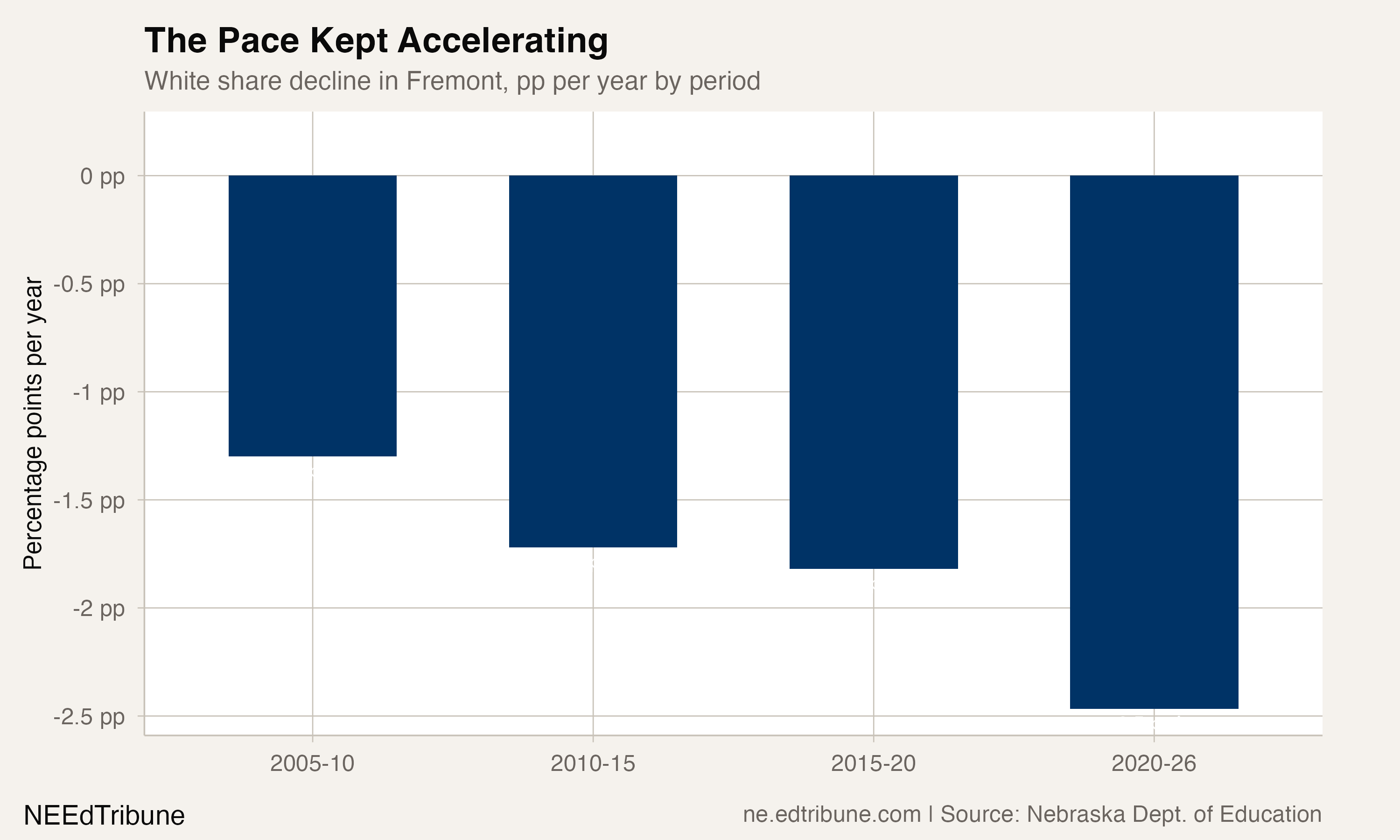
The pace of the shift accelerated in every period measured. White share declined at 1.3 percentage points per year from 2005 to 2010, 1.7 points per year from 2010 to 2015, 1.8 points per year from 2015 to 2020, and 2.5 points per year from 2020 to 2026. The ordinance did not slow the curve. Nor did the 2014 referendum that reaffirmed it by 59.5% of voters.
The plants that built a new Fremont
Three meat-processing facilities anchor the local economy. The Hormel hog plant, described as "the nation's largest producer of Spam," has operated for decades. Fremont Beef processes cattle. And in 2019, Costco opened a rotisserie chicken facility operated as Lincoln Premium Poultry, employing roughly 1,200 workers and processing two million chickens per week.
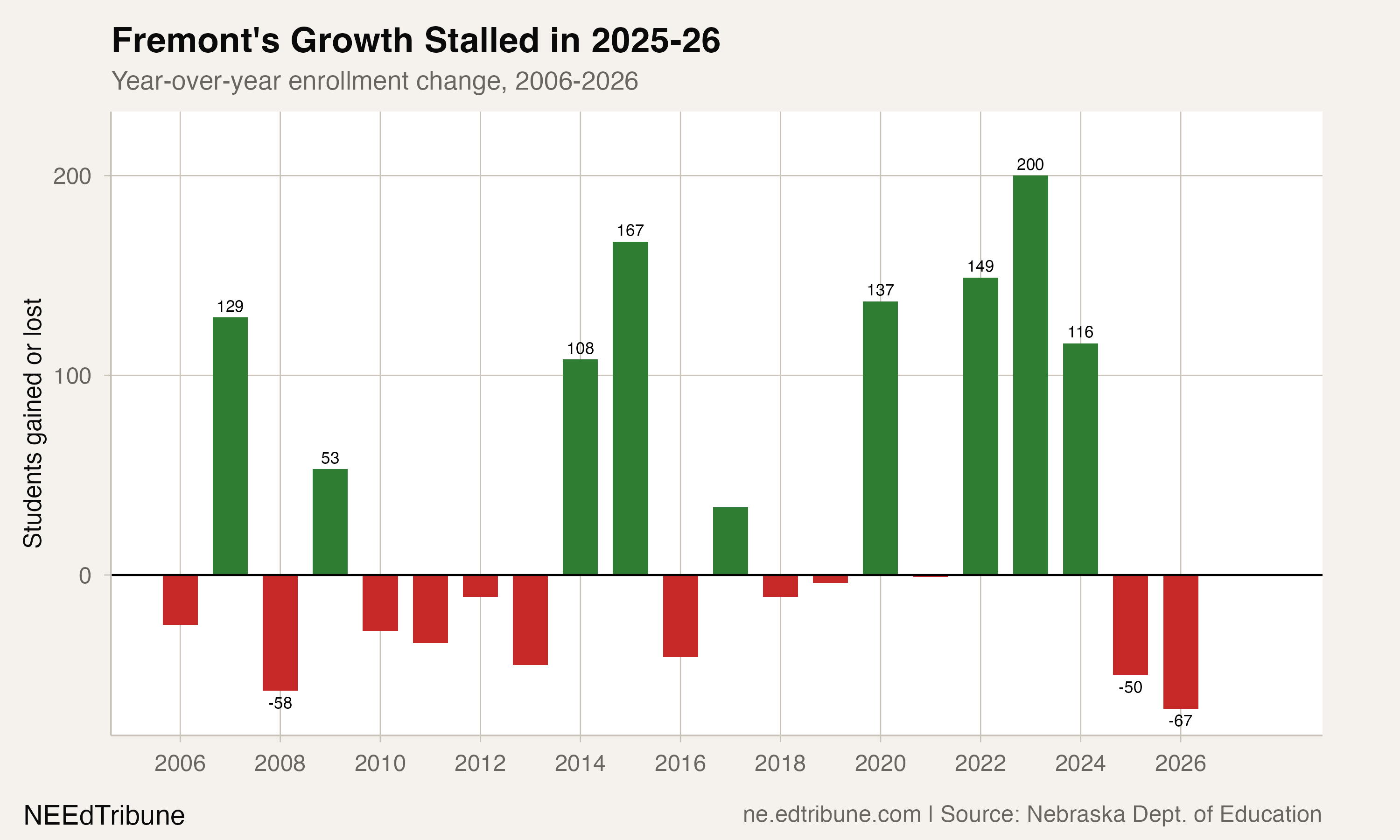
The enrollment data lines up with these economic anchors. Between 2019-20 and 2023-24, Fremont added 464 students, its strongest four-year run since the data begins. Hispanic enrollment accounted for all of the net growth and then some, rising by 681 students in that span while white enrollment fell by 236.
Mark Jensen, Fremont's city council president, put the economic reality plainly to NBC News in 2024:
"We need these people. We need this work done. This is what feeds the nation and the world."
A newer wave of workers from Guatemala, many speaking the indigenous K'iche' language rather than Spanish, has added complexity. Over 40% of recent Guatemalan arrivals speak K'iche', prompting the local hospital to hire a K'iche' translator and Costco's plant to offer language classes. The school district added 600 non-English-speaking students in the four years before 2024, according to the same NBC report.
One of 13, but the most contested
Fremont is not an outlier in Nebraska's data. Thirteen districts with 500 or more students now enroll more Hispanic students than white students. Grand Island Public Schools↗ET is 61.8% Hispanic. Columbus Public Schools↗ET is 54.9%. Crete Public Schools↗ET is 64.9%. Lexington is 77.5%. Schuyler is 88.0%.
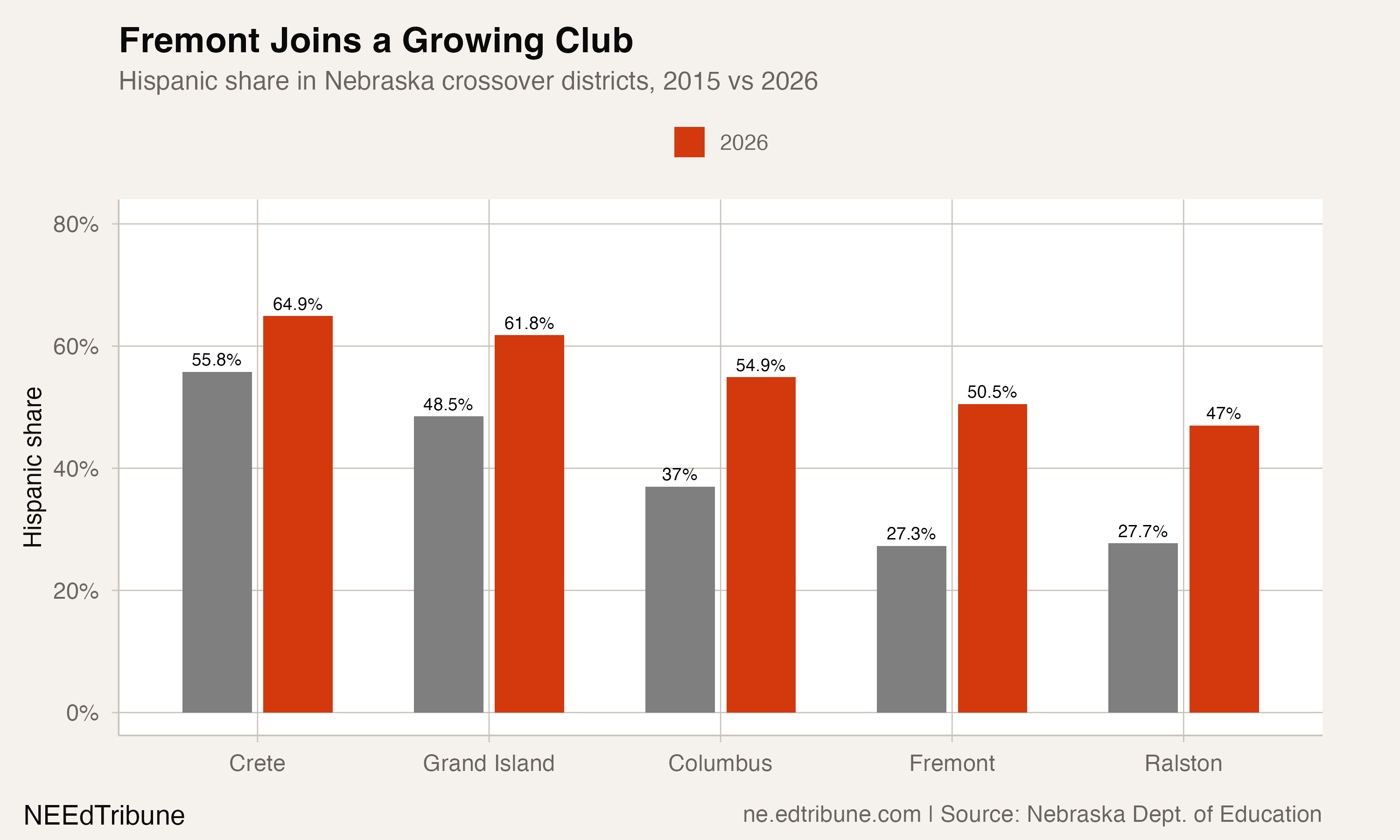
What makes Fremont different is the political backdrop. Most of these crossover districts are smaller towns where meatpacking arrived quietly. Fremont's transformation became national news. The 2010 ordinance was challenged by the ACLU, scrutinized by the Southern Poverty Law Center, and profiled by NBC News as a case study in the tension between economic dependence on immigrant labor and political resistance to immigration. As recently as September 2024, the city council voted 6-1 to keep the ordinance fully funded rather than redirect enforcement money to hire six firefighters, according to local reporting.
The enforcement mechanism has always been thin. Renters sign a declaration and pay $5 for an occupancy license. No proof of legal status is required, which is part of why the ordinance survived legal challenges. The city clerk's office told NBC News in 2024 that it processes three to five new declarations per day from migrants and other applicants. The city has spent more than $1.3 million defending the ordinance in court.
A statewide pattern, accelerating
Fremont's crossover is part of a broader transformation. Statewide, Hispanic students grew from 10.8% to 23.0% of Nebraska enrollment between 2005 and 2026. White students fell from 78.5% to 60.8%. The shift is most visible in meatpacking corridors: Grand Island, Columbus, Lexington, South Sioux City, Schuyler, and now Fremont.
At the same time, Fremont's total enrollment peaked at 5,333 in 2023-24 and has since declined by 117 students over two years. Whether that dip reflects normal fluctuation, a post-Costco plateau, or the beginning of a reversal is too early to say with two data points.
What comes next for a divided city
Fremont is the 11th-largest district in Nebraska, enrolling 5,216 students across a city of 27,000. The school district is now demographically unrecognizable from the city's voter rolls. The 2020 Census counted the city as roughly 77% white and 19% Hispanic, numbers that describe the adult population but not the classrooms. The gap between the electorate that sustains the ordinance and the student body it notionally targets will only widen.
The enrollment data cannot answer whether the ordinance deterred any families from settling in Fremont. What it can show is that white share declined faster after 2010 than before it, and that Hispanic enrollment grew in every single year of the 22 covered by this dataset. The policy meant to resist demographic change didn't stop it. Fremont had one of the fastest demographic shifts of any mid-sized district in the state. Only Ralston, with a 41.5-point drop in white share over the same period, changed faster among districts with 2,000 or more students.
The question going forward is not whether Fremont's schools will be majority-Hispanic. They already are. It is whether city government will catch up to what the school rosters have been showing for 20 years.
Detailed code that reproduces the analysis and figures in this article is available exclusively to EdTribune subscribers.
Discussion
Sign in to join the discussion.
Loading comments...