Correction (2026-05-29): An earlier version of this article ran under the headline "Nebraska's Smallest K Class in 22 Years" and reported a kindergarten enrollment of 24,170 in 2025-26 and a 2005 baseline of 24,461. The Nebraska Department of Education file we drew from pools public school districts with non-public and state-operated entities, and our data package was treating all of them as public school districts. The corrected figures are 21,275 kindergartners in 2025-26 and 21,191 in 2005, which makes the 2026 cohort 84 students above the 2005 trough, not 291 below it. The article's underlying argument, that kindergarten is shrinking after a four-year decline and the pipeline is inverting, still holds, but every grade-level figure in the piece has been updated and the title and lede have been rewritten. Thanks to a reader for flagging this.
Nebraska's K-12 enrollment climbed from 284,599 in 2004-05 to an all-time high of 330,136 in 2024-25, gaining 45,537 students over two decades. In 2025-26, enrollment fell by 1,988 to 328,148, a 0.6% decline and the first substantial non-pandemic loss in that span.
But the headline number understates what happened at the front door. Nebraska's kindergarten class fell to 21,275 students in 2025-26, the smallest entering cohort since 2005 and just 84 students above that year's trough of 21,191. The senior class, meanwhile, hit a record 26,008, the largest in the state's history. The system is now graduating 4,733 more students each year than it enrolls in kindergarten.
That arithmetic does not resolve itself.
A decade of inversion
The crossover happened in 2017. That year, Nebraska enrolled 22,283 kindergartners and graduated 23,419 seniors. The gap was modest: 1,136 more seniors than kindergartners. It has never reversed since.
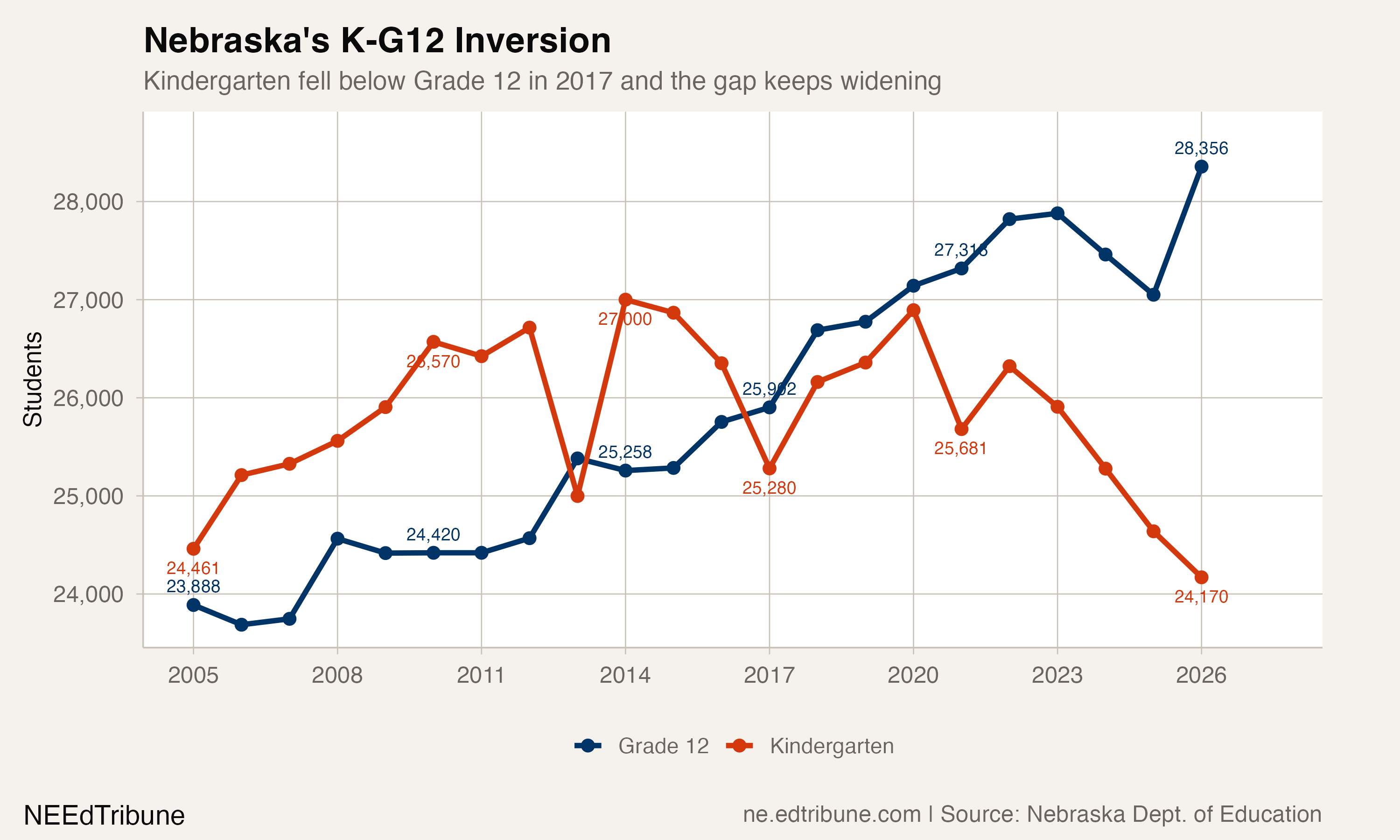
The gap held in that range for several years, then began accelerating. By 2024, seniors outnumbered kindergartners by 2,878. In 2025-26, the gap widened to 4,733, with kindergarten falling and Grade 12 jumping by 1,110 students (a 4.5% jump, the largest single-year G12 increase in the dataset).
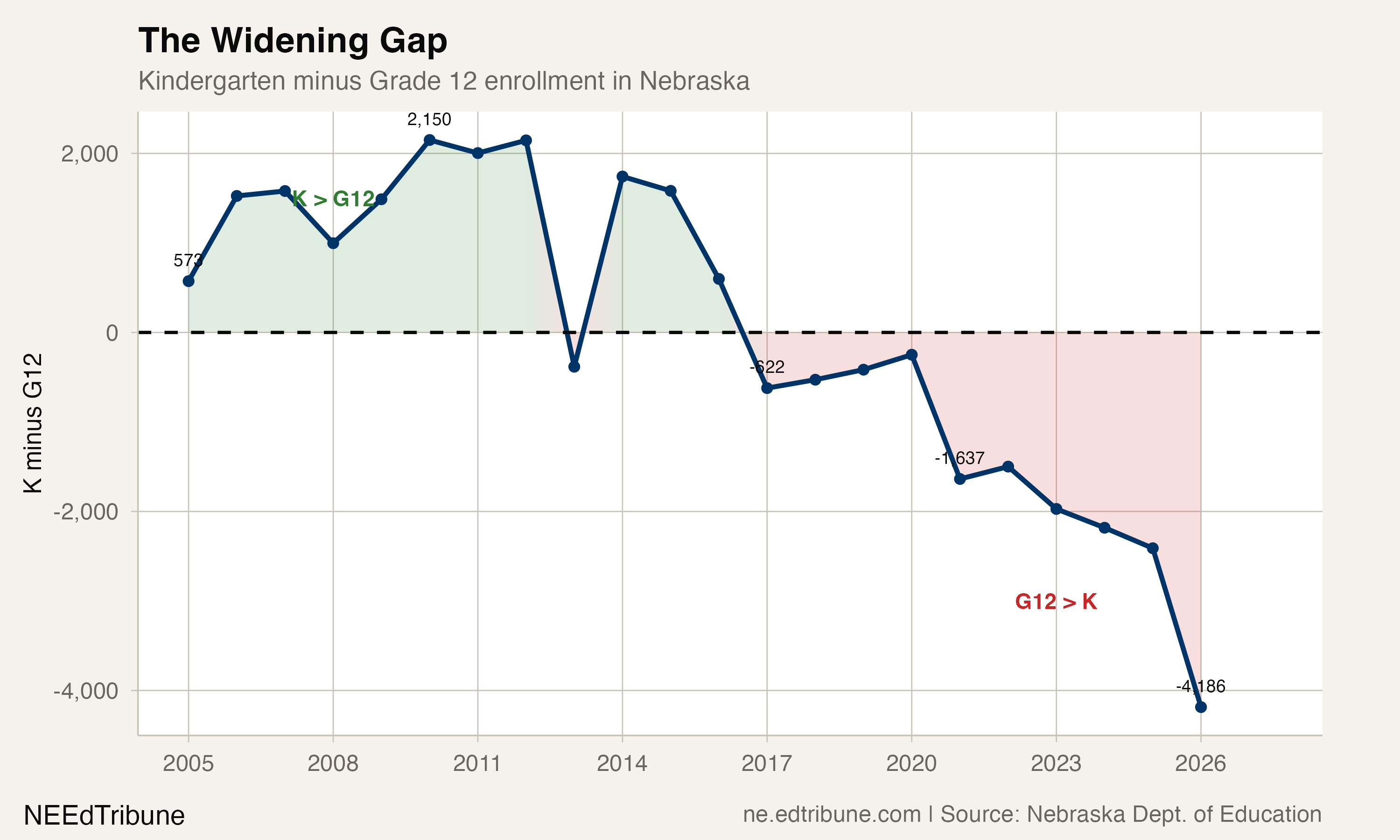
The K/G12 ratio tells the story in compressed form: 0.992 in 2005 (roughly equal), down to 0.818 in 2026 (for every 100 seniors, only 82 kindergartners are entering).
Where kindergarten is shrinking
The decline is not concentrated in one region. Of 237 districts with kindergarten enrollment in both 2019-20 and 2025-26, 153 (64.6%) lost kindergartners over that span.
The largest absolute losses hit the state's urban anchors. Omaha Public Schools↗ET lost 389 kindergartners (from 4,038 to 3,649, a 9.6% decline). Lincoln Public Schools↗ET lost 381 (from 3,053 to 2,672, a 12.5% decline). Millard Public Schools↗ET, the Omaha suburb, lost 251 (15.0%). Grand Island Public Schools↗ET, the largest district in central Nebraska, lost 203, a 24.7% decline that is disproportionate to its size.
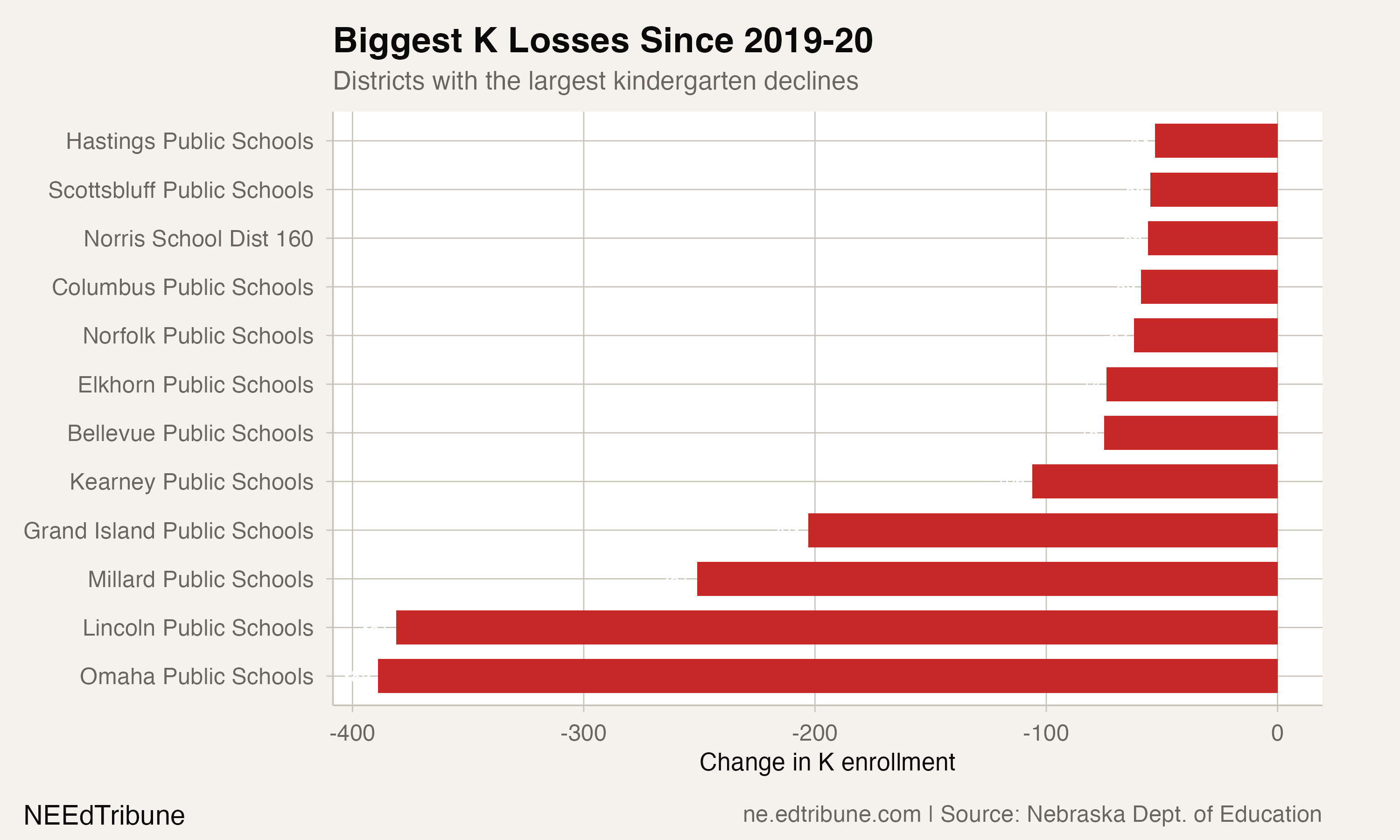
The percentage losses in mid-sized districts are starker. Norris School District 160 lost 28.6% of its kindergarten class. Scottsbluff lost 22.4%. Kearney lost 20.1%. These are not urban districts experiencing outmigration to suburbs. They are regional anchors in their own right.
The pipeline is splitting in half
Kindergarten is the leading indicator, but it is not the only grade shrinking. Since 2019-20, grades PK through 5 collectively lost 4,603 students. Grades 6 through 12 gained 3,461. The lower elementary grades are contracting while larger cohorts from the early-to-mid 2010s continue pushing through middle and high school.
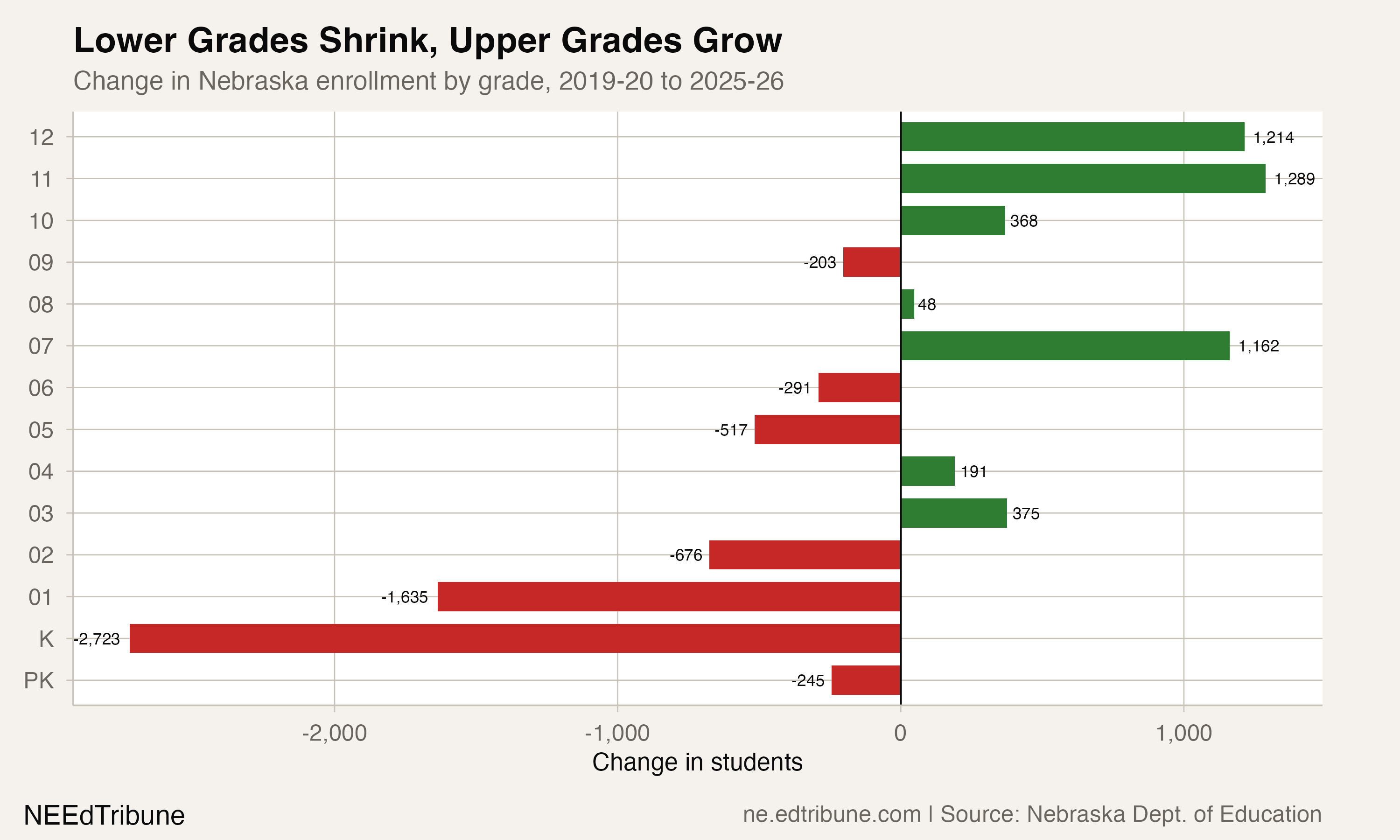
In 2025-26 alone, five of seven elementary grades (PK through Grade 5) declined. Grade 1 lost 870 students, the largest single-grade loss in the system. Grade 2 lost 799. The losses are cascading upward from kindergarten year by year.
The upper-grade gains are temporary. They reflect the passage of the large cohorts that entered kindergarten between 2008 and 2014, when K enrollment ranged from 22,584 to 24,025. Once those cohorts graduate, the system will be fed entirely by the smaller classes now entering.
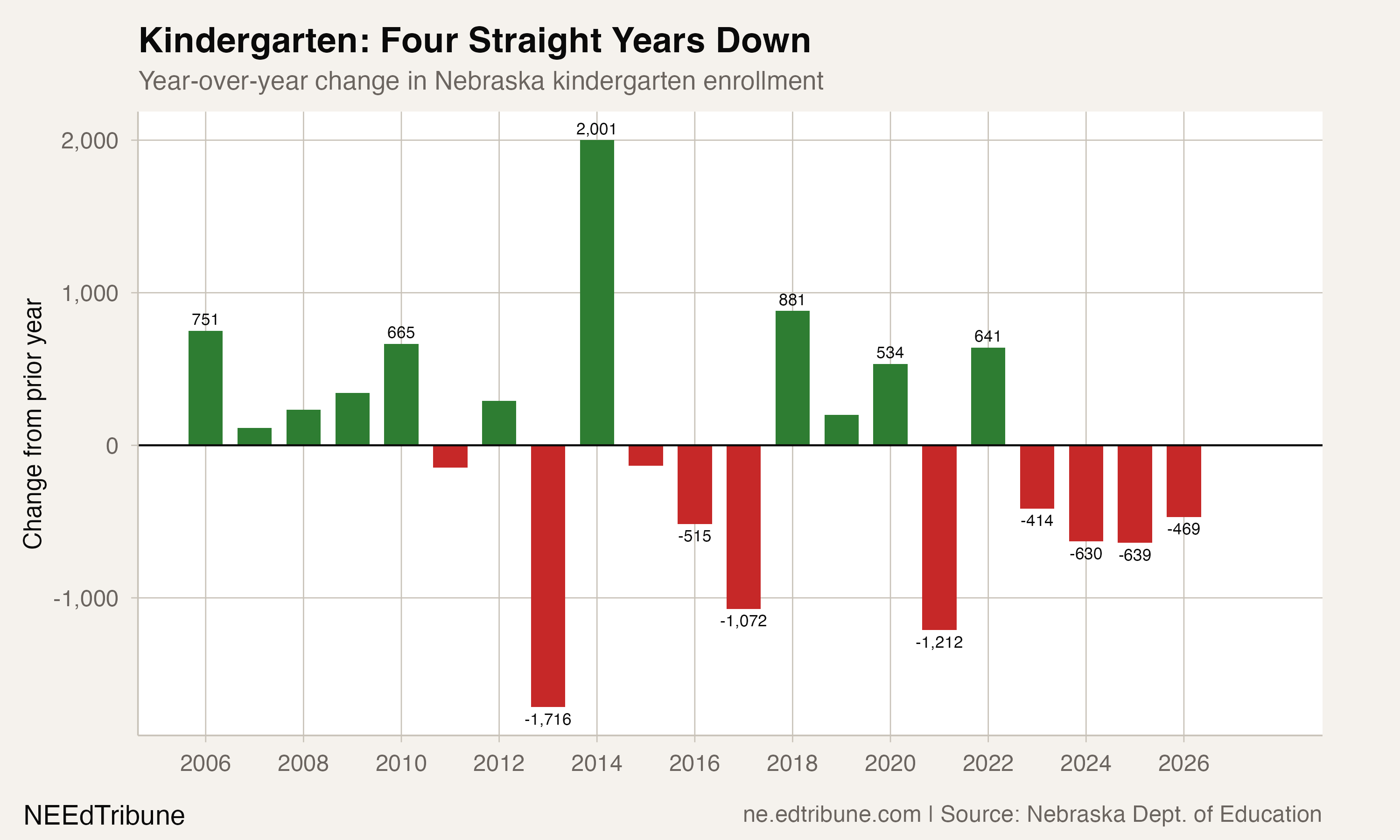
Kindergarten has now declined four consecutive years, from 23,391 in 2022-23 to 21,275 in 2025-26, a cumulative loss of 2,116 students (9.0%). The current four-year streak is the longest sustained decline in the dataset.
Birth rates and the five-year lag
The children entering kindergarten in fall 2025 were born in 2019 and 2020. National birth data shows that U.S. births fell sharply during the pandemic, with births in early 2021 down as much as 10% compared to the prior year. The kindergarten classes of 2026-27 and 2027-28 will be drawn from those pandemic-era birth cohorts, which suggests the bottom has not yet arrived.
Nebraska's fertility rate was 62.5 per 1,000 women ages 15-44 in 2023, according to the March of Dimes. That is above the national average but part of a long downward trend. The decline in births predates the pandemic. Nebraska's kindergarten peak of 24,025 in 2013-14 corresponds to births around 2008, before the post-recession fertility decline accelerated nationally.
The connection between births and kindergarten operates on a roughly five-year delay. The current kindergarten trough reflects births around 2019-2020. If national patterns hold, the cohorts born in 2020 and 2021 were even smaller, meaning Nebraska's kindergarten numbers likely have further to fall before stabilizing.
A state that gains students through the pipeline
One unusual feature of Nebraska's data: the state consistently graduates more seniors than it enrolls as kindergartners, even in absolute terms. Every tracked cohort from K-2005 through K-2014 shows a G12 class that is 3% to 8% larger than the K class that entered 12 years earlier.
This means Nebraska is a net importer of students during the school-age years. Families arrive after kindergarten, whether through interstate migration, immigration, or entry from private or home-school settings. That pipeline gain has historically masked the shrinking front-end. It may not be large enough to offset the scale of the current kindergarten decline.
The funding question
Nebraska funds schools primarily through a combination of the TEEOSA formula and local property taxes. TEEOSA calculates each district's "need" based partly on enrollment counts, then subtracts local resources. In practice, only about a third of Nebraska's districts receive equalization aid from the state. The rest rely almost entirely on property taxes.
For districts that do receive state aid, kindergarten decline feeds directly into lower need calculations. For those that do not, the fiscal pain is different: fewer students spread fixed costs across fewer families without a corresponding drop in the property tax base.
"This is the first year that there was no look-back money, so the amount of funding did decrease this year by $138,665.80." -- Sabetha Herald, March 2026
That quote comes from a Kansas superintendent describing the same dynamic playing out across the Great Plains: the elimination of enrollment averaging provisions that once cushioned declining districts. Nebraska's rural districts face identical arithmetic. Friend Public Schools and Exeter-Milligan Public Schools, which saw a combined 49% enrollment decline over two decades, merged in 2025 to form a single district. Kindergarten decline accelerates that consolidation clock for every small district in the state.
What the kindergarten number is and is not
The kindergarten number is a reliable forward indicator of total enrollment. The cohorts moving through Nebraska's schools are fixed. The 21,275 kindergartners of 2025-26 will, barring unusual migration, become roughly 21,000-22,000 first-graders in 2026-27, second-graders the year after, and so on for 12 years.
It is not a forecast of anything beyond enrollment. It does not predict school quality, community viability, or whether Nebraska's education system will adapt well or poorly. But it does set a ceiling on the number of students the system will serve for the next decade, and that ceiling is lower than anything Nebraska has seen in a generation.
The cohort born during the pandemic has not yet entered school. The children born in 2021, when national births dropped to their lowest level in decades, will enter kindergarten in fall 2027. Friend and Exeter-Milligan already merged because they couldn't sustain separate buildings. For rural districts running kindergarten classes of seven or eight, the 2027 class will determine whether they can keep those doors open at all.
Detailed code that reproduces the analysis and figures in this article is available exclusively to EdTribune subscribers.
Discussion
Sign in to join the discussion.
Loading comments...