Correction (2026-05-29): An earlier version of this article cited a Grade 12 all-time high of 28,356, kindergarten enrollment of 24,170, a K-to-G12 gap of 4,186 students, a 2014 kindergarten peak of 27,000, a class-of-2026 cohort that grew by 1,356 (5.0%) from kindergarten to graduation, statewide totals of 365,323 and 367,549, and K-5 and 9-12 totals of 156,403/153,496 and 99,204/109,484. The Nebraska Department of Education file we drew from pools public school districts with non-public and state-operated entities, and our data package was treating all of them as public school districts. The corrected figures are a Grade 12 all-time high of 26,008, kindergarten of 21,275, a K-to-G12 gap of 4,733, a 2014 kindergarten peak of 24,025, a class-of-2026 cohort that grew by 1,983 (8.3%) from kindergarten to graduation, statewide totals of 328,148 in 2025-26 and 330,136 in 2024-25, and K-5 and 9-12 totals of 139,547/136,567 and 89,612/100,130. Thanks to a reader for flagging this.
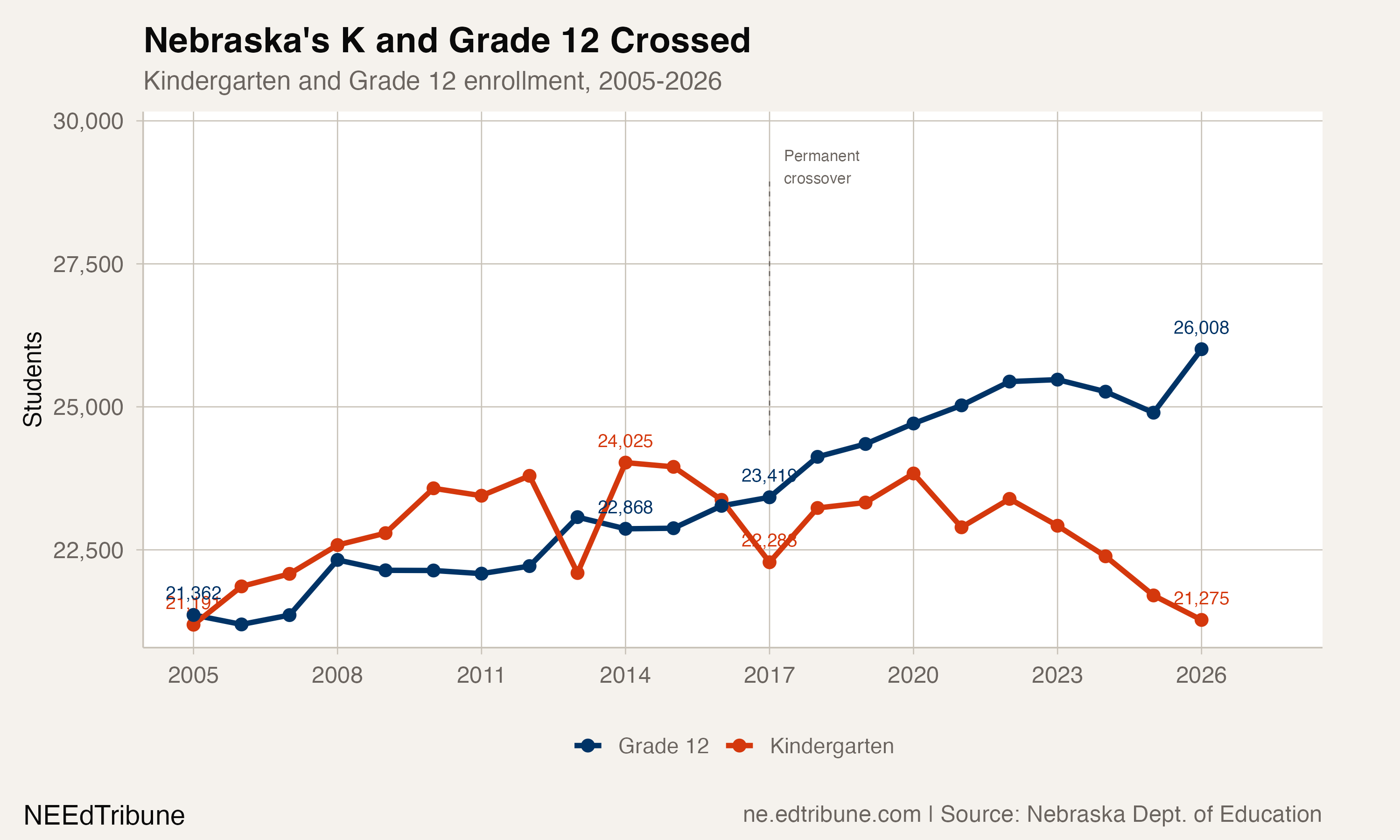
Nebraska enrolled 26,008 seniors in 2025-26, the most in at least 23 years. It enrolled 21,275 kindergartners, just 84 students above the 2005 trough of 21,191. The gap between them, 4,733 students, is the widest on record. When the largest senior class in state history graduated in spring 2026, the system behind it was measurably thinner at the bottom.
The inversion is not new. Grade 12 enrollment first exceeded kindergarten in 2013, briefly. By 2017, the crossover became permanent. But the 2025-26 data marks an acceleration: Grade 12 jumped 4.5% in a single year, one of the largest percentage gains in the dataset, while kindergarten extended its decline to a fourth consecutive year. The system is not merely top-heavy. It is becoming more top-heavy faster.
The staircase
In a stable enrollment system, each grade is roughly the same size. In Nebraska in 2025-26, the grade profile reads like a staircase: pre-K has 19,599 students, kindergarten has 21,275, and enrollment climbs with every step through Grade 12's 26,008. The youngest grades are the smallest. The oldest are the largest.
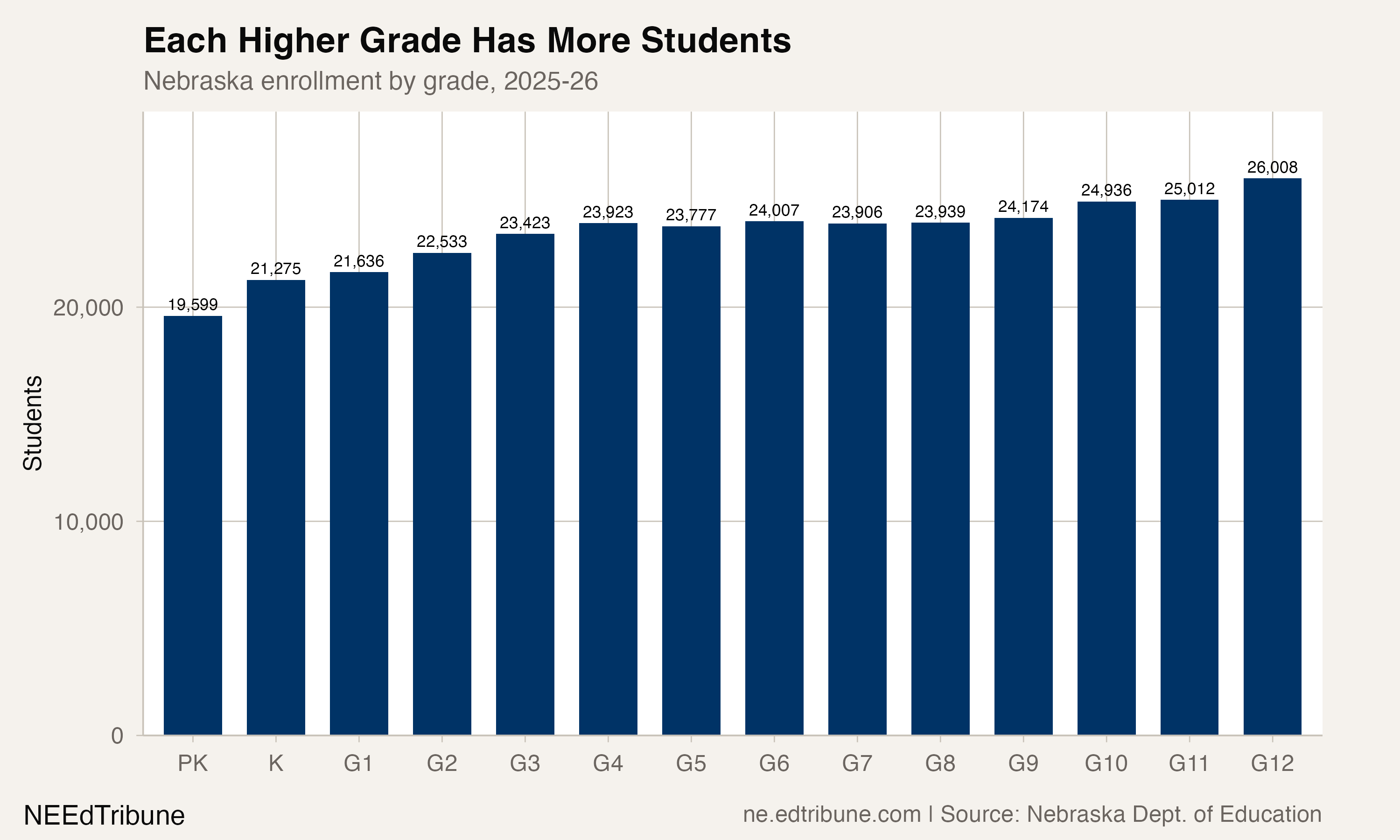
This shape is a time capsule of Nebraska's demographic history. The large senior class is the echo of the 2014 kindergarten cohort, which at 24,025 was the state's biggest kindergarten class on record. That cohort grew as it moved through the system, a pattern consistent across Nebraska's data. Grade 11-to-Grade 12 progression has averaged 104.6% over the past 20 years, meaning senior classes are routinely about 4.5% larger than the junior class that preceded them. The bump comes from private-school transfers, homeschoolers returning, and some students taking a fifth year to finish.
The 2026 senior class followed the pattern precisely. Its 104.4% progression rate from Grade 11 is almost identical to the historical average. The record was set not by unusual retention but by the sheer size of the upstream cohort.
A cohort biography
Tracking the class of 2026 from kindergarten to graduation reveals a remarkably stable journey. The 24,025 students who entered kindergarten in 2014 stayed within a narrow band through elementary school, then expanded in high school. By Grade 12, the cohort reached 26,008, a net gain of 1,983 students, or 8.3%, over 12 years.
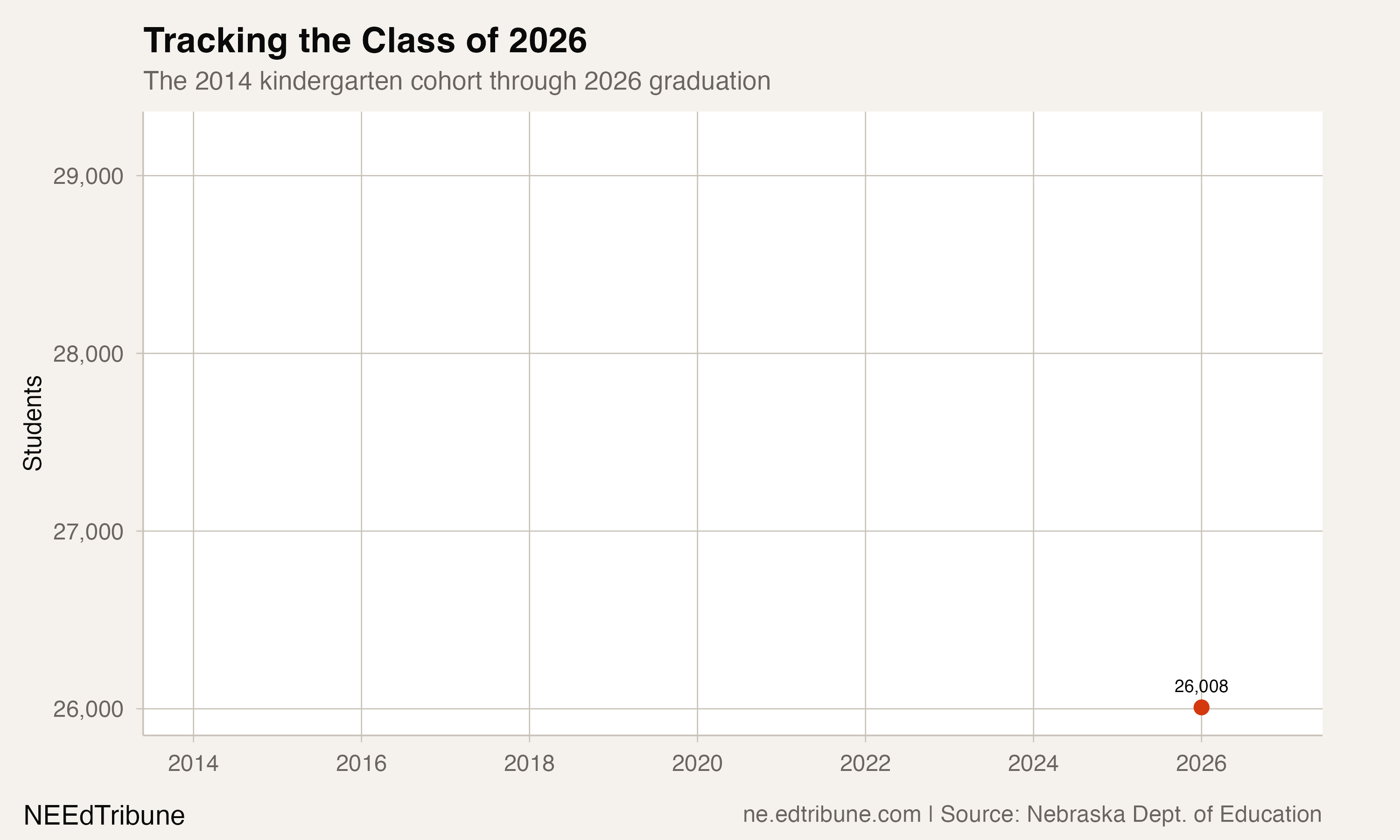
The high school expansion is the most significant feature. Between ninth grade and twelfth grade, the cohort gained students. Some of this reflects Nebraska's Enrollment Option Program, which allows students to transfer between public districts up to three times during their K-12 career. Some reflects students entering from private and home education, which are not captured in public school data until the student enrolls. And some portion reflects students who spend more than four years in high school before counting in the senior-year headcount.
What the bottom of the staircase means
The kindergarten trendline is the one that matters for planning. Kindergarten peaked at 24,025 in 2014 and has fallen 11.4% since, losing 2,750 students. The current streak of four consecutive annual declines tracks national birth rate patterns. Children entering kindergarten in fall 2025 were born in 2019 and 2020, years when fertility rates continued a multi-decade decline. Nebraska's fertility rate stood at 62.5 births per 1,000 women aged 15-44 as of the most recent federal data, part of a national pattern that accelerated during the pandemic.
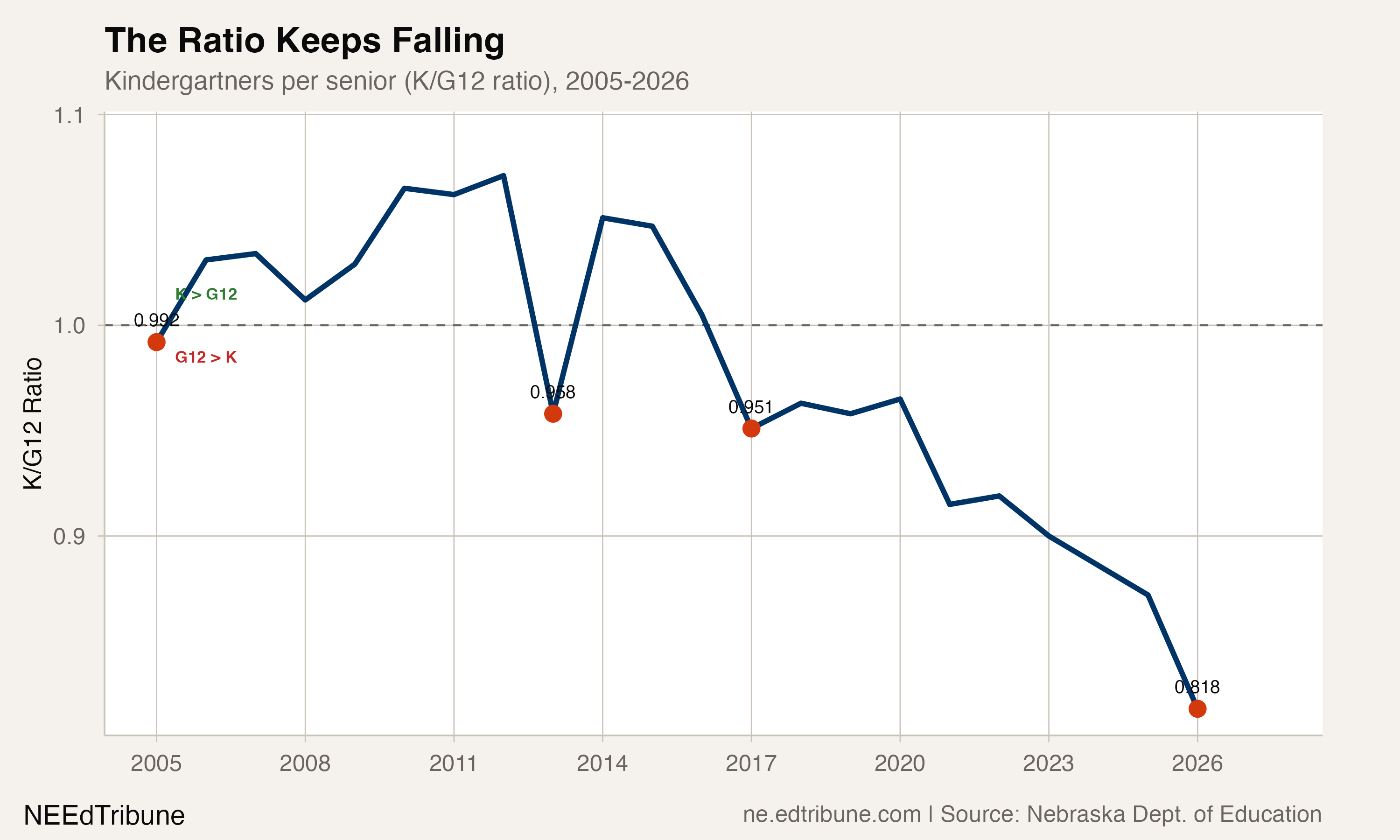
The K-to-G12 ratio captures the structural shift in a single number. In 2005, Nebraska had roughly 0.99 kindergartners for every senior. By 2017, the ratio fell well below 1.0, meaning more seniors than kindergartners. In 2025-26, it hit 0.818. For every 100 seniors graduating, only 82 kindergartners are entering. Unless that ratio reverses, each graduating class will be replaced by a smaller one.
The G12 surge in context
The 1,110-student jump in Grade 12 stands out against the previous two years. In 2023-24 and 2024-25, Grade 12 enrollment fell by 211 and 367 students respectively, a brief interruption in what had been steady growth. The 2025-26 rebound erased both years of losses and then some, pushing past the previous high set earlier in the decade.
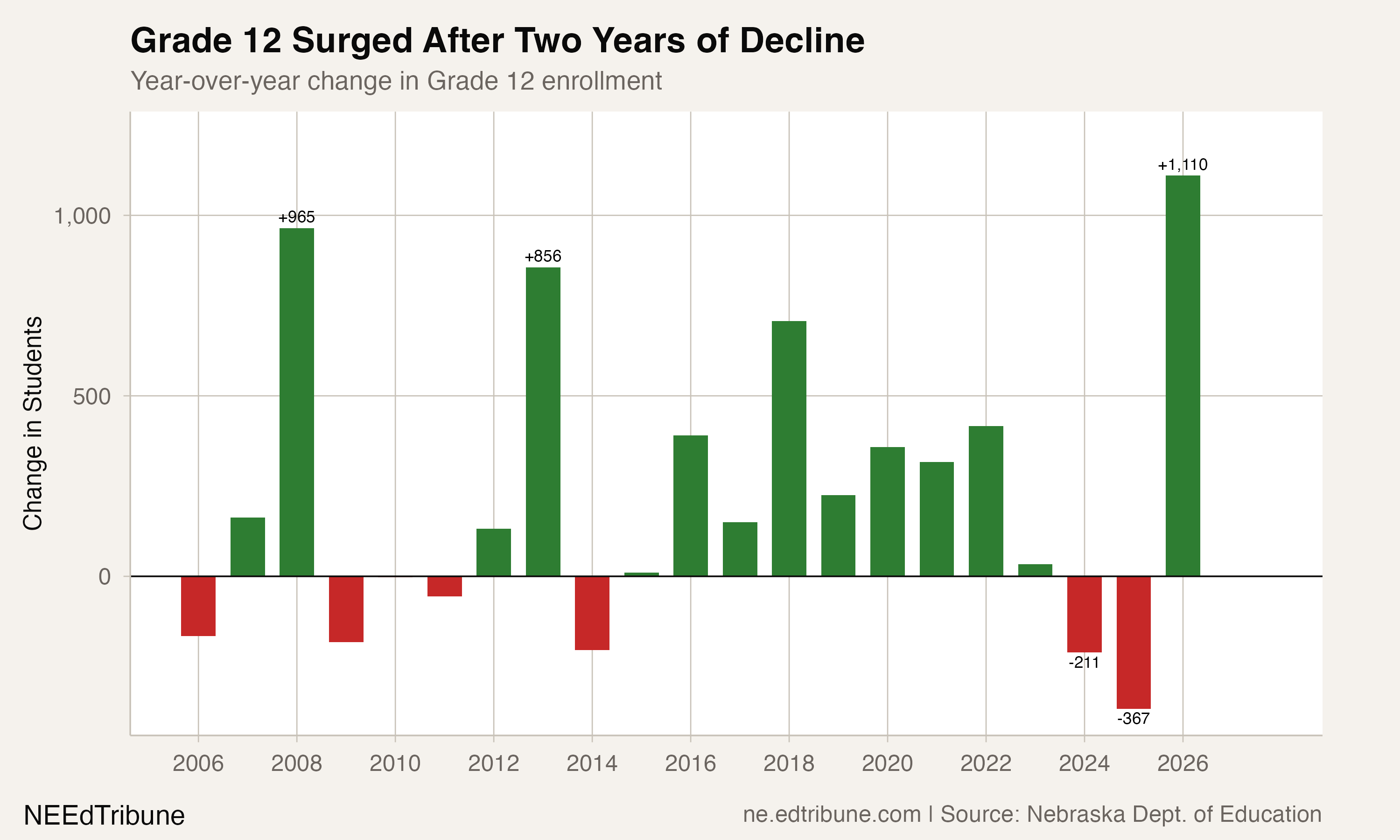
The two-year dip followed by a record surge is itself revealing. Smaller Grade 11 cohorts fed smaller senior classes in 2023-24 and 2024-25. Then the 2024-25 Grade 11 class, one of the largest in the dataset, was promoted to 12th grade and produced the record. The swings aren't random. They're what happens when big classes and small classes take turns graduating.
The funding geometry
Nebraska's school funding formula, TEEOSA, calculates district needs partly from enrollment counts. When a large senior class graduates and is replaced by a smaller kindergarten class, the net effect on total enrollment is negative. Nebraska's total enrollment fell by 1,988 students between 2024-25 and 2025-26, from 330,136 to 328,148, despite 15 years of growth before the pandemic.
The gap between what the elementary and high school ends of the building contribute to headcount is already narrowing. K-5 enrollment has fallen from 139,547 in 2014-15 to 136,567, while 9-12 enrollment climbed from 89,612 to 100,130 over the same period. The 49,935-student cushion that elementary grades once provided over high school grades has shrunk to 36,437.
"Districts with declining student population still have significant fixed costs because, unless enrollment drops dramatically, such districts still need teachers and support staff to instruct the remaining students." — OpenSky Policy Institute
That dynamic, well documented in Nebraska's rural districts, is beginning to apply to grade-level planning statewide. A school that staffed for 24,025 kindergartners a decade ago now serves 21,275.
After the class of 2026 walks
The staircase shape predicts its own unraveling. Every year, the largest class in the building graduates. Every year, the replacement class entering kindergarten is smaller than the one before it. Pre-K enrollment, at 19,599, sits below kindergarten and suggests no imminent reversal. The 2025-26 pre-K class has grown substantially from 5,698 in 2004-05, a more than threefold expansion driven by state investment in early childhood programs. But that expansion has not translated into larger kindergarten classes. It has broadened access to public pre-K without increasing the number of children who then enter kindergarten.
The question is not whether the pyramid will continue inverting. The data makes that arithmetic clear. The question is how fast. If kindergarten enrollment keeps falling, and if senior classes continue absorbing roughly 4.5% more students than the junior class that preceded them, the gap will keep widening. The class of 2026 is 26,008 strong. The kindergarten class that entered public school in fall 2025 numbers 21,275. If historical patterns hold and that cohort grows by the time it reaches 12th grade, the class of 2038 would still be far smaller than the class of 2026. The bottom of the staircase is already built.
Detailed code that reproduces the analysis and figures in this article is available exclusively to EdTribune subscribers.
Discussion
Sign in to join the discussion.
Loading comments...