Correction (2026-05-29): An earlier version of this article cited statewide Hispanic enrollment of 32,373 in 2005 and 78,959 in 2026, a 9.9% to 21.6% share shift, and 13 majority-Hispanic districts. The Nebraska Department of Education file we drew from pools public school districts with non-public and state-operated entities, and our data package was treating all of them as public school districts. The corrected statewide figures are about 30,700 Hispanic students in 2005 and 75,590 in 2026, a share rising from roughly 11% to 23%, with 10 majority-Hispanic districts of 100 or more students. District-level numbers for Grand Island, Schuyler, Lexington, South Sioux City, Fremont, Columbus, Crete, and Madison were not affected, and the article's central finding is unchanged. Thanks to a reader for flagging this.
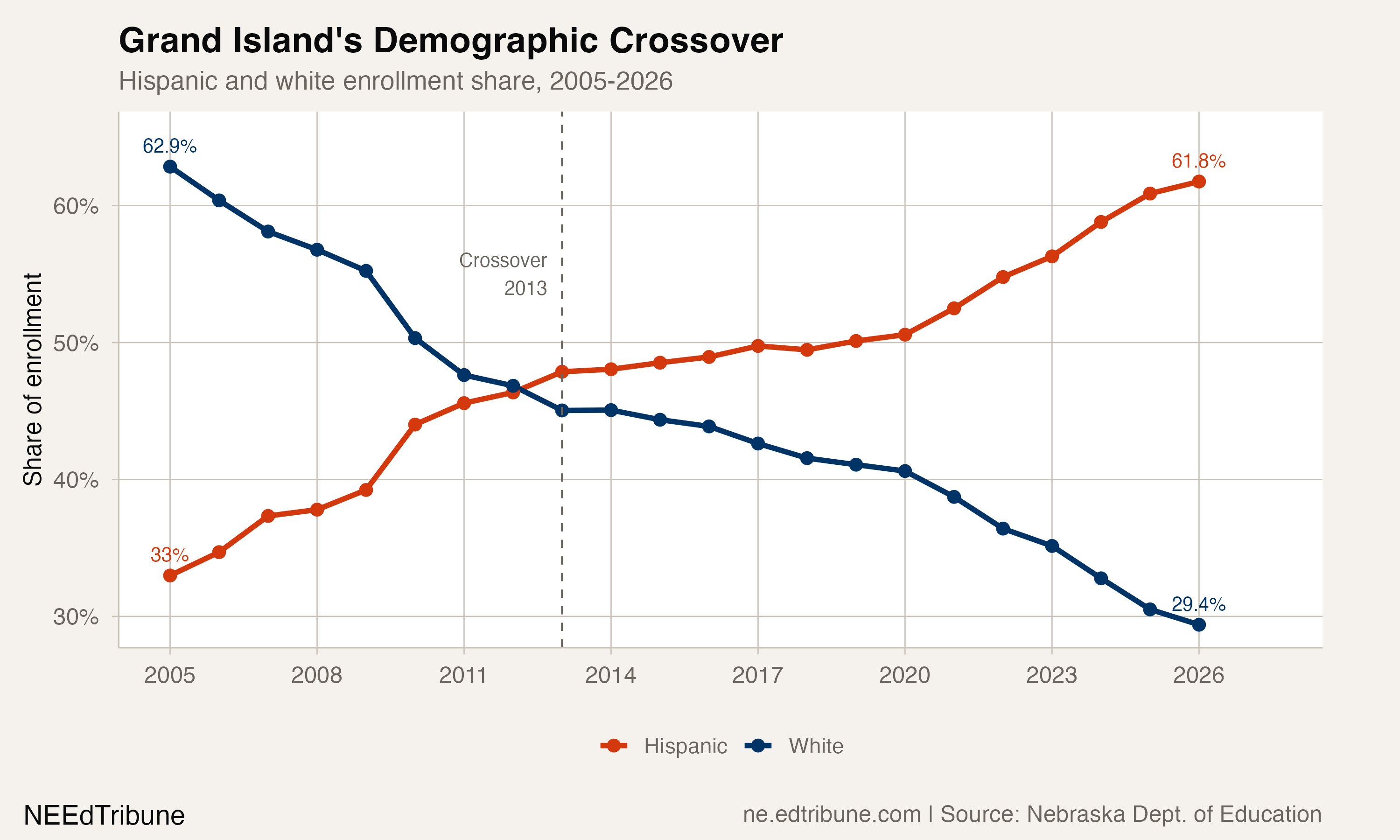
In 2005, white students outnumbered Hispanic students nearly two to one in Grand Island Public Schools↗ET. The district enrolled 5,072 white students and 2,662 Hispanic students, proportions that reflected the central Nebraska city's identity as an agricultural hub settled by German and Danish immigrants.
By 2026, those numbers have inverted. Grand Island enrolls 6,018 Hispanic students and 2,864 white students. Hispanic students now constitute 61.8% of Nebraska's sixth-largest district, a 28.8 percentage-point swing in 22 years. The crossover happened in 2013, and the gap has widened every year since.
Grand Island is not an outlier. It is the largest point on an arc of meatpacking and food-processing towns stretching across central and eastern Nebraska where the same transformation has played out, each town on its own timeline but driven by the same economic engine.
The corridor in 2026
Four districts along this corridor tell the story at different stages of the same process.
Schuyler Community Schools↗ET, home to a Cargill beef plant that employs 2,200 workers, enrolled 1,847 students in 2026. Of those, 1,625 are Hispanic, an 88.0% share. White enrollment has fallen to 143 students, or 7.7% of the district. In 2005, before a district consolidation expanded Schuyler's boundaries, the predecessor district was roughly half Hispanic and half white.
Lexington Public Schools↗ET, built around what was until January 2026 a Tyson beef processing plant, enrolled 3,161 students, 77.5% of them Hispanic. The district was already 73.2% Hispanic in 2005. White enrollment has dropped from 664 to 360 over that period, a 45.8% decline.
South Sioux City Community Schools↗ET, anchored by the Tyson Fresh Meats plant along the Missouri River, enrolled 3,910 students, 66.7% Hispanic. White students constitute 13.5% of enrollment, down from 41.9% in 2005.
Grand Island, by far the largest of the four at 9,744 students, has seen the most gradual shift. Its Hispanic share climbed from 33.0% to 61.8% over 22 years, roughly 1.3 percentage points per year.
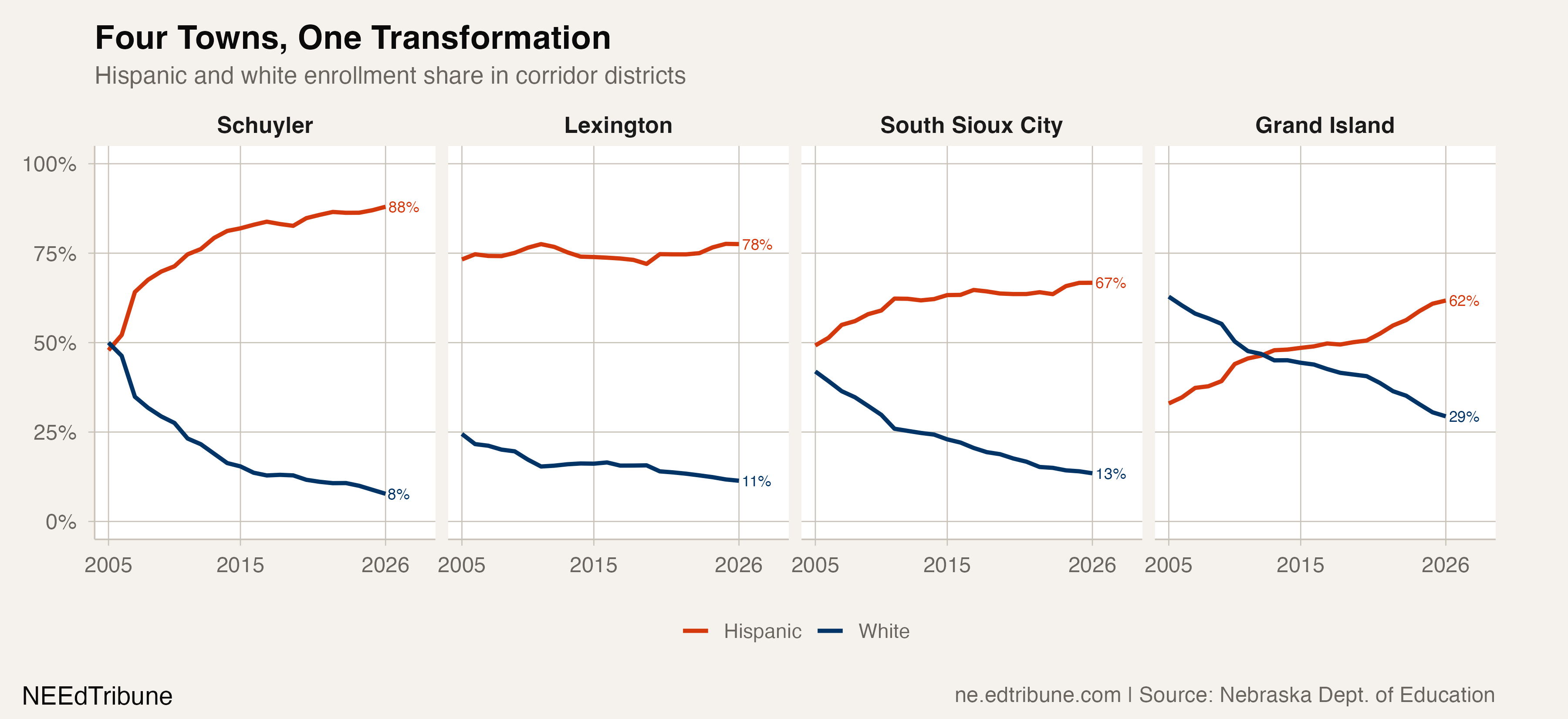
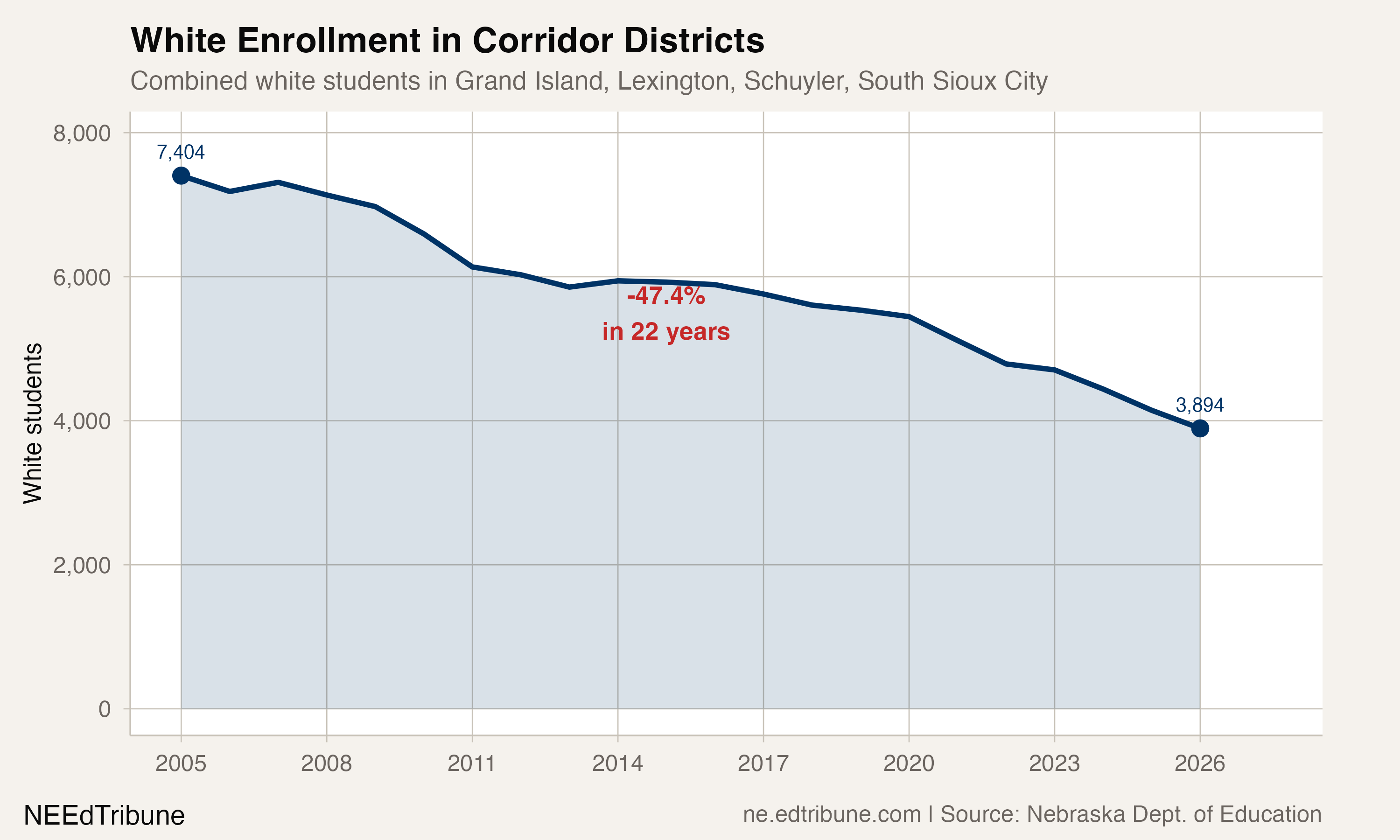
Combined, these four districts enrolled 12,703 Hispanic students in 2026, up from 6,562 in 2005. Their combined white enrollment fell from 7,404 to 3,894, a 47.4% decline.
How meatpacking reshaped the map
The transformation traces to a single economic decision repeated across rural Nebraska in the late 1980s and 1990s. When IBP (later acquired by Tyson) opened a beef processing plant in Lexington on November 8, 1990, it was the first of a wave of large meatpacking facilities sited in small Nebraska cities that depended on immigrant labor.
Lexington had been shrinking. The 1980s farm crisis cost the city 940 jobs when Sperry-New Holland closed its combine plant in 1985. Governor Kay Orr, according to the Nebraska State Historical Society, described the mood at the time:
"We were little by little dying, by inches."
The IBP plant promised 1,200 to 1,300 jobs and a $24 million annual payroll. It delivered those jobs, but filling them required recruiting workers from Texas border communities and, increasingly, directly from Mexico and Central America. Lexington's population surged 52% in the 1990s after declining 6.2% in the 1980s.
The same pattern repeated in Schuyler (Cargill), South Sioux City (Tyson Fresh Meats), and Grand Island (JBS, which employs 3,500 at its plant). Each plant created a gravitational pull for immigrant families. The school enrollment data tracks the generational result: the children and now grandchildren of those original workers filling classrooms in numbers that dwarf the remaining white student population.
The second wave
The transformation is not confined to the original four corridor towns. A second tier of Nebraska food-processing communities has crossed or is approaching the majority-Hispanic threshold.
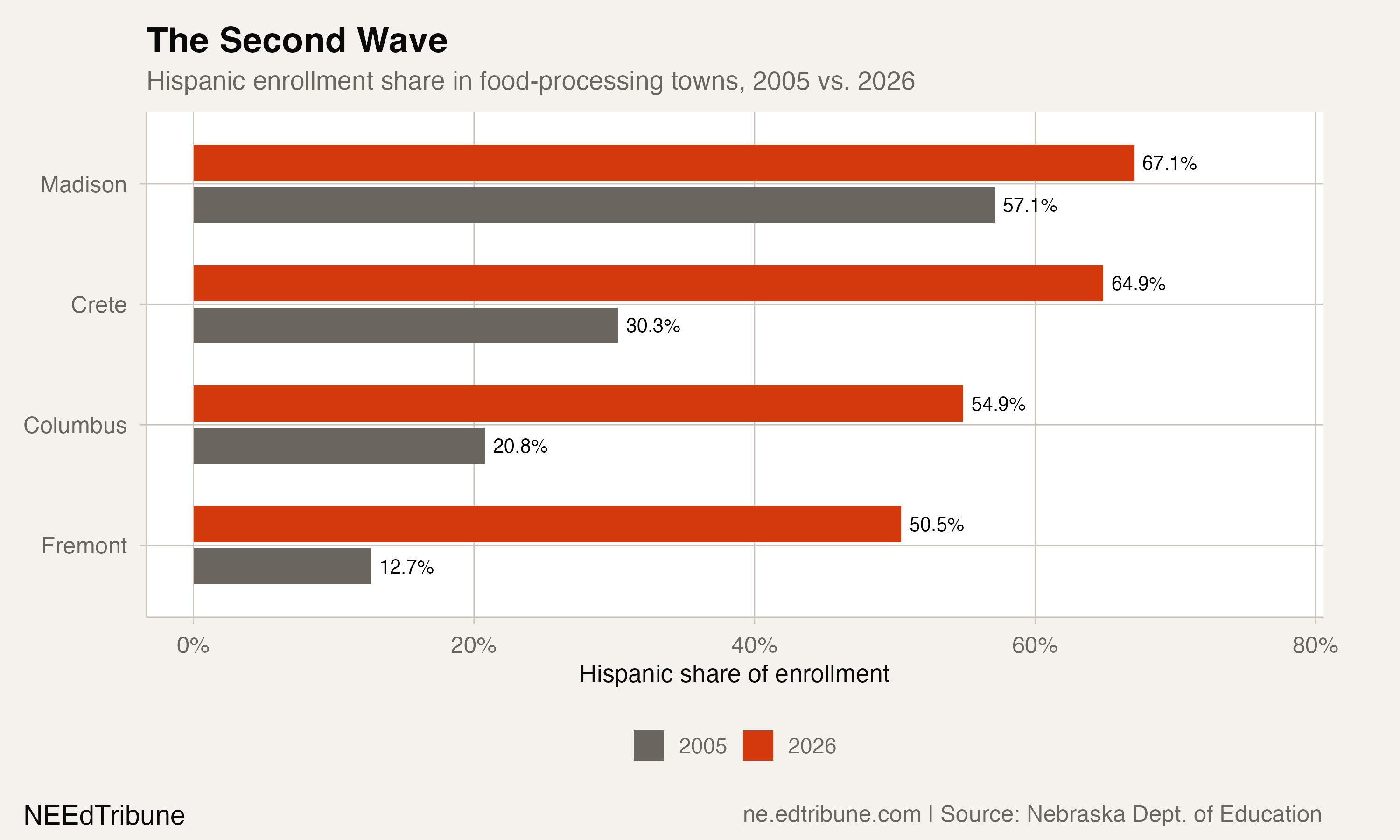
Fremont Public Schools↗ET, where Hormel processes 10,000 hogs daily, went from 12.7% Hispanic in 2005 to 50.5% in 2026, crossing the majority line for the first time. That shift is notable because Fremont voted in 2010 to ban renting property to undocumented immigrants, an ordinance aimed at the same meatpacking-driven demographic change the enrollment data now reflects as irreversible.
Columbus Public Schools↗ET went from 20.8% to 54.9% Hispanic. Crete Public Schools↗ET went from 30.3% to 64.9%. Madison, already 57.1% Hispanic in 2005, reached 67.1%.
Nebraska now has 10 districts with enrollment above 100 students where Hispanic students constitute a majority. The number of districts where Hispanic students exceed 20% of enrollment has grown sharply, from 20 in 2005 to 35 in 2026.
A statewide shift powered by local concentration
Statewide, Nebraska's Hispanic enrollment share has more than doubled, climbing from about 10.8% in 2005 to 23.0% in 2026. In absolute terms, Hispanic enrollment grew from 30,683 to 75,590, a gain of 44,907 students, or 146.4%.
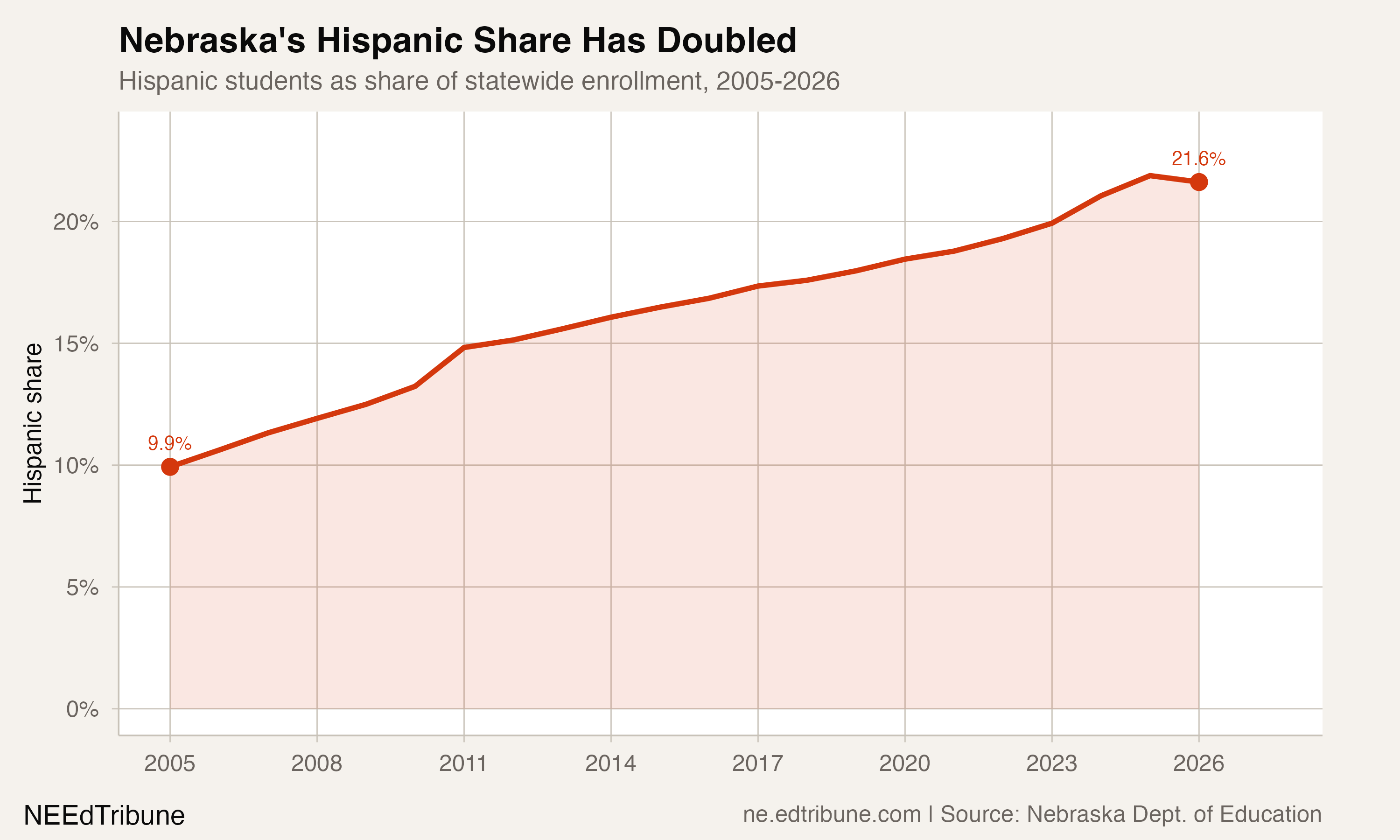
The corridor's share of that statewide Hispanic total has actually declined, from 21.4% in 2005 to 16.8% in 2026. The arithmetic explains an important dynamic: Hispanic population growth has dispersed well beyond the original meatpacking towns. Omaha, Lincoln, and the second-wave processing communities now collectively enroll more Hispanic students than the original corridor. The corridor started the transformation; the rest of the state absorbed and amplified it.
The Lexington test case
The January 2026 closure of Tyson's Lexington plant, which employed roughly 3,200 workers processing nearly 5,000 cattle per day, represented 4.8% of total U.S. beef slaughter capacity. A University of Nebraska-Lincoln analysis estimated statewide economic losses of $3.3 billion annually and more than 7,000 jobs lost when ripple effects are included.
The school district faces the most immediate uncertainty. Lexington's superintendent, Dr. John Hakonson, told Cowboy State Daily that an estimated 50% of students have one or both parents who worked at the plant:
"The plant's been here for 35 years, so yeah, it's multigenerational with its impact. We have grandparents that are in some of the houses, so I think there's a pull to try and stay here."
The worst-case scenario is losing roughly half the district's 3,200 students. Best-case estimates put the loss at a few hundred, returning the district to enrollment levels from a decade ago. Nebraska's funding formula provides a one-year buffer: October enrollment counts determine the following year's budget, so 2026-27 funding remains secure at current levels regardless of how many families leave.
The 2026 enrollment data in this analysis reflects counts taken before the plant's January 20 closure. The full impact will not appear until the 2027 data.
Roots vs. paychecks
Enrollment data tracks where students are. It does not distinguish between families who arrived for meatpacking work, those who followed relatives already established in a community, and those born in Nebraska to parents who came decades ago. By 2026, the corridor's Hispanic enrollment is substantially second- and third-generation. The meatpacking plants created the initial migration pathway, but the communities these families built, the churches, businesses, and family networks, are what sustain enrollment independent of any single employer.
Lexington will test that proposition directly. If the corridor's demographic transformation is truly employer-dependent, the plant closure should produce a visible enrollment decline in 2027. If the community roots run deeper than the paycheck, the impact may be smaller than the worst-case projections suggest.
Detailed code that reproduces the analysis and figures in this article is available exclusively to EdTribune subscribers.
Discussion
Sign in to join the discussion.
Loading comments...