Correction (2026-05-29): An earlier version of this article said Nebraska's statewide enrollment grew 3.3% from 2016 to 2026. The Nebraska Department of Education file we drew from pools public school districts with non-public and state-operated entities, and our data package was treating all of them as public school districts. The corrected statewide growth over the same period is closer to 4%. North Platte's district-level enrollment, the seven-year decline streak, peer-district comparisons, race shares, grade-band pipeline, and Osgood Elementary details are all unchanged. Thanks to a reader for flagging this.
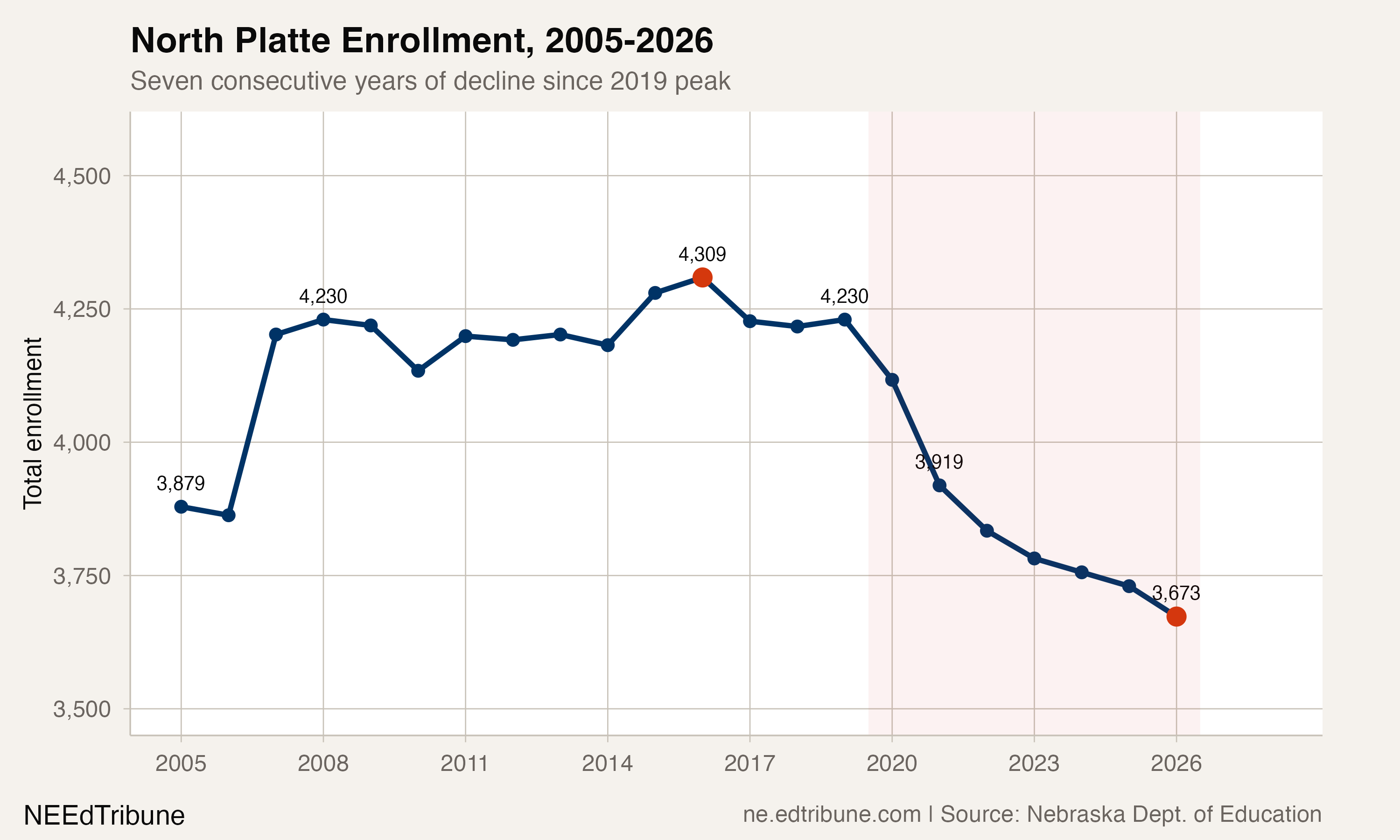
No other mid-size district in Nebraska has declined for as long as North Platte↗ET. The Lincoln County seat has lost students in seven consecutive years, a streak that began before COVID and shows no sign of ending. From a peak of 4,309 in 2015-16, enrollment has fallen to 3,673 in 2025-26, a loss of 636 students, or 14.8%. That is not a rounding error. It is one in seven students gone.
The decline stands out because it is happening in isolation. Nebraska's statewide enrollment grew roughly 4% over the same period. Every comparable western and central Nebraska district held steady or grew. North Platte dropped five spots in the state's size ranking, from 11th to 16th, and the district is now auctioning off an elementary school it can no longer justify heating.
The streak
North Platte's enrollment was stable for a decade before the slide began. From 2007 to 2016, the district hovered in a narrow band between 4,182 and 4,309, never straying far from 4,200. Then 2016-17 brought a loss of 82 students, and a brief recovery in 2018-19 pushed enrollment back to 4,230. That was the last time the number moved in the right direction.
COVID hit North Platte harder than many Nebraska districts. The district lost 113 students in 2019-20 and another 198 in 2020-21, a combined 7.4% drop in two years. But the more telling pattern is what happened afterward. Where other districts stabilized or recovered, North Platte kept losing: 85 students in 2021-22, 52 in 2022-23, 26 in each of the next two years, and then 57 in 2025-26. The losses slowed, but they never stopped.
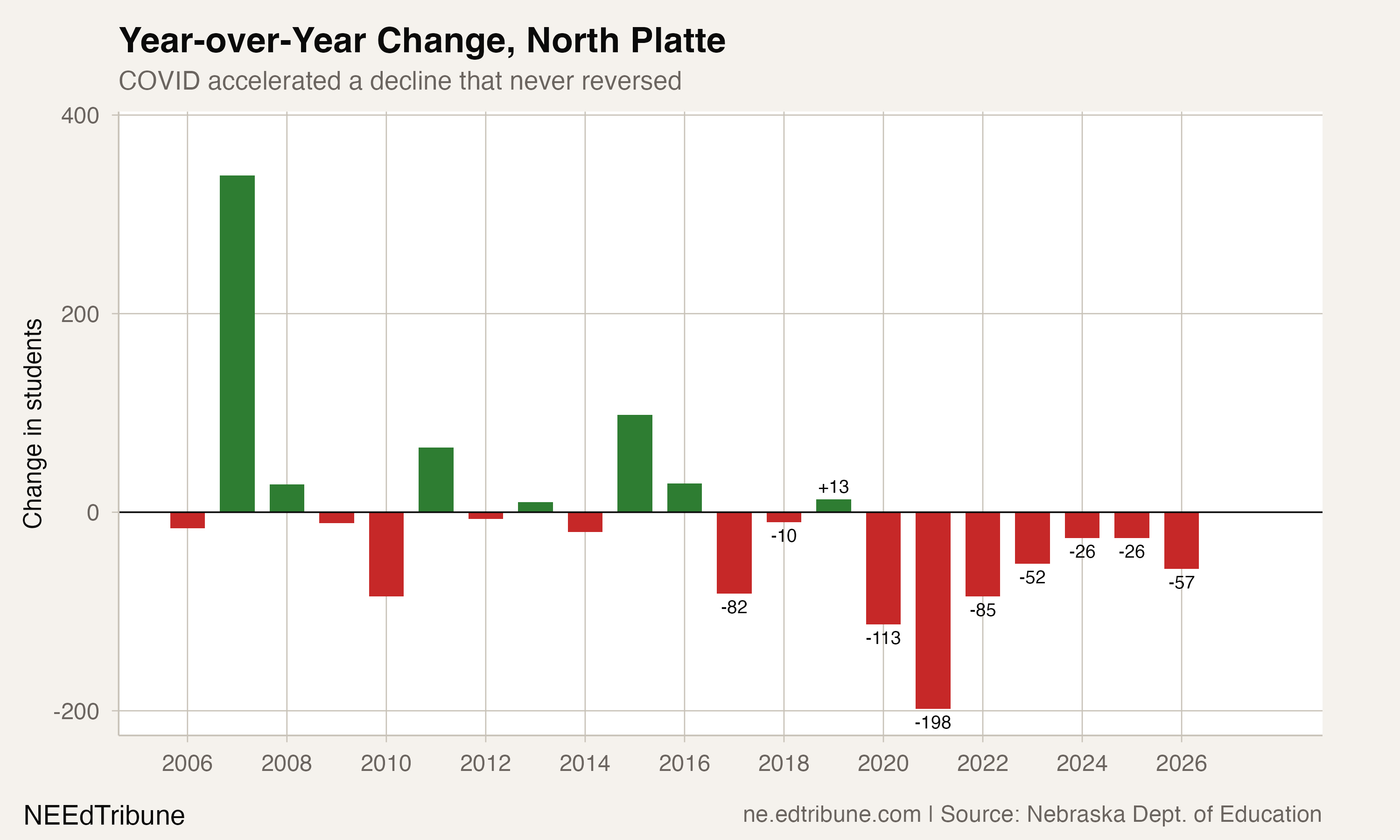
The seven-year streak is the longest active decline among any Nebraska district with at least 2,000 students. The next longest belongs to Millard, at four years, a suburban Omaha district facing an entirely different set of pressures.
Alone among peers
What makes North Platte's slide unusual is that no peer district shares it. Kearney↗ET, 150 miles to the east, grew 10.2% over the same period. Lexington↗ET, a meatpacking hub 100 miles east, grew 6.0%. Even Hastings↗ET and Scottsbluff↗ET, neither of which is a growth magnet, each added students and finished 2025-26 within 1% of their 2016 enrollment.
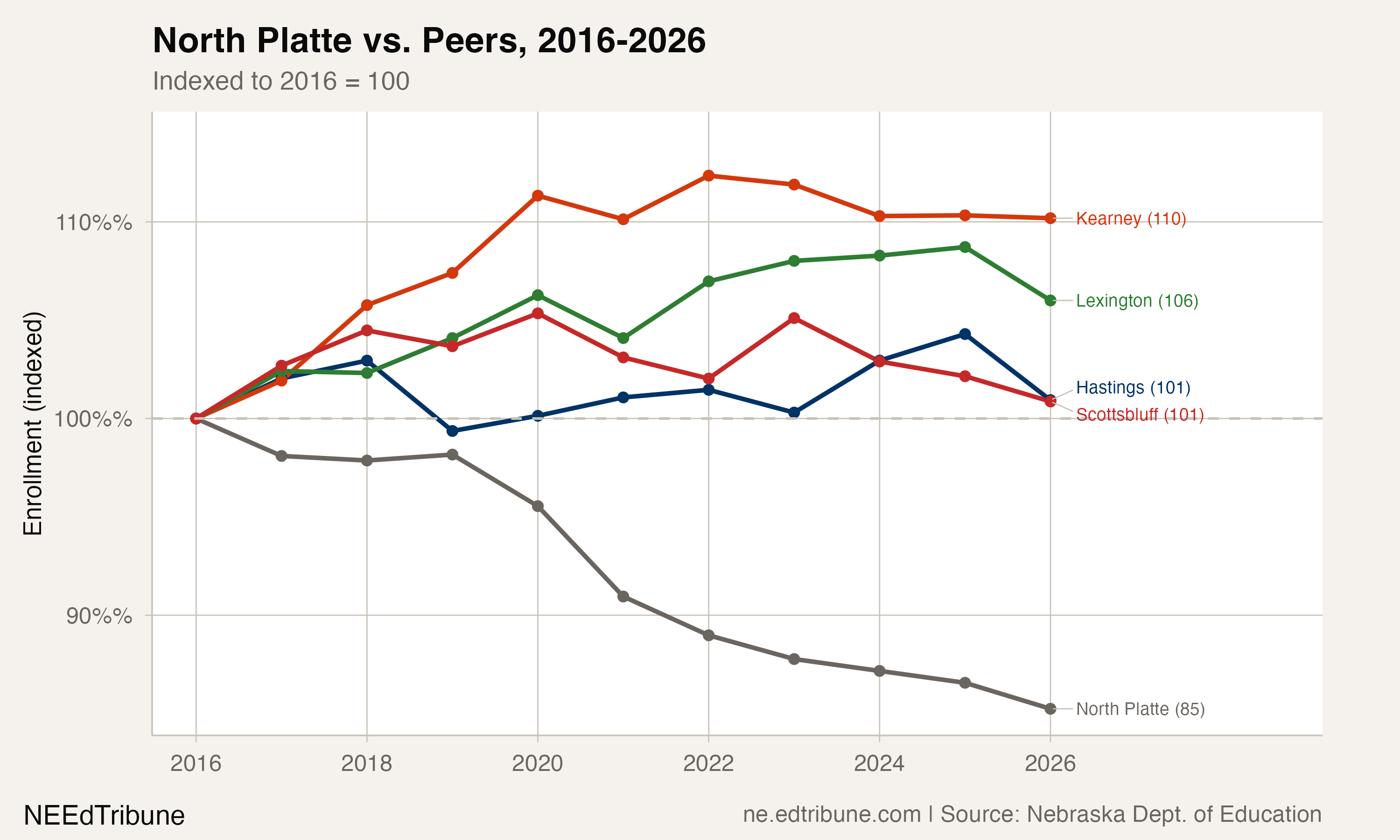
Indexed to their 2016 enrollment, all four peers sit between 101 and 110 in 2025-26. North Platte sits at 85. The gap between North Platte and its nearest peer is 16 percentage points, a divergence that has widened every year since 2019.
Kearney and Lexington have both benefited from meatpacking and food processing employment that draws immigrant families with school-age children. North Platte's economy is anchored by Union Pacific's Bailey Yard, the world's largest rail classification yard, which employs highly skilled workers but does not generate the same volume of family in-migration.
The housing bottleneck
North Platte's population has been shrinking alongside its schools. Lincoln County lost 1,309 residents between 2020 and 2023, the largest absolute decline among western Nebraska counties. Mayor Brandon Kelliher put the stakes bluntly:
"If we don't end it in another 50 years, we might not be here. It'll just be a railroad station." -- Nebraska News Service, May 2024
One contributing factor is a housing stock that cannot absorb new families even when jobs are available. Fifty-five percent of North Platte's housing was built before 1970. Nebraska Public Media reported that roughly 40 homes were on the market in the city at any given time, less than a third of the 140 to 150 that would constitute a healthy inventory.
"Even with competitive wages, we're unable to get people to move here...because they have nowhere to live." -- Vince Dugan, Trego-Dugan Aviation, Nebraska Public Media
Gary Person, president of the North Platte Area Chamber of Commerce, called the inventory "ridiculously low for a community our size". Housing constrains enrollment because families that might otherwise relocate for work cannot find a place to live, and young adults who leave for college have no starter homes to return to.
A building with no students
The enrollment loss has made physical infrastructure redundant. Osgood Elementary, a single-track K-5 school built in 1960 and renovated in 2004, has not held classes since the 2018-19 school year. Superintendent Todd Rhodes told the school board in November 2024 that the neighborhood feeding the school had aged out:
"The neighborhood that really fed into Osgood was Indian Hills, right to the south of the school. Many of the residents are older now and don't have children anymore." -- Dr. Todd Rhodes, Superintendent, KNOP News 2, Nov. 2024
In December 2024, the board voted to auction the building. Rhodes noted that even after removing Osgood, the district's seven remaining elementary schools had 545 open seats. The middle school had 290 open seats. The high school, built for 1,600, enrolled roughly 1,140. Across the district, more than 1,200 seats sit empty.
Who left
The decline is overwhelmingly concentrated in white enrollment. White students fell from 3,435 to 2,615 between 2016 and 2026, a loss of 820, or 23.9%. That exceeds the district's total enrollment loss because Hispanic enrollment partially offset it, rising from 629 to 721 over the same period, a 14.6% gain. Black enrollment also grew, from 53 to 127.
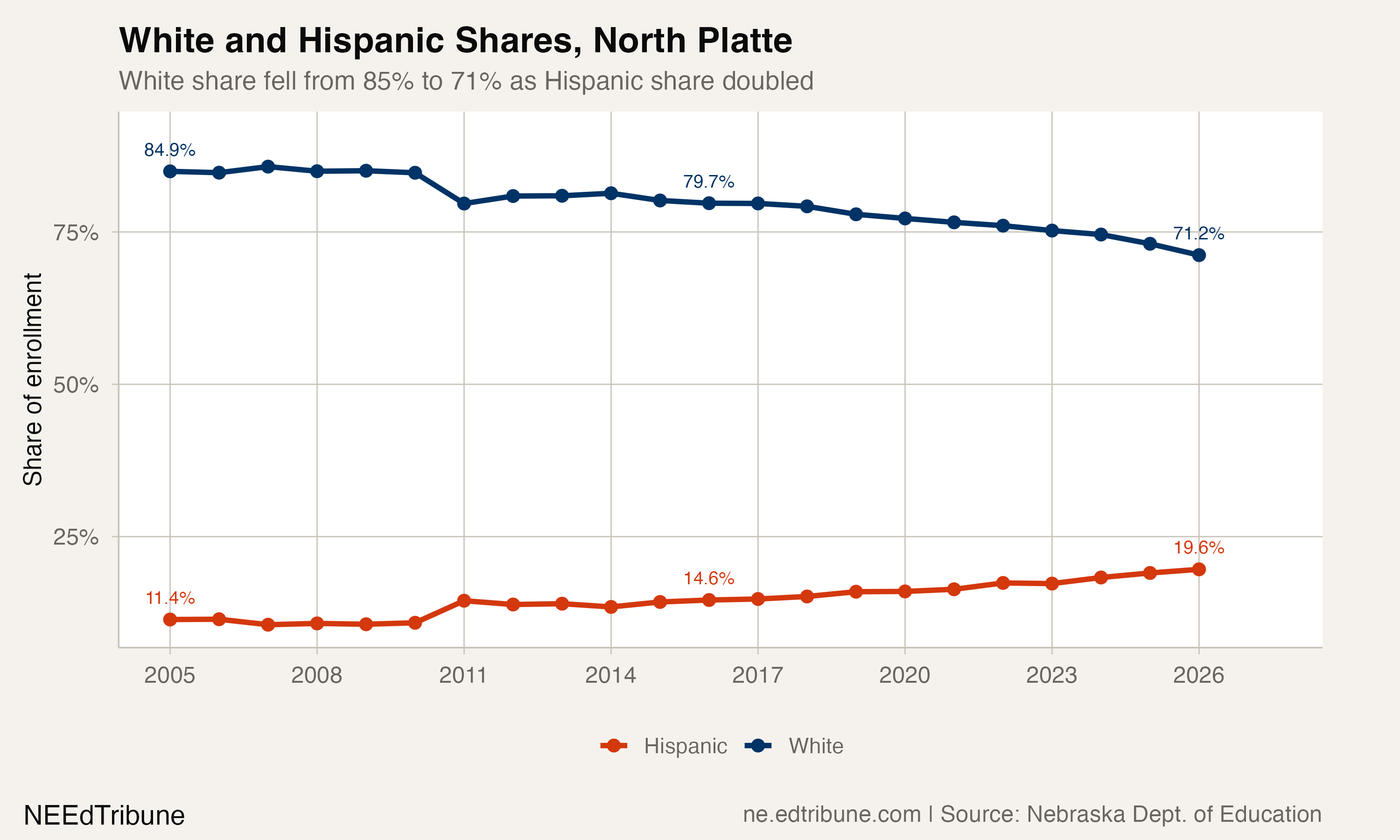
White students made up 84.9% of North Platte's enrollment in 2005. By 2026, that share had fallen to 71.2%. Hispanic students rose from 11.4% to 19.6% over the same span. North Platte is becoming more diverse, but it is doing so by losing white students faster than it gains students of color. The district's total non-white enrollment grew by 184 students over the decade; white enrollment shrank by 820. That arithmetic means diversification here is a byproduct of departure, not arrival.
The pipeline narrows
The grade-level data shows that the decline wave is still working its way through the system. Kindergarten enrollment fell from 355 in 2016 to 243 in 2026, a 31.5% drop. The PK-3 band, which feeds into higher grades over time, declined 16.5% from 1,545 to 1,290. The 4-8 band lost 19.1%, falling from 1,552 to 1,256.
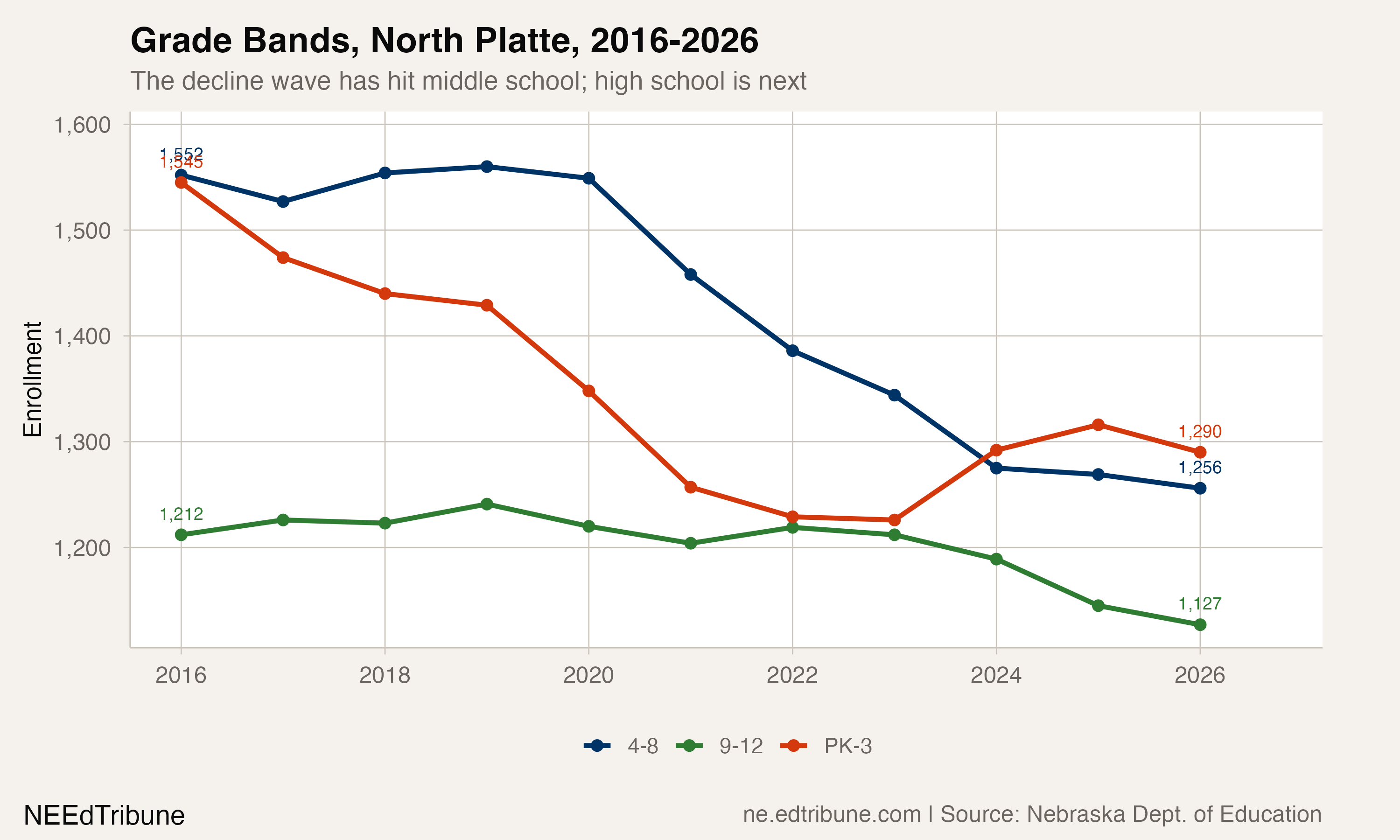
High school enrollment has been more resilient so far. The 9-12 band fell 7.0% over the decade, from 1,212 to 1,127. But those high school students entered the pipeline when kindergarten classes were still above 300. The smaller cohorts now in elementary school will reach high school by 2030-31. When they do, the high school will likely see the same contraction the lower grades have already absorbed.
Fiscal pressure from two directions
Declining enrollment feeds directly into state funding. Under Nebraska's TEEOSA formula, aid is calculated partly on student headcounts. Acting Superintendent Damon McDonald told the board in early 2025 that state aid had been "certified at $2 million less than current year." The district also faced a nearly $500,000 correction tied to lower-than-expected actual enrollment.
At the same time, the district's fixed costs do not shrink proportionally. A school built for 1,600 students costs nearly as much to heat and staff when it serves 1,140. The Osgood auction will save roughly $30,000 a year in utilities and custodial costs, a small figure against the larger budget gap.
What to watch
North Platte's kindergarten enrollment in 2025-26 was 243, barely two-thirds of what it was a decade ago. If that number does not recover, the 2025-26 enrollment of 3,673 begins to look like a waypoint, not a floor. The district could fall below 3,500 within two to three years as the smaller elementary cohorts advance through the system and larger graduating classes exit.
The open question is whether North Platte can break the link between population loss and enrollment loss. Kearney and Lexington demonstrate that western Nebraska districts can grow, but both have drawn heavily on immigrant labor markets tied to food processing. North Platte's economy is built around rail logistics and regional services, sectors that have not historically attracted the same family in-migration. Until either the housing stock expands or the employment base diversifies enough to bring families in, the seven-year slide has no obvious end point.
Detailed code that reproduces the analysis and figures in this article is available exclusively to EdTribune subscribers.
Discussion
Sign in to join the discussion.
Loading comments...