Correction (2026-05-29): An earlier version of this article said three suburbs accounted for 43.9% of statewide enrollment growth (now 39.6%), that they enrolled 1.9% of the state's students in 2005 and 6.4% in 2026 (now 2.2% and 7.2%), that Nebraska added 39,240 students statewide for a 12.0% increase (now 43,549 and 15.3%), and that 310 of 422 districts enroll fewer than 500 students with 196 of 384 long-tracked districts shrinking (now 151 of 244 and 103 of 227). The Nebraska Department of Education file we drew from pools public school districts with non-public and state-operated entities, and our data package was treating all of them as public school districts. The corrected statewide race shares for 2026 are 60.8% white and 23.0% Hispanic. The three districts in this piece (Bennington, Gretna, Elkhorn), the 21-year unbroken growth streak, the individual district enrollment counts and growth rates (659% / 266% / 219%), and the 2026 year-over-year gains are unchanged. Thanks to a reader for flagging this.
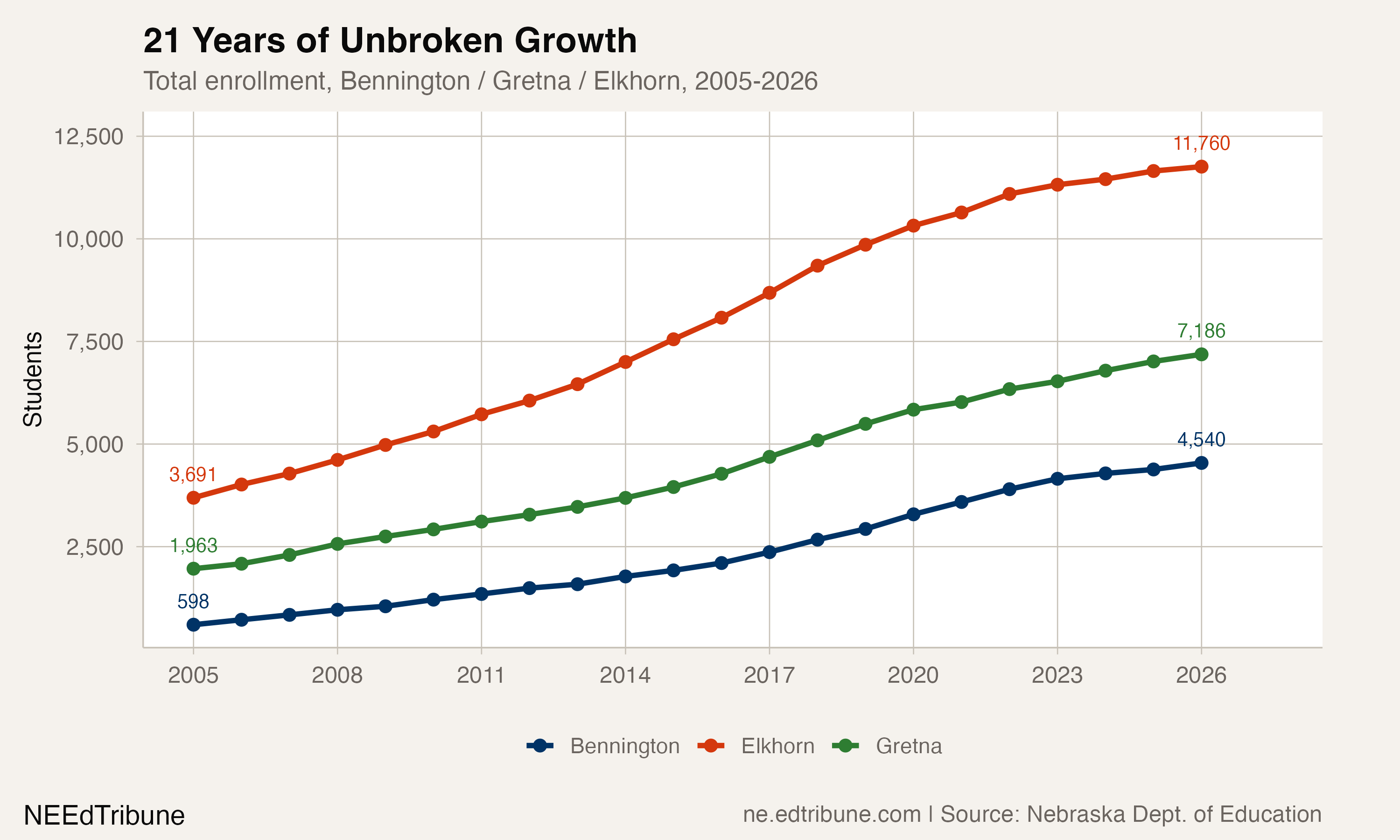
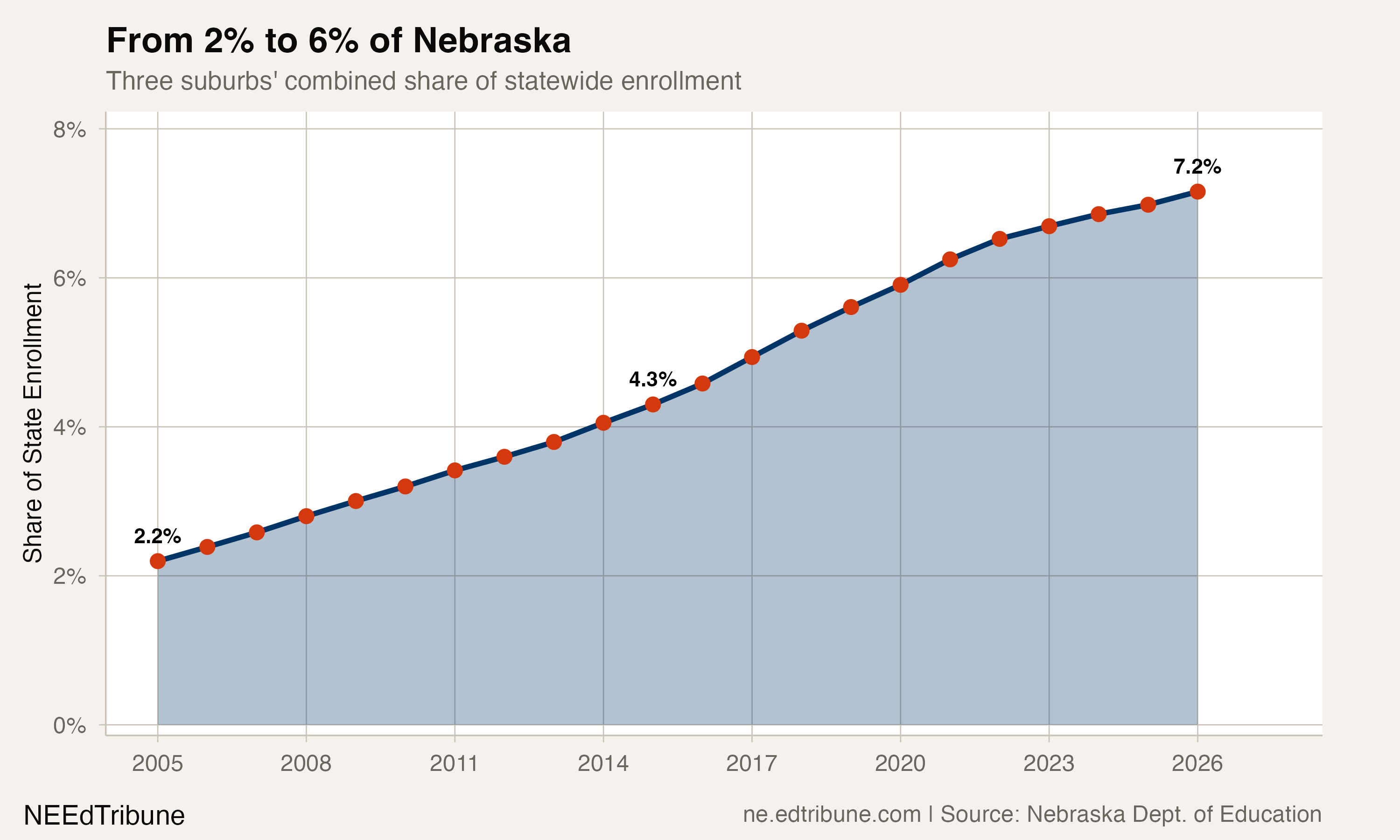
Of 227 Nebraska school districts with complete enrollment records going back to 2005, exactly three have grown in every single year. All three sit in the ring suburbs northwest of Omaha. Together, Bennington↗ET, Gretna↗ET, and Elkhorn↗ET have added 17,234 students since 2005, accounting for 39.6% of Nebraska's total statewide enrollment growth over that span. They started the period enrolling 2.2% of the state's students. They now enroll 7.2%.
That 21-year unbroken streak is not just rare. It is unique. No other district in Nebraska has even 19 growth years out of 21. The next-best record belongs to Lincoln↗ET, at 18. In a state where 151 of 244 districts enroll fewer than 500 students and 103 of 227 long-tracked districts have shrunk since 2005, these three have been on a different path.
The scale of the divergence
Bennington has grown 659%, from 598 students to 4,540. Gretna has grown 266%, from 1,963 to 7,186. Elkhorn has grown 219%, from 3,691 to 11,760. Indexed to 2005, the three suburbs combined stand at 376 while Nebraska statewide sits at 112.
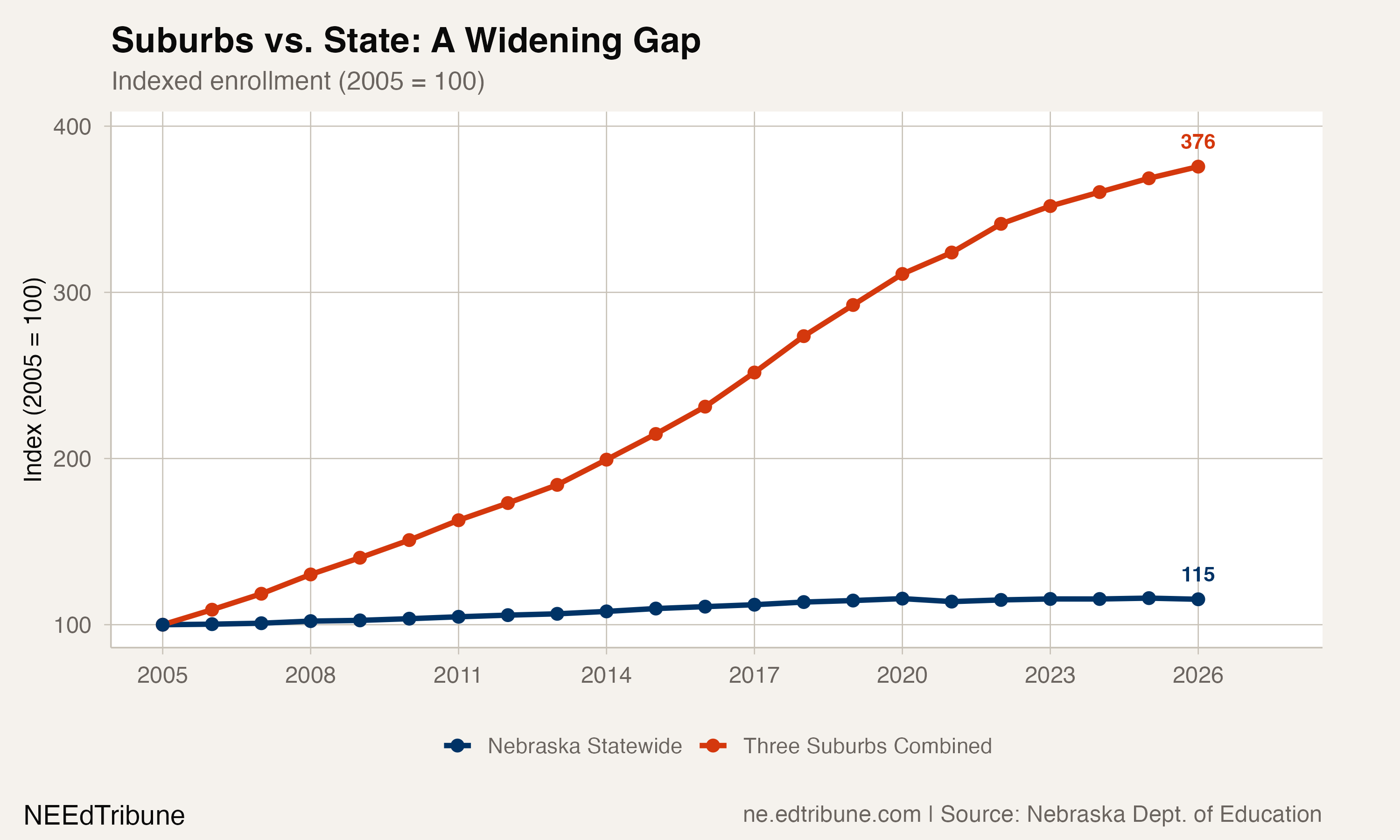
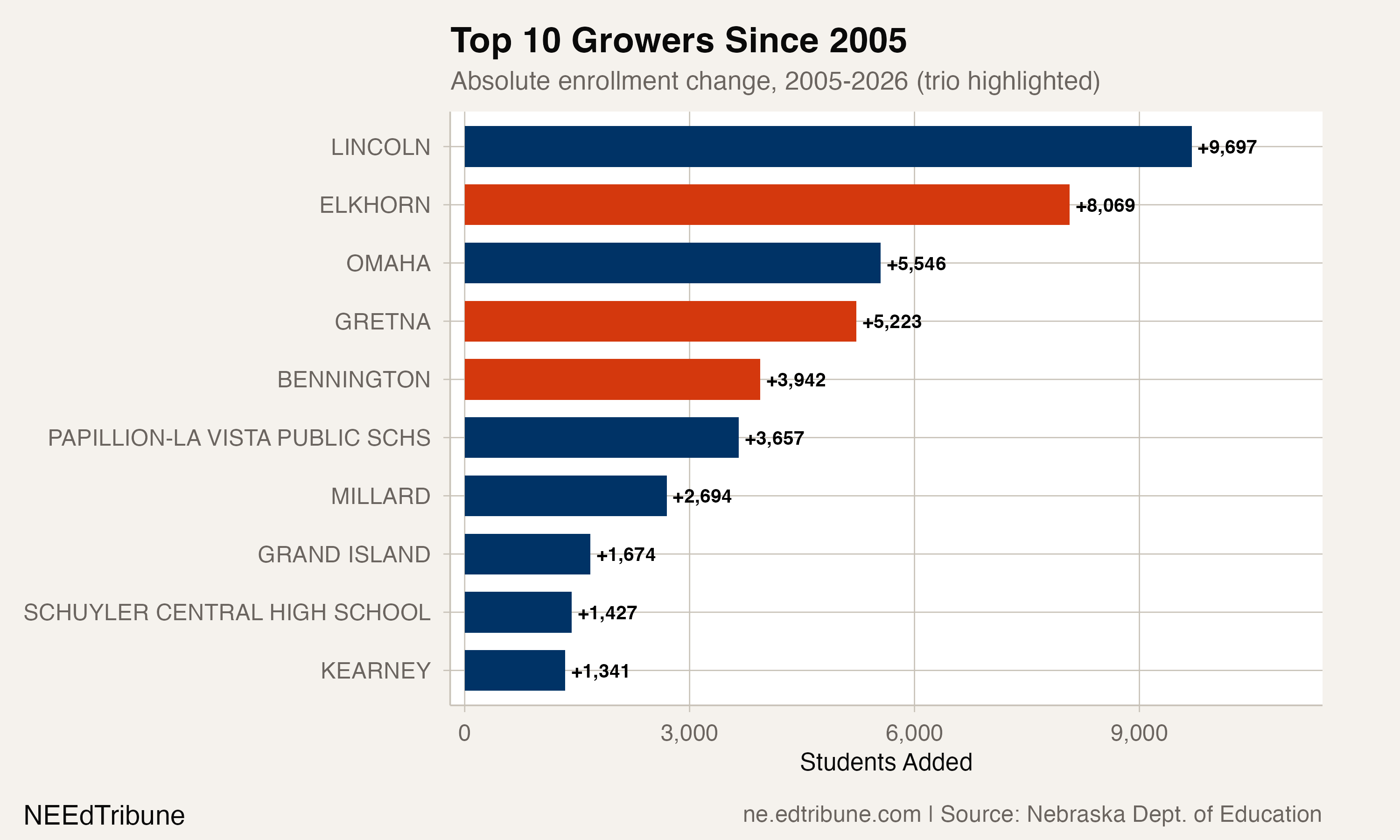
The arithmetic is stark. Nebraska added 43,549 students statewide between 2005 and 2026, a 15.3% increase. Three districts, representing a tiny sliver of the state's geography, captured nearly 40% of that growth. Lincoln, the state's second-largest district, added 9,697 students over the same period. Omaha↗ET added 5,546. Neither matched these three suburbs combined.
Their rising share of state enrollment has not paused. In 2005, the three districts combined enrolled 6,252 students, 2.2% of the state total. By 2026, that share stood at 7.2%. About one in every 14 Nebraska students now attends school in Bennington, Gretna, or Elkhorn.
A deceleration, not a stop
The streak is intact, but the velocity has changed. All three districts are growing at roughly half the pace they maintained between 2015 and 2020.
Elkhorn averaged 554 new students per year during that mid-decade surge, peaking at 662 in 2018. Since 2020, it has averaged 240. Gretna went from 377 per year to 225. Bennington dropped from 273 per year to 209. In 2026, the three combined added 439 students, down from a peak of 1,368 in 2018.
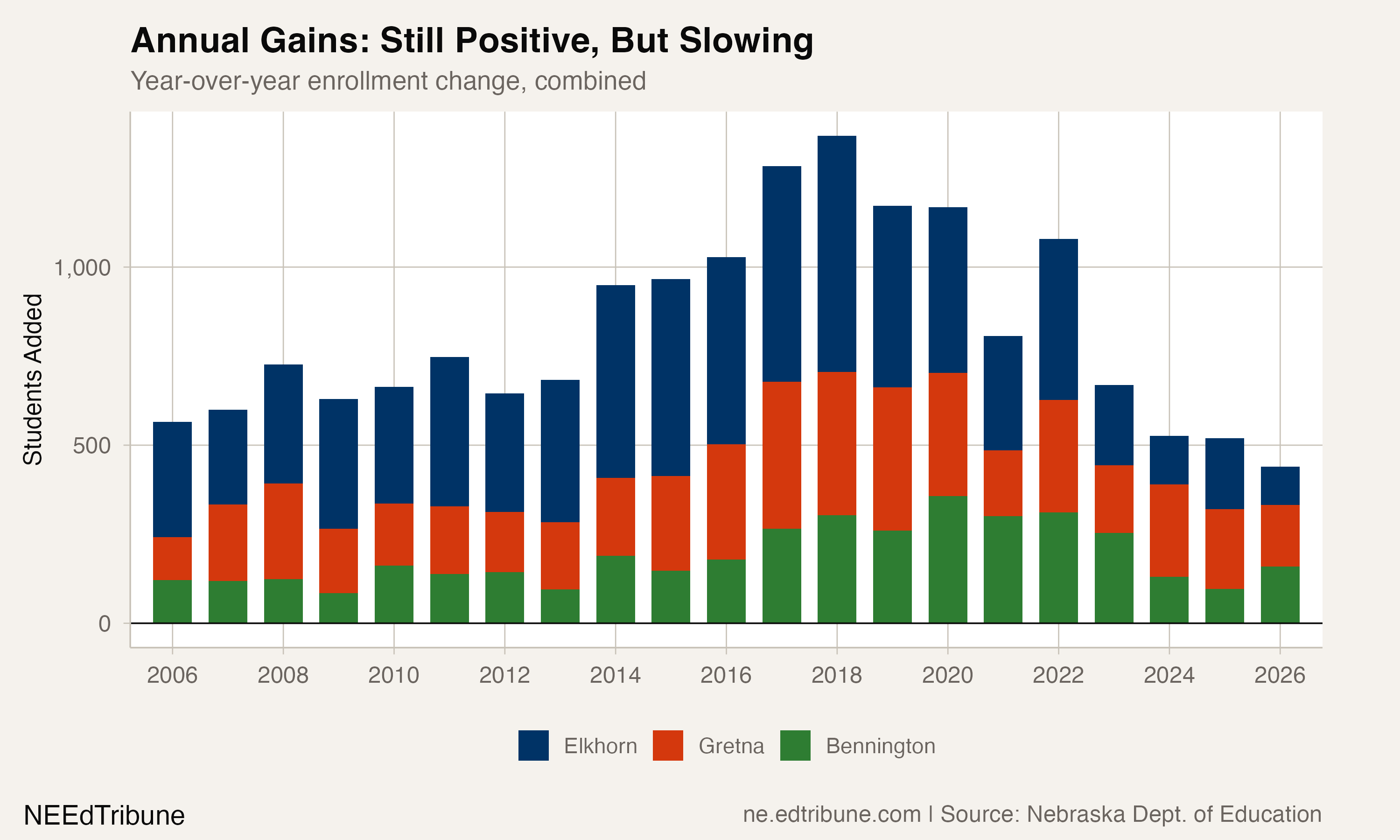
The slowdown is consistent across all three, which suggests a regional dynamic rather than anything district-specific. Housing inventory is one likely factor: Elkhorn's superintendent noted in 2018 that the district had over 4,200 available construction lots. As that inventory absorbs, the pace of family arrivals naturally moderates. Rising home prices may also play a role. Gretna's median home price has nearly doubled since 2010, climbing to over $428,000 by 2025, which narrows the affordability advantage that drew young families outward in the first place.
Building to keep up
The growth has forced a construction cycle unlike anything in rural Nebraska. Elkhorn voters approved a $149.6 million bond in 2018 to build a new high school, middle school, and elementary school. The district has opened eight new schools over the past decade to keep pace with growth.
"The Elkhorn Public Schools are growing 6-8% annually, adding 600-700 new students that come to our doors in August that were not here the May prior." -- Elkhorn Public Schools, March 2018
By 2025, the district was opening two more elementary schools, Iron Bluff and Stone Pointe, its 13th and 14th, to absorb another 600 students. Superintendent Dr. Bary Habrock said the district's current footprint spans three high schools, five middle schools, and fourteen elementary schools, built across what he called "over four decades of continuous growth."
Habrock framed the district's trajectory as inseparable from the community it serves. "The district works to maintain a powerful partnership between the schools and community we serve and remains a vital component of the continued success of the Elkhorn Public Schools," he said. "An overarching systemic culture of continuous improvement and strong community support sustains and drives the standard, guiding the district as it navigates community expansion." The streak, by his read, is not a district achievement on its own: "The district benefits from the long-standing success of a community that prioritizes its students, which helps to define the path forward."
Bennington's challenge is more acute because its growth started from a smaller base. The district needed a second high school but had to go to voters three times before getting it approved. A $150 million proposal failed in 2022. A pared-down $119 million version failed by 178 votes in 2024. In March 2025, a $112 million bond finally passed with roughly 60% support. District officials have said the current high school is already operating near capacity.
"This is a great day for our community, our students and our staff. This topic has been front and center of so many discussions over the last couple years." -- Superintendent Aaron Plas, Omaha World-Herald, March 2025
Gretna opened its $60 million Giles Creek Middle School in August 2025, its third middle school, welcoming roughly 600 students. The district's enrollment grew 88% between 2013 and 2023.
Diversifying while growing
The three suburbs are not only getting bigger. They are getting more diverse, though they remain substantially whiter than Nebraska as a whole.
In 2005, Gretna was 97.1% white. By 2025, that share had fallen to 85.2%. Elkhorn went from 94.9% to 77.1%. Bennington went from 96.0% to 81.6%. Hispanic enrollment, while still a small share, has more than doubled in relative terms across all three districts: from 0.9% to 6.7% in Gretna, from 3.1% to 6.3% in Elkhorn, from 2.8% to 5.4% in Bennington.
Statewide, Nebraska's student population is 60.8% white and 23.0% Hispanic. The suburbs are converging toward the state average, but from a long distance away.
The diversification is worth watching because it tracks a broader shift in Omaha's metropolitan geography. International migration accounted for 5,307 new residents in Douglas County alone in 2024, up from 2,066 the prior year. Some share of those new arrivals are settling not in Omaha proper but in the ring suburbs, drawn by school quality ratings and newer housing stock.
What the streak means for everything else
The sustained growth of these three districts has consequences for every other district in the Omaha metro. Papillion-La Vista↗ET gained 3,657 students over the same period, a respectable 43.2% increase but less than half of Gretna's rate despite being a larger and more established suburb. Bellevue, the older military-adjacent suburb, gained just 257, a 2.8% increase barely above flat. Millard, which was more than three times the size of these three combined in 2005, added 2,694 students but saw its growth rate slow to 13.2%.
The pattern is classic metropolitan decentralization: growth leapfrogs the inner suburbs and concentrates at the development frontier, where land is cheap and districts can build new schools from scratch rather than retrofit aging buildings. The question is how long the frontier holds. A 2024 analysis of Census estimates found that population growth in Bennington, Gretna, and Papillion had begun to stall, while exurbs farther out, such as Plattsmouth, Wahoo, and Ashland, were accelerating. If the growth wave moves further outward, these districts could transition from boomtowns to mature suburbs within a decade.
For now, though, the streak is intact. Bennington added 159 students in 2026. Gretna added 173. Elkhorn added 107. In a state where most districts are fighting to hold steady, 439 new students across three districts is a rounding error for Nebraska. It is also a building program, a bond election, and a second high school.
Detailed code that reproduces the analysis and figures in this article is available exclusively to EdTribune subscribers.
Discussion
Sign in to join the discussion.
Loading comments...