Correction (2026-05-29): An earlier version of this article cited a statewide denominator of 422 districts and reported that 227 districts had lost enrollment in the most recent year. The Nebraska Department of Education file we drew from pools public school districts with non-public and state-operated entities, and our data package was treating all of them as public school districts. The corrected statewide count is 244 public school districts, of which 132 lost enrollment in 2025-26. Bennington's 2005 statewide rank moved from 80th (in a contaminated denominator) to 68th of 477 (Class I-VI era), and the Douglas County share figures cited later in the piece have been updated. The district-level Bennington numbers, 598 to 4,540 students and a 659% growth rate, are unchanged. Thanks to a reader for flagging this.
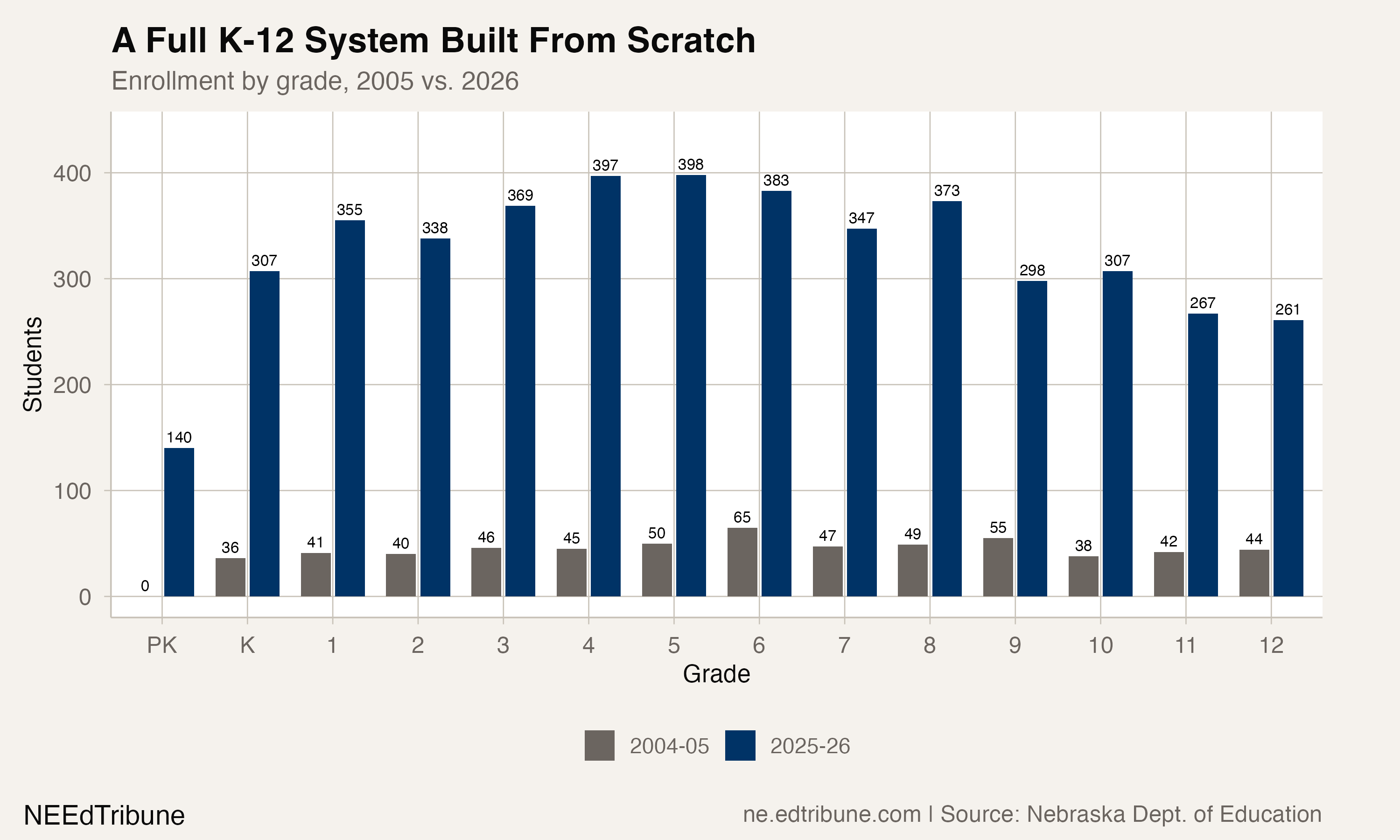
In 2004-05, Bennington Public Schools enrolled 598 students. Its largest graduating class had 44 seniors. Its kindergarten had 36. The district sat on the far northwestern edge of the Omaha metro, surrounded by farmland, operating as the kind of small Nebraska system that most education analysts would have trouble finding on a map.
Twenty-one years later, Bennington↗ET enrolls 4,540 students, ranks 12th among Nebraska's 244 public school districts, and is building a $112 million second high school because the first one is already at capacity. The 659% growth rate is the highest of any Nebraska public school district over that span. No year in the dataset shows a decline.
Twenty-one consecutive years, zero declines
The streak is the headline, but the shape of the growth is the story. Bennington did not have a single surge. It had a sustained, accelerating build-out that peaked between 2017 and 2022 and is now decelerating.
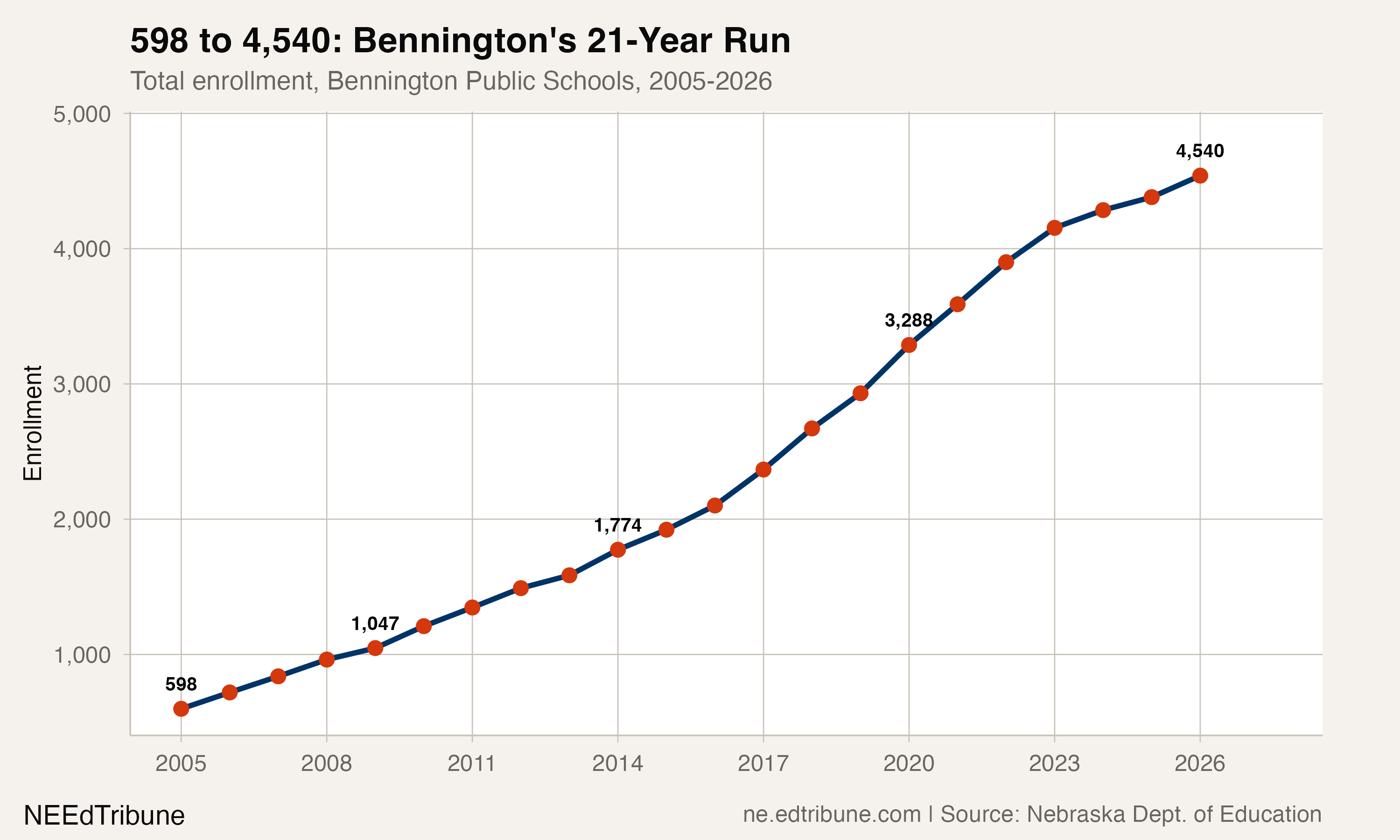
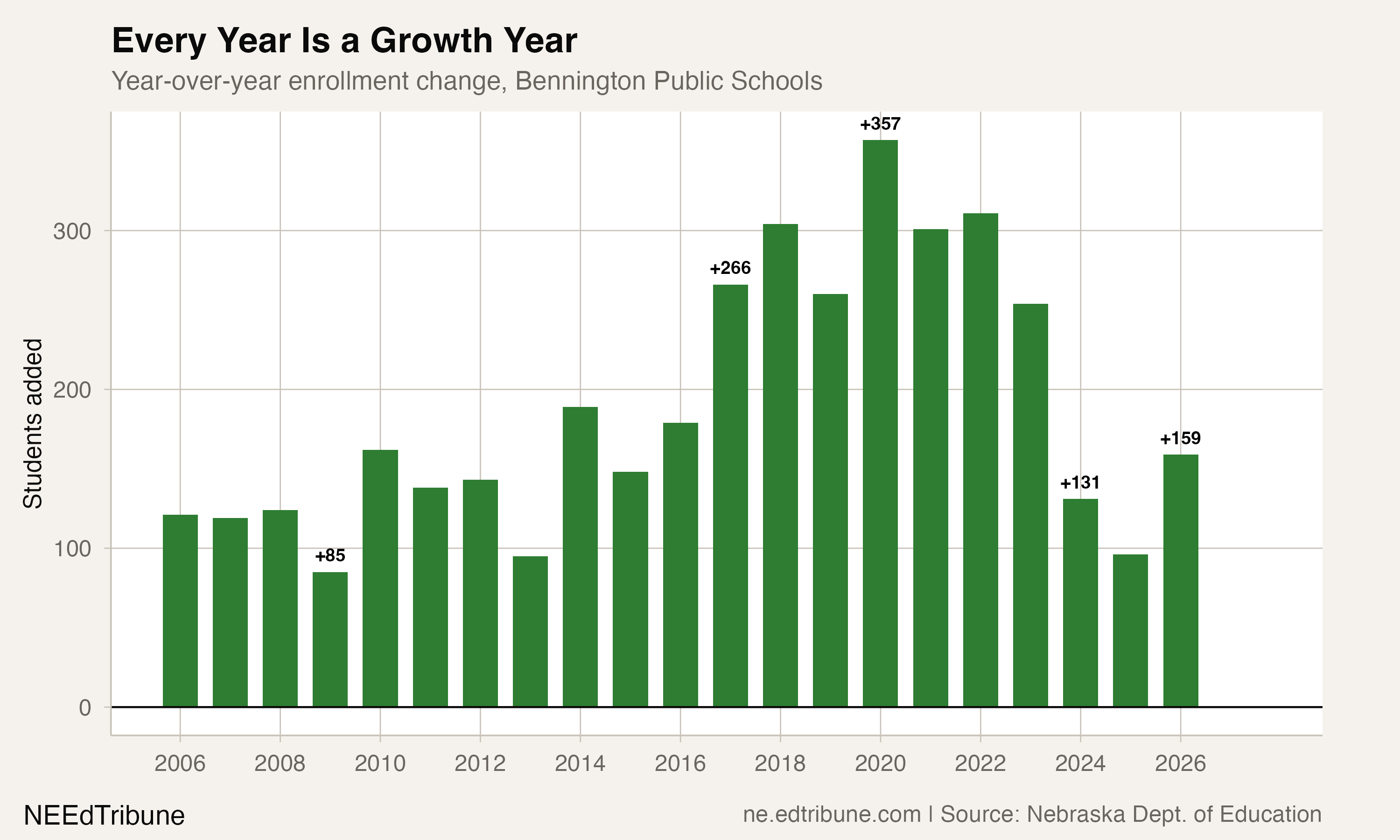
In the early years, the district added roughly 127 students annually, growing from 598 to 1,490 between 2005 and 2012. The pace nearly doubled in the next stretch: 243 students per year from 2013 to 2020, pushing enrollment past 3,000. The single largest annual gain came in 2019-20, when Bennington added 357 students in one year, a 12.2% jump.
Since 2021, the rate has cooled. The district has averaged 190 new students per year, and the 2025-26 gain of 159 students represents 3.6% growth. In 2024-25, the rate dipped to 2.2%, the lowest in the dataset. The kind of pace that many districts would celebrate is, for Bennington, a marked slowdown.
The doubling milestones tell the story most efficiently: Bennington crossed 1,000 in 2009, 2,000 in 2016, 3,000 in 2020, and 4,000 in 2023. Seven years between the first two thresholds, four between the next two, three for the last. The district has been in a perpetual state of construction, opening a second middle school and fifth elementary school in fall 2023 to keep up.
The western corridor's outlier
Bennington is not the only western Omaha suburb growing. Elkhorn↗ET and Gretna↗ET share the same 21-year unbroken growth streak, the longest active streaks among Nebraska's 244 public school districts. But Bennington's growth rate dwarfs them both.
Indexed to 2005, Bennington's enrollment stands at 759, meaning it has grown by more than 7.5 times its original size. Elkhorn, which started much larger at 3,691 students, has grown to an index of 319. Gretna, which started at 1,963, sits at 366.
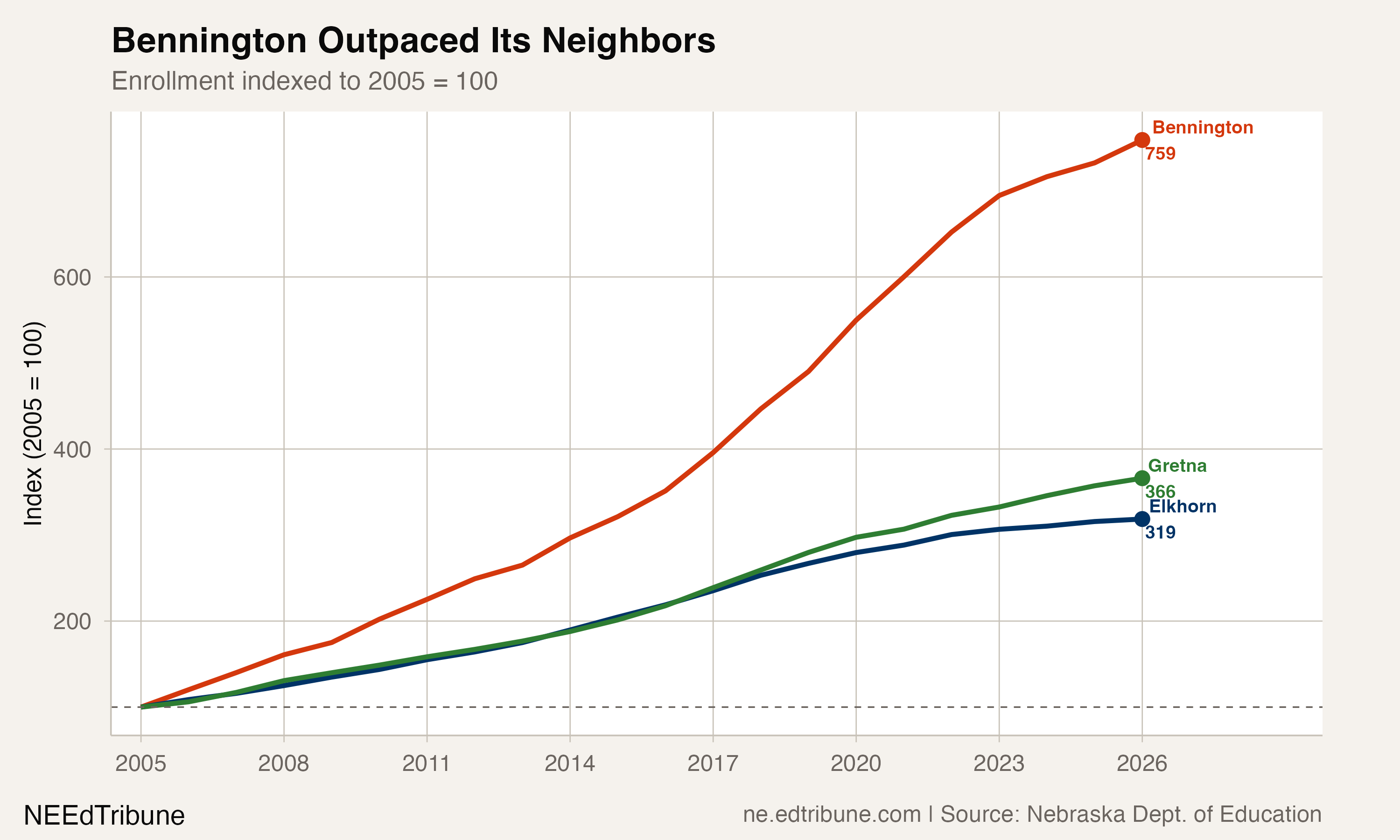
In absolute terms, Elkhorn added more students (8,069 to Bennington's 3,942), but Elkhorn was already a midsize district when the growth began. Bennington's trajectory is qualitatively different: it was a district with 44 seniors that now graduates over 260 per year. The district essentially started over.
The grade-level data makes this visible. In 2005, no grade at Bennington had more than 65 students. In 2026, kindergarten alone enrolls 307, and grades 4 and 5 each top 390.
What built this
The driver is residential construction. Bennington sits between Omaha and the Elkhorn corridor in Douglas County, directly in the path of the metro's westward expansion. The district's share of Douglas County enrollment has risen from 0.7% in 2005 to 4.4% in 2026, while Omaha Public Schools↗ET, the county's dominant district, has seen its share slip from 57.5% to 50.9% over the same period. Omaha itself grew 11.9% over those 21 years, respectable by most standards, but a fraction of Bennington's pace.
The construction pressure on the school system has been a recurring theme in local reporting. Former Superintendent Terry Haack told 3 News Now that the high school, opened less than 20 years ago, had already been renovated four times to accommodate the growth:
"So without any growth at all, we're going to exceed the capacity in about four years."
That warning proved prescient. By 2025, the current high school was at capacity with over 1,000 students. District officials warned that without a new building, Bennington would face overcrowding, reduced course offerings, and modular classrooms in parking lots.
A bond issue that took three tries
The capacity crisis forced a political question that Bennington voters took years to resolve. A $153 million bond proposal failed in November 2022. A scaled-down $119 million version failed by just 178 votes in March 2024, with 3,187 opposed and 3,009 in favor. On the third attempt, in March 2025, voters approved a $112 million bond for a second high school by a 71% margin, with 4,551 in favor and 1,859 opposed.
The new facility is expected to open for the 2028-29 school year. Whether it will be sufficient depends on what happens to the growth rate. The district has projected enrollment could reach 12,000 to 14,000 students by 2046, though those figures carry substantial uncertainty. Long-range enrollment projections in fast-growing suburbs are notoriously unreliable in both directions.
A changing student body
Bennington in 2005 was 96.0% white. In 2026, it is 79.5% white. The share of students of color has risen from 4.0% to 20.5%, driven by growth across every non-white subgroup. Hispanic enrollment grew from 17 to 271 (6.0% of total), Black enrollment from three to 235 (5.2%), and Asian enrollment from four to 223 (4.9%).
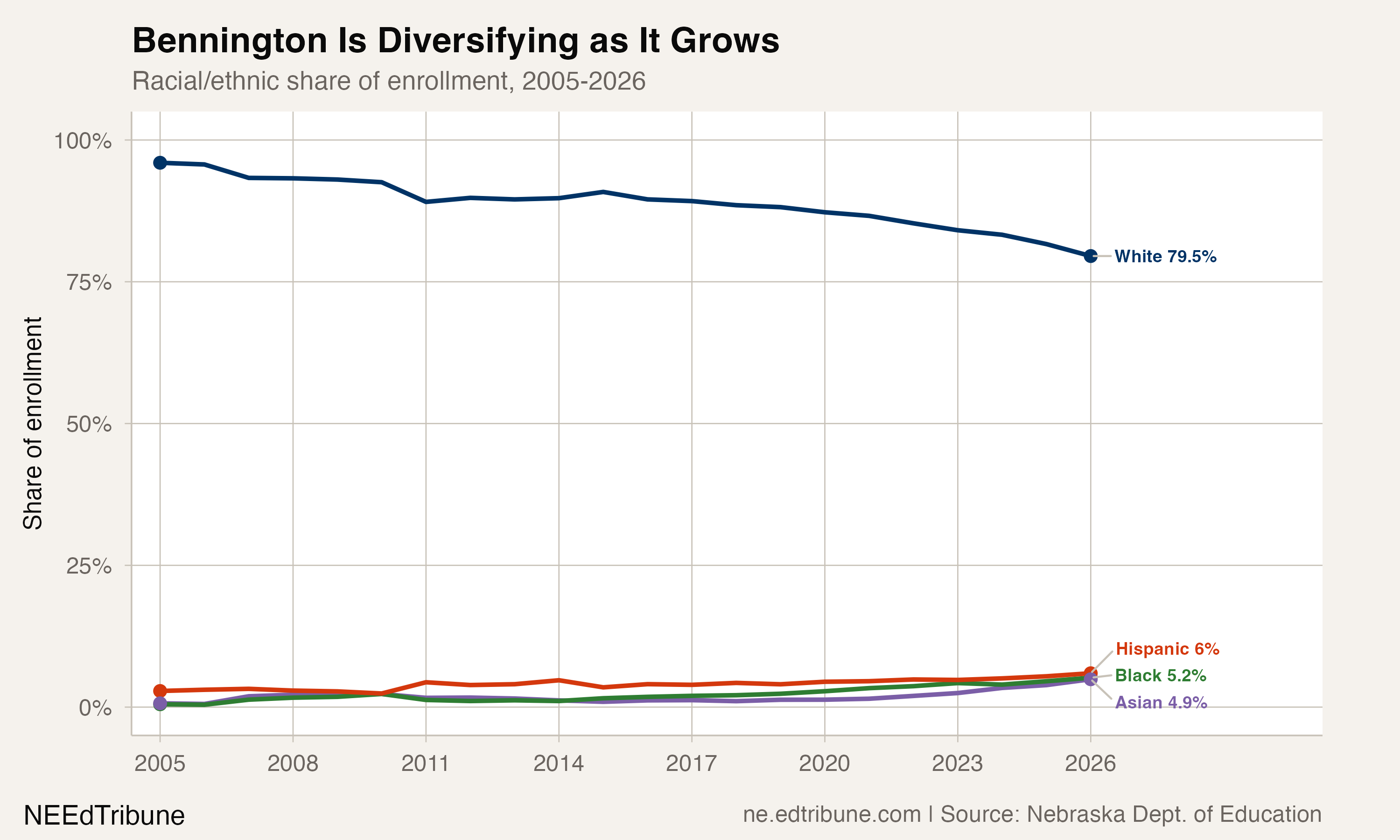
This is not a composition shift driven by white departure. White enrollment itself grew by 3,037 students, from 574 to 3,611. Bennington is diversifying because the new families moving in are more diverse than those already there, the same pattern playing out across Omaha's western suburbs.
Where the growth is slowing
The deceleration in the last three years is worth watching. Kindergarten enrollment peaked at 341 in 2021 and fell to 307 in 2026, a 10.0% decline. If the K pipeline is the leading indicator it typically is, Bennington's growth rate will continue to compress. The district may still add students for years to come as its large elementary cohorts age into the upper grades, but the era of 250-to-350-student annual gains appears to be over.
Statewide, 132 of Nebraska's 244 public school districts lost enrollment in the most recent year. The next active growth streak after the western trio's 21 years belongs to Ashland-Greenwood at 11. Bennington's run is not just unusual for Nebraska; there is no close parallel in the dataset.
Bennington's $112 million second high school is slated to open in 2028-29. By then, the 390-student fifth-grade class will be entering eighth grade, and the 307-student kindergarten class will have moved into the elementary seats those older kids vacated. The district spent three bond elections and six years convincing voters to build for the wave already in the building. Whether 307 kindergartners will fill a campus designed for the era of 350 is a math problem the next superintendent will inherit.
Detailed code that reproduces the analysis and figures in this article is available exclusively to EdTribune subscribers.
Discussion
Sign in to join the discussion.
Loading comments...