Correction (2026-05-29): An earlier version of this article cited the wrong statewide enrollment totals (367,549 in 2025 and 365,323 in 2026) and the wrong district count (422). The Nebraska Department of Education file we drew from pools public school districts with non-public and state-operated entities, and our data package was treating all of them as public school districts. The corrected figures are 330,136 students in 2025, 328,148 in 2026, and 244 public school districts. Race totals, grade-level figures, and percentages throughout have been updated. Charts have been regenerated. Thanks to a reader for flagging this.
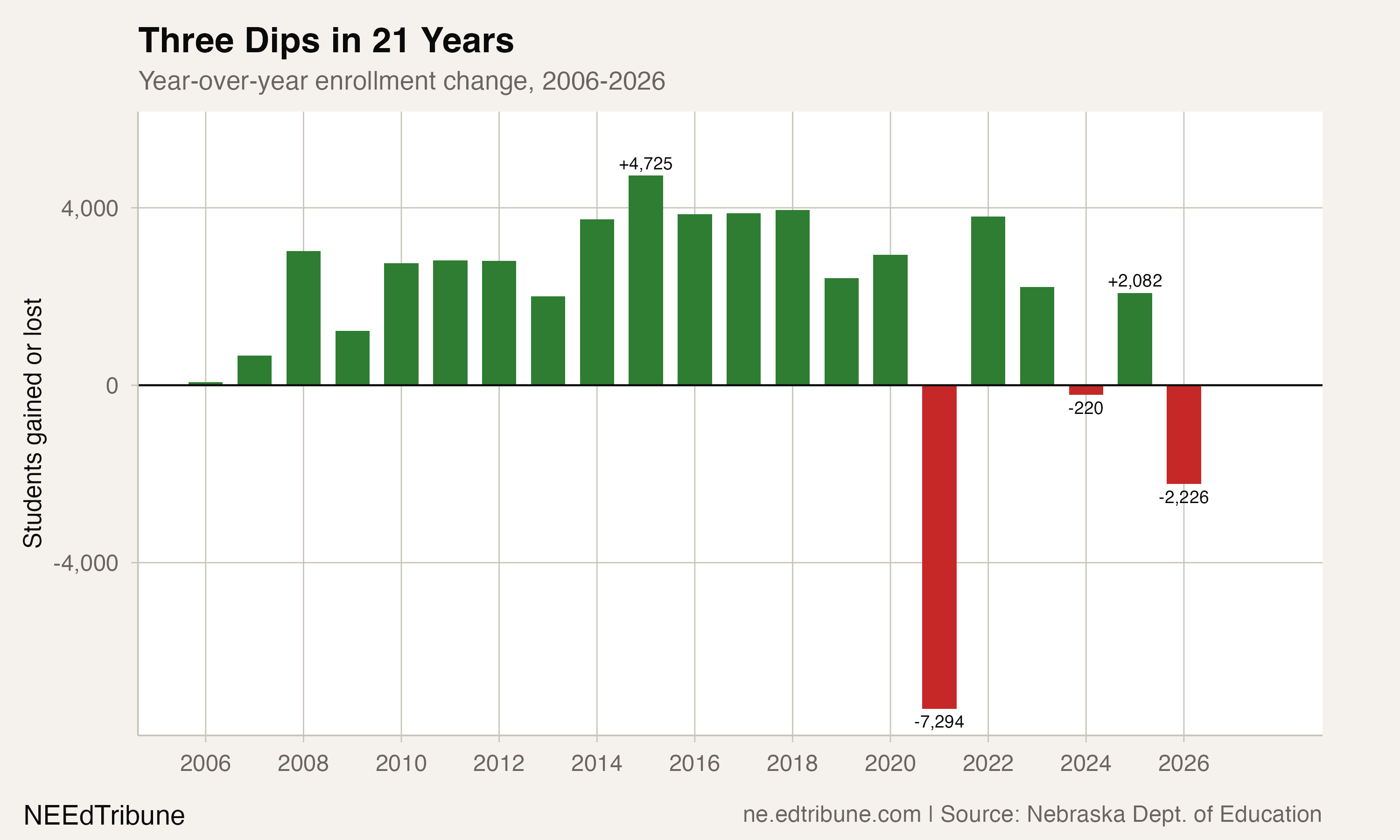
For 20 years, Nebraska did something most states could not: it grew. From 284,599 students in 2005 to an all-time high of 330,136 in 2025, the state added 45,537 students, a 16.0% gain that ran counter to the enrollment declines sweeping the Midwest. Only three years in that span registered a loss, and one of them (2024, at -73 students) was statistical noise.
Then 2026 arrived, and 1,988 students vanished. The 0.6% decline is modest by any single-year measure, but it represents the first substantial, non-pandemic enrollment loss Nebraska has recorded since at least 2005. The question is whether this is a blip at the top of a long climb or the first step down.
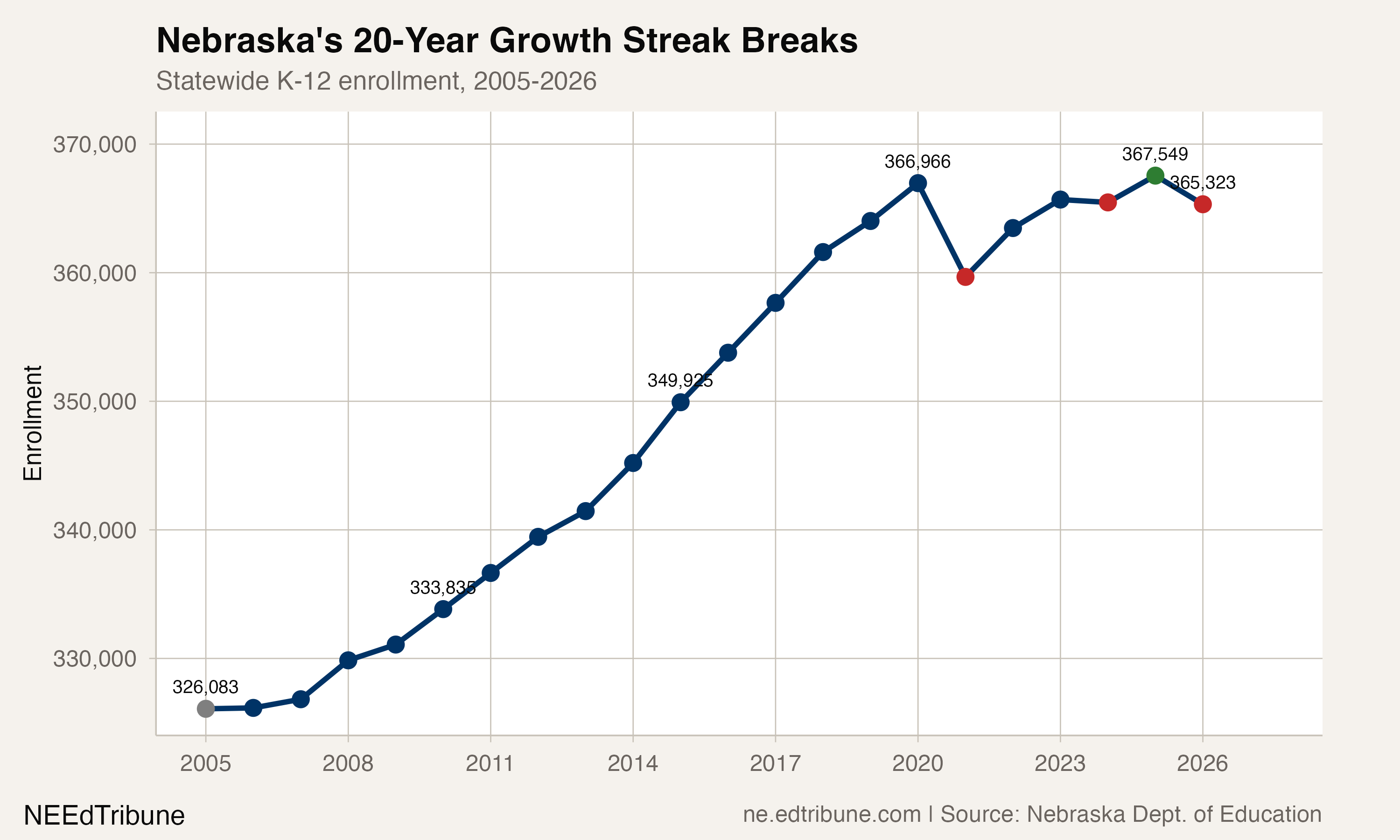
The two engines that stalled at once
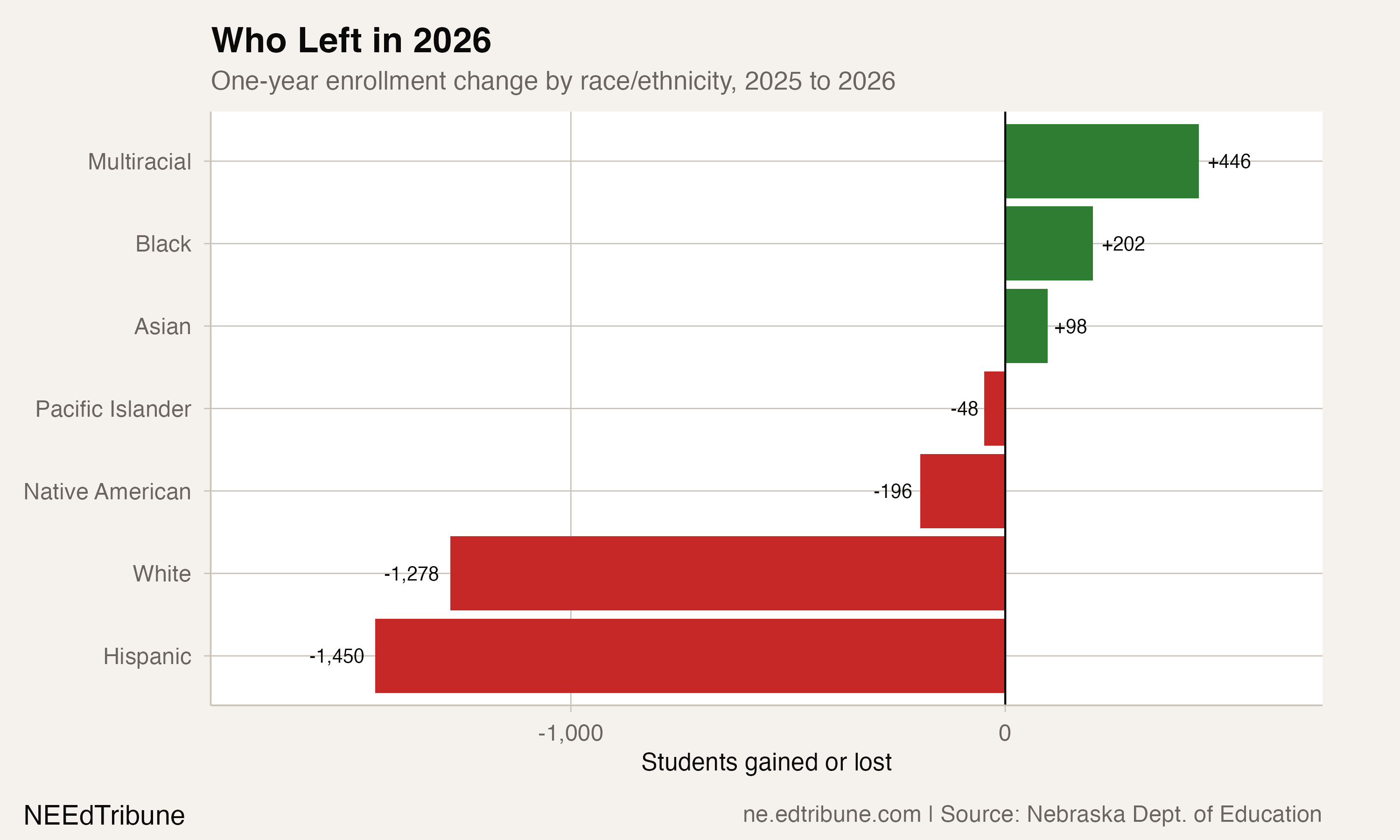
The 2026 decline has an unusual structure: it was driven almost equally by losses in the state's two largest racial groups. Hispanic enrollment fell by 1,363 students (-1.8%), and white enrollment fell by 1,120 (-0.6%). Together, those two groups account for the entire net loss and then some. Black (+99), Asian (+85), and multiracial (+534) enrollment all grew, partially offsetting the damage.
The Hispanic decline is the more startling of the two. Hispanic enrollment in Nebraska had grown almost without interruption for two decades, rising from 30,683 students in 2005 to 76,953 in 2025, a 151% increase that reshaped the demographic profile of schools from Omaha to the meatpacking corridor towns of Grand Island, Lexington, and Schuyler. A loss of 1,363 students in a single year has no precedent in the dataset.
White enrollment, by contrast, has been declining for most of the period. The white student population peaked at 223,284 in 2005 and has fallen to 199,358 in 2026, shedding roughly 1,200 students per year on average. The 2026 loss of 1,120 is consistent with that long-term trajectory.
A shrinking front door
The grade-level data reveals a structural shift that goes beyond any single year's loss. Kindergarten enrollment peaked at 24,025 in 2014 and has fallen to 21,275 in 2026, an 11.4% decline over 12 years. Grade 12 enrollment, meanwhile, hit 26,008, an all-time high. Grade 12 now exceeds kindergarten by 4,733 students, the widest gap in the dataset.
Lincoln Public Schools illustrates the dynamic at the district level. LPS Associate Superintendent Mike Gillotti told the district that "larger grade-level cohorts are in the upper grades and graduating out, while smaller cohorts are entering elementary levels." LPS enrollment fell by 334 students in 2026 after coming within 15 students of its all-time record the year before.
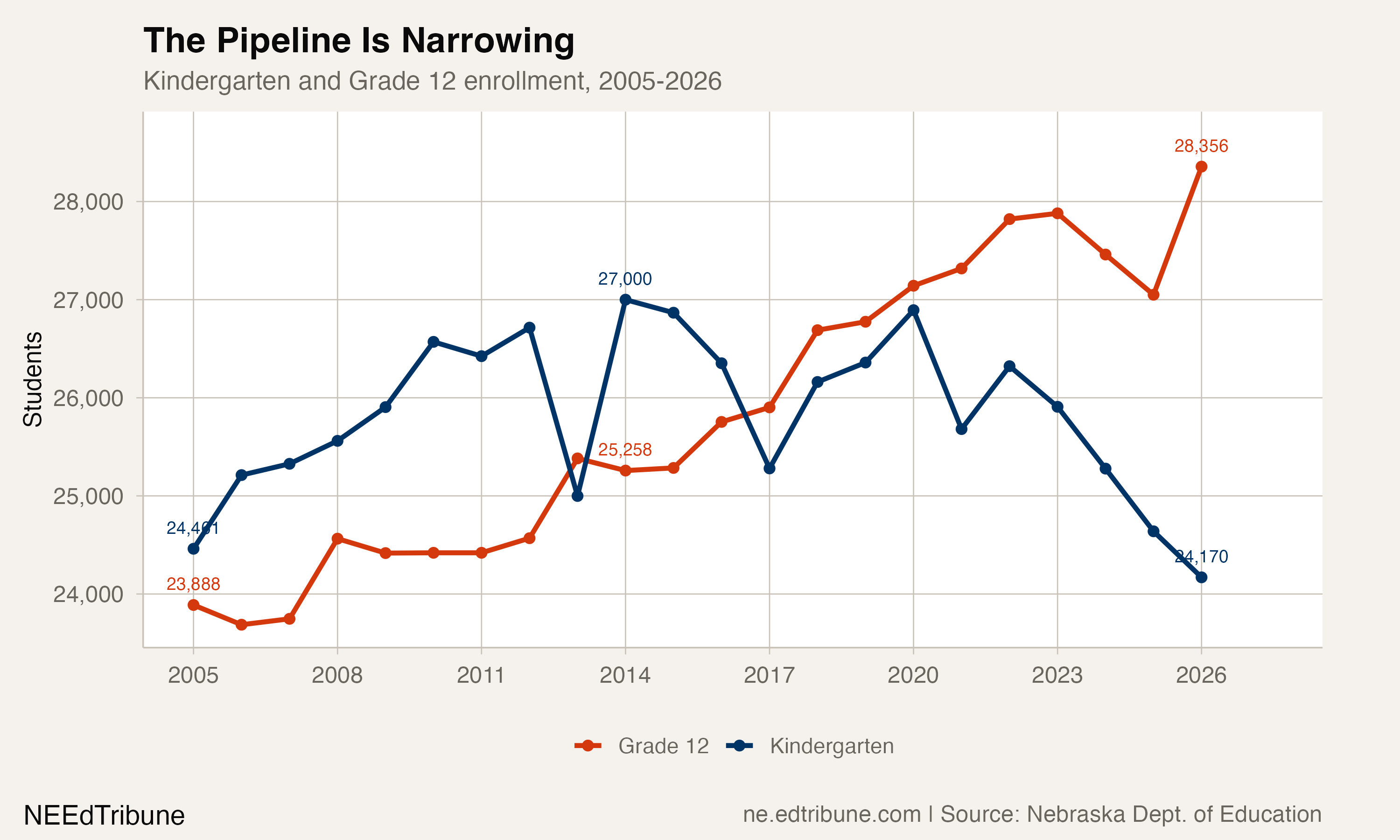
This pipeline inversion means the 2026 decline was not caused by a sudden shock. It is the arithmetic consequence of smaller birth cohorts entering the system while larger ones leave. The kindergarten trend line tells the story directly: a class of 24,025 entered in 2014, but just 21,275 entered in 2026. Those missing kindergartners compound through every subsequent grade.
The ICE enforcement question
The Hispanic enrollment decline demands a closer look because it coincides with a documented surge in federal immigration enforcement. ICE arrests in Nebraska rose 329% in 2025, from 291 detentions in the first 10 months of 2024 to 1,246 in the same period of 2025, according to The Reader.
"Something that we realized very quickly was that the spaces that used to be safe, where people felt like they could congregate and they felt safe going to get information, are no longer safe spaces." -- Roxana Cortes-Mills, Legal Director of the Center for Immigrants and Refugees of the Archdiocese, quoted in The Reader, March 2026
Whether the enforcement surge directly caused school enrollment losses is difficult to establish from enrollment data alone. The 1,363-student Hispanic decline could reflect families withdrawing children from school out of fear, families leaving the state, or both. It could also partly reflect the same birth-cohort dynamics affecting white enrollment, as Hispanic birth rates have also moderated nationally. But the timing is suggestive: Hispanic enrollment in Nebraska had grown almost every year for two decades before this reversal.
The meatpacking corridor towns, where Hispanic families are concentrated, saw some of the steepest declines. Grand Island Public Schools, where 61.8% of students are Hispanic, lost 239 students overall. Schuyler Community Schools (88.0% Hispanic) lost 130. Norfolk Public Schools lost 139.
The two Nebraskas
The statewide number obscures a deepening geographic divide. Of Nebraska's 244 public school districts, 151 enroll fewer than 500 students and just 5 enroll fewer than 100. Omaha Public Schools (52,095) and Lincoln Public Schools (41,967) anchor a top 10 that educates more than half of all Nebraska students.
The Omaha metro area's share of statewide enrollment has grown from 43.4% in 2005 to 52.4% in 2026. Within that metro area, the story is suburban: Bennington Public Schools↗ET has grown 659% since 2005 (from 598 to 4,540 students), Gretna↗ET 266% (from 1,963 to 7,186), and Elkhorn↗ET 219% (from 3,691 to 11,760). All three continued growing in 2026, even as the state contracted.
But even this suburban engine is decelerating. Across the 243 districts that posted year-over-year changes, 132 lost students in 2026 while 107 gained. The suburban gains in Bennington, Gretna, and Elkhorn are still not large enough to offset the losses accumulating elsewhere.
A demographic transformation, paused
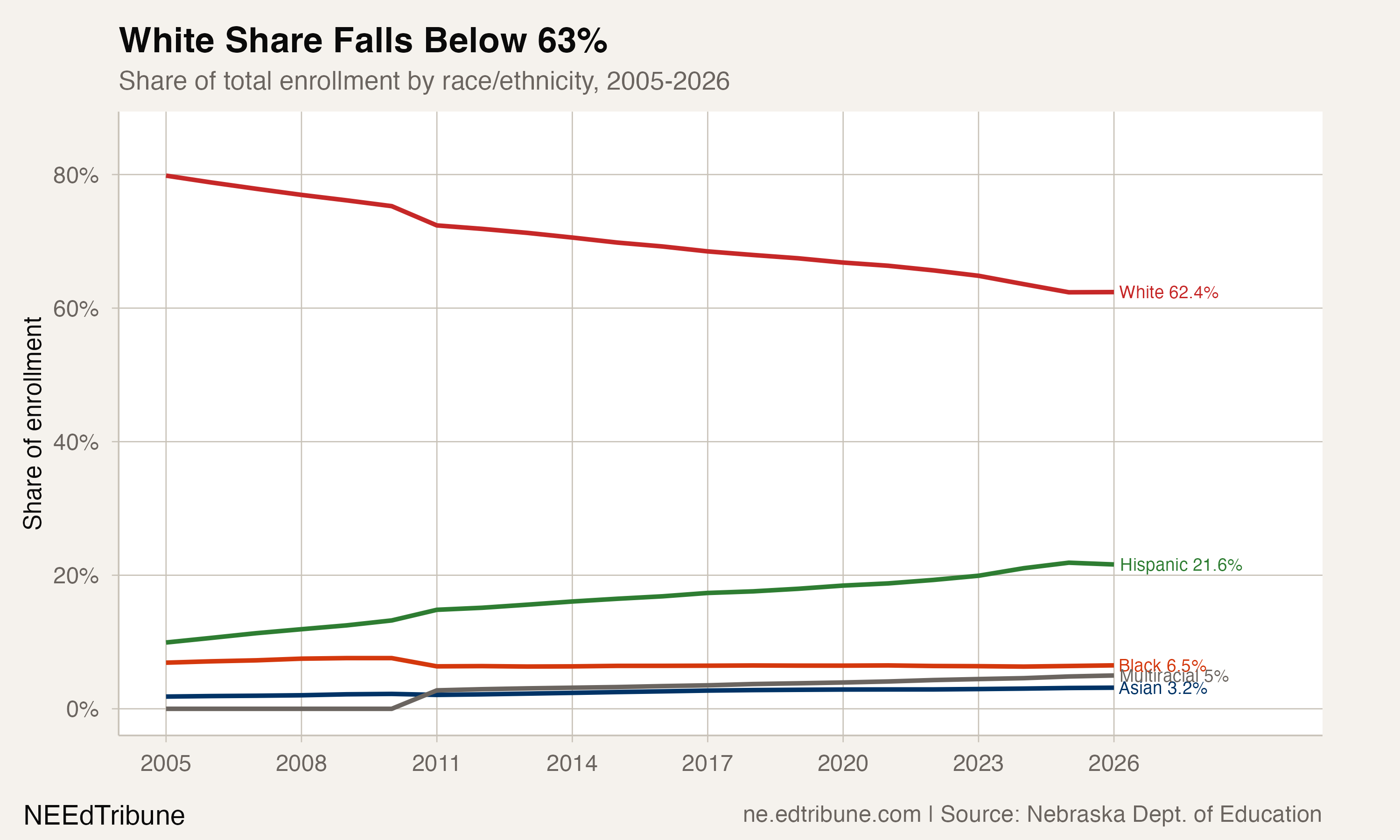
The broader composition shift in Nebraska schools has not stopped, even if it slowed in 2025-26. White students made up 78.5% of enrollment in 2005; they now account for 60.8%. Hispanic students rose from 10.8% to 23.0% over the same period. Nearly one in four Nebraska students is now Hispanic, compared with about one in ten two decades ago.
The 2026 data is the first year that shift paused. Hispanic share actually ticked down, from 23.3% in 2025 to 23.0%. Whether this represents a temporary fluctuation or the beginning of a plateau depends on things outside the enrollment data: immigration patterns, Hispanic birth rates, and whether enforcement is scaring families away from schools.
What 2027 will answer
Nebraska remains 43,549 students (15.3%) above where it started in 2005. Even after the 2026 decline, it has not slipped much below pre-pandemic levels only because its pre-pandemic levels were themselves the product of sustained growth (329,290 in 2020 versus 328,148 in 2026). The state is now 1,142 students below that 2020 mark.
Nebraska still sits comfortably above states like Iowa and Illinois that have been bleeding enrollment for a generation. But the two engines that built that cushion, white families staying in state and Hispanic families arriving, both stalled in the same year for the first time. Bennington can keep building subdivisions. Gretna can keep opening schools. At some point, the suburban ring runs out of cornfields to pave, and the 132 districts that lost students in 2026 are still there on the other side of the ledger.
Detailed code that reproduces the analysis and figures in this article is available exclusively to EdTribune subscribers.
Discussion
Sign in to join the discussion.
Loading comments...