Correction (2026-05-29): An earlier version of this article cited a statewide white share of 62.4% and a 42-point district-vs-state gap. Those figures came from a data file that pooled public, non-public, and state-operated entities, which our package was treating as public school districts. The corrected statewide white share for 2026 is 60.8% and the OPS-vs-state gap is 40.5 percentage points. OPS's district-level numbers in this article were not affected. Thanks to a reader for flagging the underlying error.
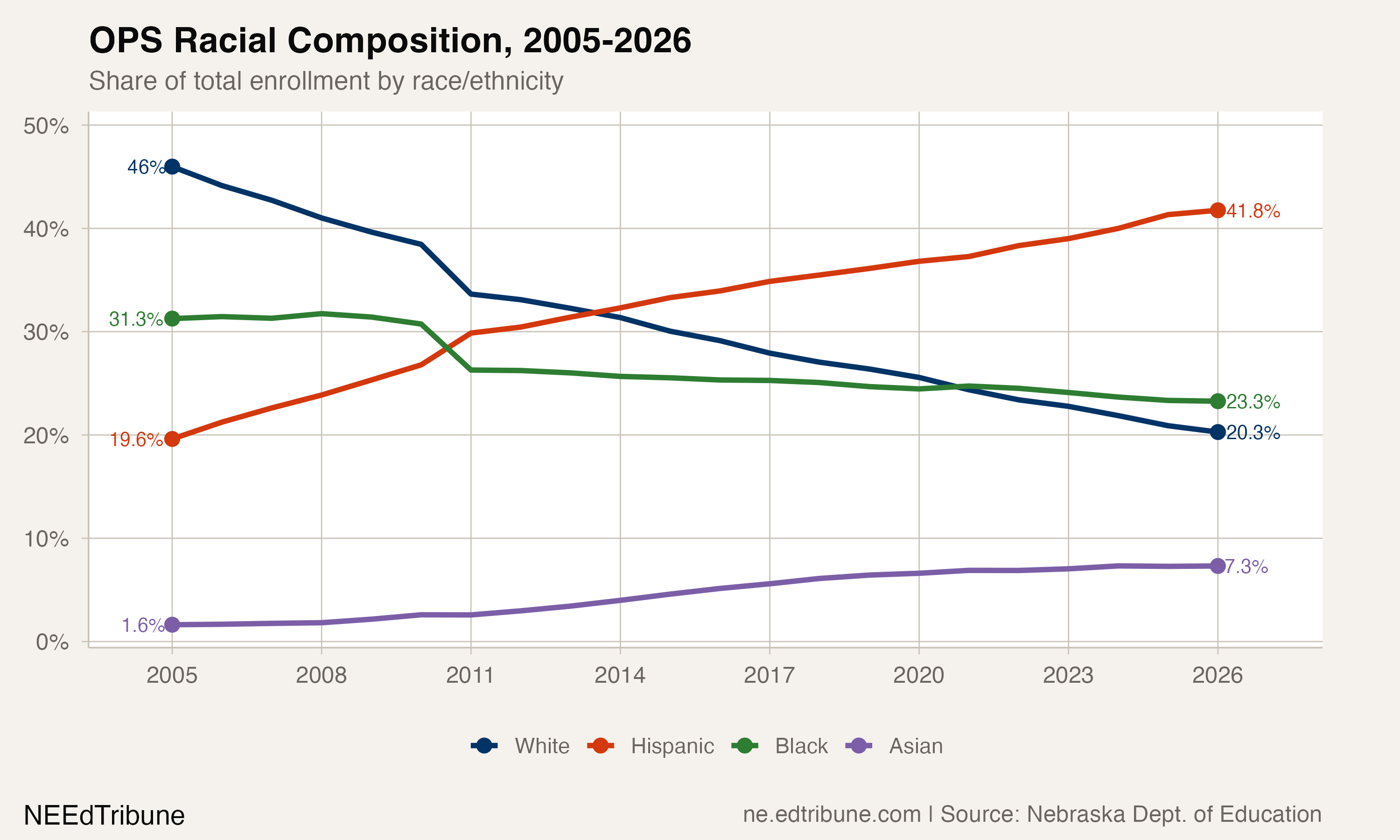
In 2005, white students made up 46% of Omaha Public Schools↗ET, the largest school district in Nebraska. They were the clear majority, outnumbering the next-largest group, Black students, by nearly 7,000.
Twenty-one years later, white students account for 20.3% of OPS enrollment. Hispanic students, who were 19.6% of the district in 2005, now make up 41.8%. The district did not shrink during this transformation. It grew, adding 5,546 students. The white share was simply replaced, student by student, year after year, by growth in Hispanic and Asian enrollment that more than offset every white departure.
Two crossovers in three years
The transformation unfolded in distinct phases. Hispanic enrollment overtook Black enrollment in 2011, then overtook white enrollment in 2014 to become the district's largest racial group. By 2026, Hispanic students outnumber white students more than two to one: 21,751 to 10,566.
The absolute numbers tell a starker story than the percentages. OPS lost 10,837 white students over 21 years, a 50.6% decline. In the same period, Hispanic enrollment grew by 12,621 students, a 138.2% increase. Black enrollment fell by 2,432, and Asian enrollment rose by 3,053, a 402% increase from a small base of 759 students.
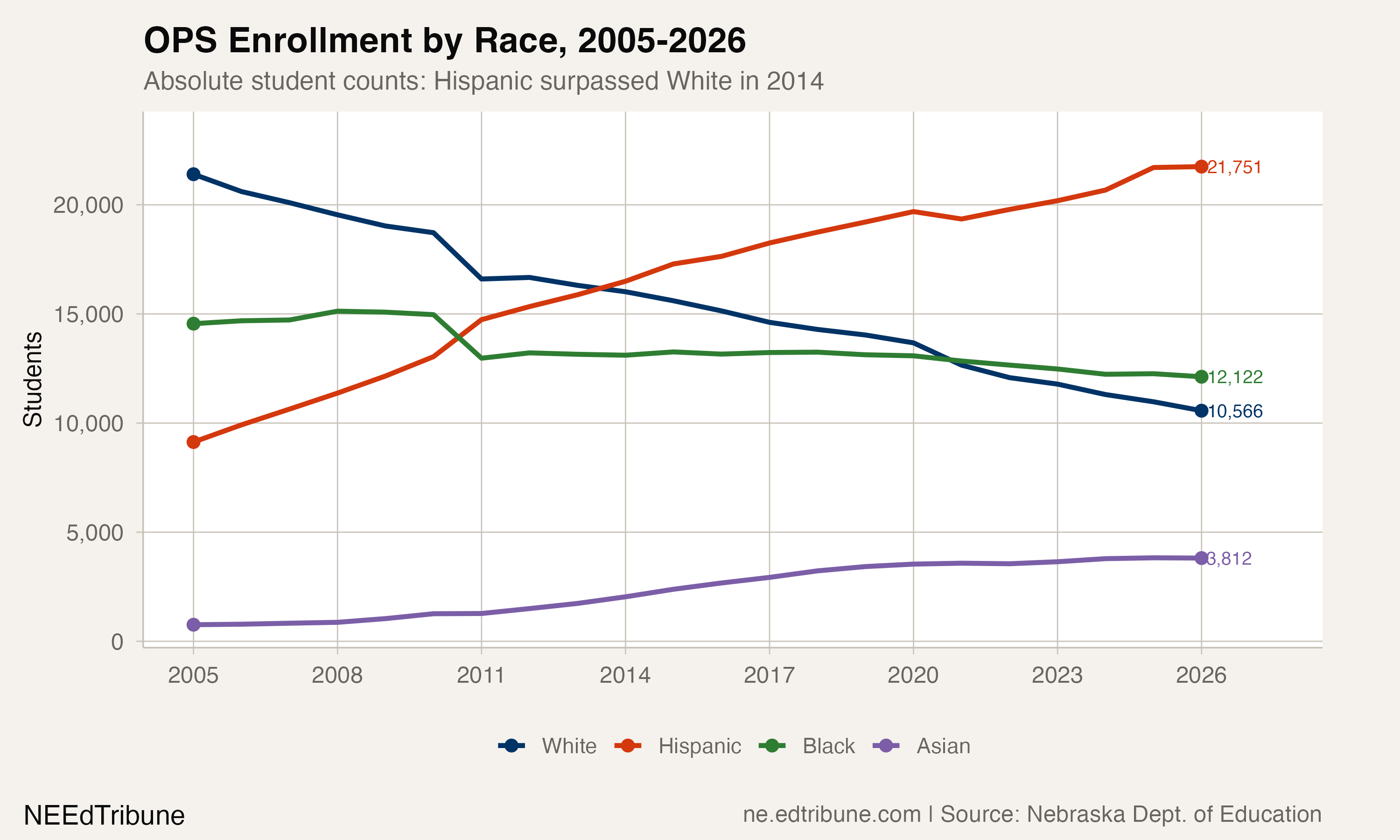
One year stands out on the chart: 2011. White enrollment dropped by 2,122 in a single year and Black enrollment by 1,996. That was not a mass exodus. It was a reclassification. Nebraska introduced the multiracial category that year, and 3,062 OPS students who had previously been counted as white or Black were recategorized. The structural decline in white enrollment is real, but the 2011 cliff is an artifact of how students are counted, not how many left.
The meatpacking pipeline and the refugee corridor
The growth of Hispanic enrollment in OPS reflects a broader demographic force reshaping Nebraska. Between 2022 and 2023 alone, Hispanic residents accounted for more than 80% of the state's total population growth, adding roughly 8,400 people to a state that grew by about 10,100.
The roots of this growth predate the enrollment data. South Omaha's meatpacking industry has drawn Hispanic workers for generations. What changed in the 2000s and 2010s was scale: the Omaha metro's foreign-born population grew 28.4% between 2010 and 2019, more than double the 12.9% national rate. That growth translated directly into school enrollment as families with children settled in OPS attendance zones.
Asian enrollment tells a parallel story. OPS went from 759 Asian students in 2005 to 3,812 in 2026, a fivefold increase. Much of this growth traces to refugee resettlement. Thousands of Karen refugees from Myanmar have settled in Omaha since 2005, part of a broader Southeast Asian and Bhutanese refugee population that has made the city one of the largest resettlement destinations in the Great Plains.
Where the white students went
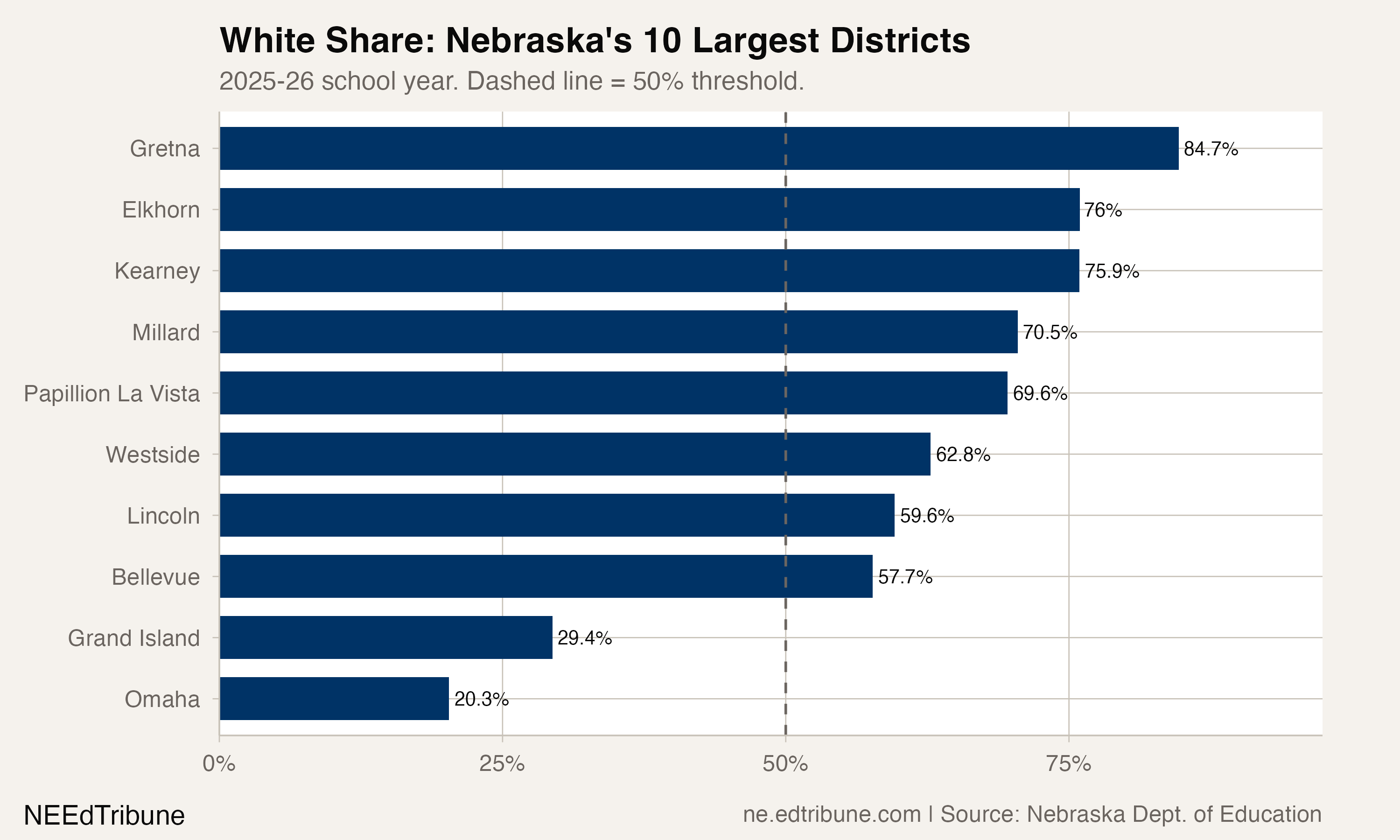
The white enrollment decline at OPS, an average of 436 students per year since 2012, has a geographic footprint. While OPS serves a district that is 20.3% white, Elkhorn Public Schools↗ET, 15 miles to the west, is 76% white. Gretna↗ET, the fastest-growing large district in the Omaha metro, is 84.7% white.
The pattern is not unique to Omaha. It has deep historical roots. White flight from OPS accelerated after 1976, when a federal court ordered the district to desegregate. The court-ordered busing program ran until 1999, but the demographic momentum it set in motion never reversed. Nebraska's enrollment option program, which allows families to transfer between districts, provides a continuing mechanism for families who want to leave.
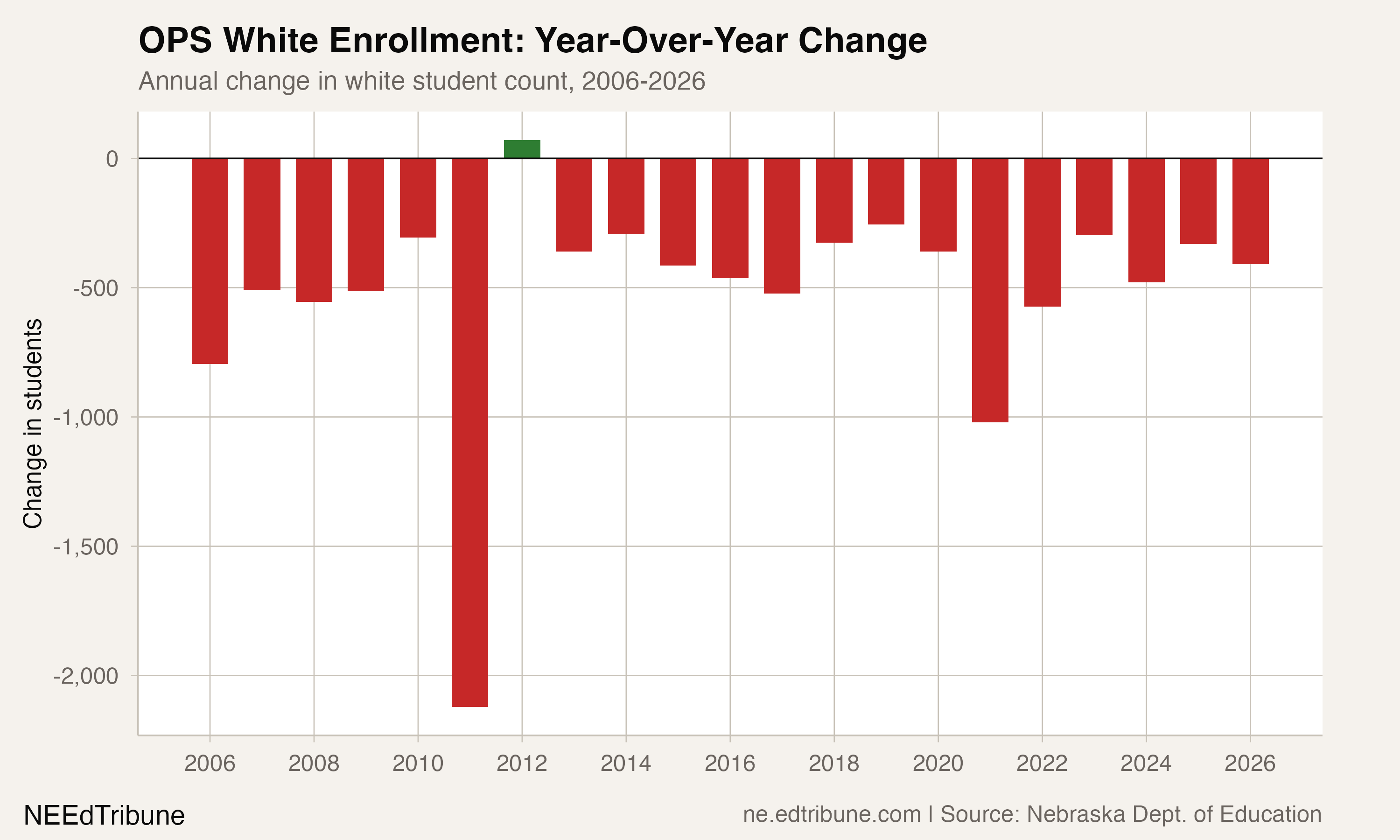
The pandemic sharpened the trend. In fall 2020, 1,000 white students left OPS in a single year, more than double the largest previous single-year drop. Suburban districts reopened for in-person instruction sooner than OPS, and some families who transferred during the disruption never came back.
"OPS put kids in front of a tablet and were like, 'Watch these videos, this is how you're learning today.'" — The Hechinger Report, Jan. 2023
The frustration with remote learning was not unique to white families, but white families had more exit options. OPS lost 1,021 white students in 2021 (the 2020-21 school year) and another 573 in 2022.
A 40-point gap between district and state
Nebraska as a whole is 60.8% white. OPS is 20.3% white. That 40.5-percentage-point gap has widened from 32.5 points in 2005, meaning OPS is diverging from the state it serves faster than the state itself is changing.
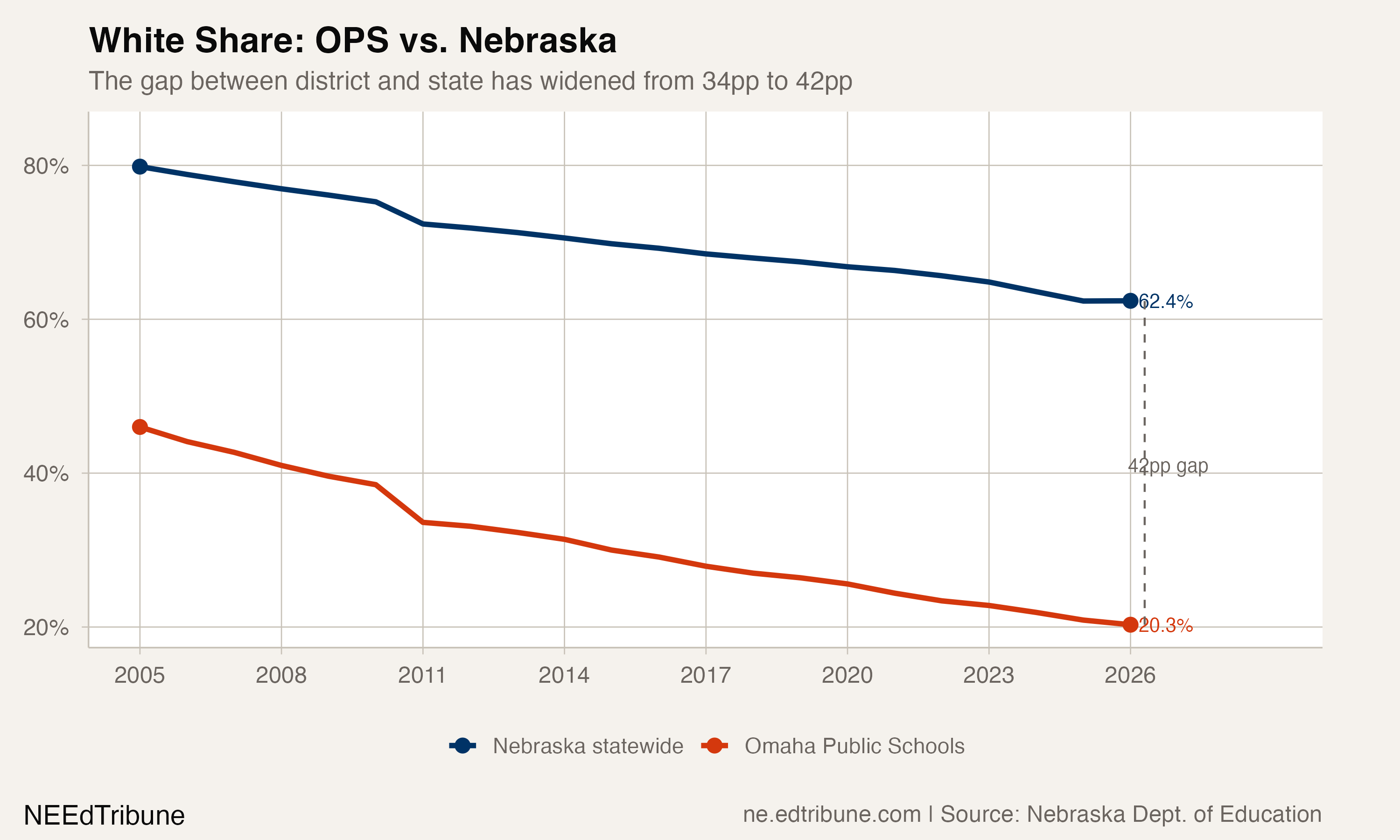
OPS is not the only Nebraska district where this divergence is visible. Grand Island Public Schools↗ET, the state's sixth-largest district, went from 62.9% white and 33.0% Hispanic in 2005 to 29.4% white and 61.8% Hispanic in 2026. Lincoln Public Schools↗ET, the second-largest, dropped from 80.8% to 59.6% white over the same period. But no large district has moved as far or as fast as OPS.
The fiscal implications are structural. Districts serving the most students of color receive over $3,000 less per student in state and local funds than predominantly white districts, according to an Education Trust analysis cited in reporting on OPS. That gap compounds as the student body changes: a district that was half white and is now one-fifth white faces different instructional demands, from bilingual programming to culturally responsive curriculum, on a funding base that was never designed for the district it has become.
What the next decade holds
The white share decline at OPS has slowed from 1.7 percentage points per year in 2010-2015 to 0.9 points per year since 2015. At the current pace, white enrollment will fall below 15% by roughly 2032. But the rate of Hispanic growth has also moderated: OPS added just 41 Hispanic students in 2026, compared to 500 to 800 per year through most of the 2010s. Whether that flattening reflects a plateau in immigration-driven growth or just a one-year fluctuation will shape the district's trajectory.
OPS has 10,566 white students, roughly the enrollment of Elkhorn alone. It has 21,751 Hispanic students, more than any other district in the state. The bilingual programming, the culturally responsive hiring, the translated family communications — those are not aspirational goals for a future district. They are the operational baseline for the one that already shows up every morning at 52,095 desks.
Detailed code that reproduces the analysis and figures in this article is available exclusively to EdTribune subscribers.
Discussion
Sign in to join the discussion.
Loading comments...