Correction (2026-05-29): An earlier version of this article cited a 2025 all-time high of 367,549 students, a 2026 enrollment of 365,323, and a 2026 decline of 2,226 students. The Nebraska Department of Education file we drew from pools public school districts with non-public and state-operated entities, and our data package was treating all of them as public school districts. The corrected figures are a 2025 high of 330,136, a 2026 enrollment of 328,148, and a 2026 decline of 1,988 students. Statewide race subtotals, district counts, and the kindergarten pipeline numbers have also been updated. District-level changes for Elkhorn, Gretna, Bennington, Omaha Public Schools, Millard, Bellevue, and Lincoln were not affected, and the article's central finding (a state-level recovery masking a district-level decline) is unchanged. Thanks to a reader for flagging this.
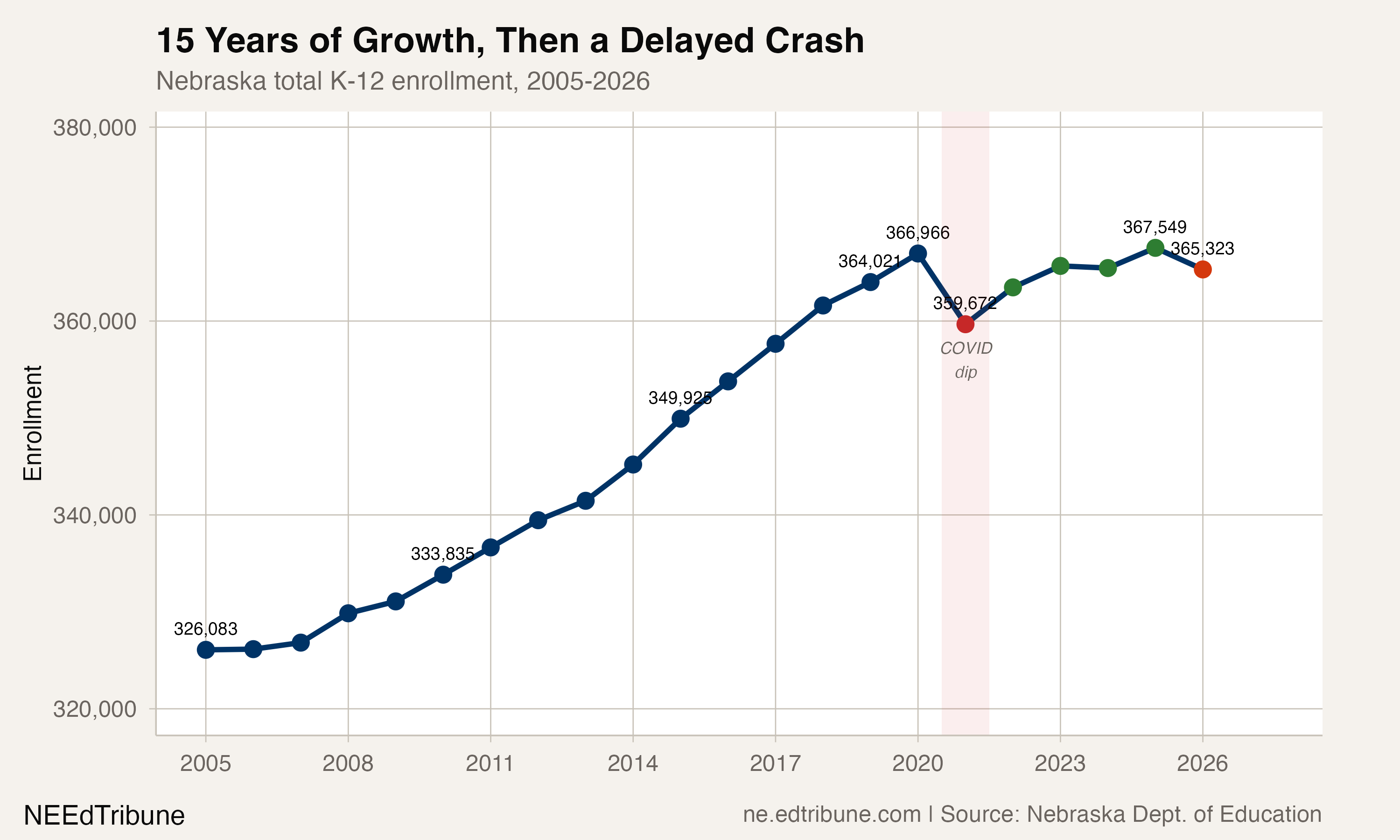
Nebraska did something almost no other state managed during the pandemic: it grew. In the 2019-20 school year, while most states were hemorrhaging students, Nebraska added 3,306, pushing enrollment to 329,290. The state reached a new all-time high of 330,136 in 2025. Then 2026 happened. The state lost 1,988 students, its largest decline outside the delayed COVID crash of 2021, and the pattern underneath the statewide number is worse than the headline suggests.
The state-level recovery rate looks extraordinary. Nebraska sits 2,164 students above its pre-COVID level, a recovery rate above 200% that puts it among the strongest in the nation. But that aggregate figure is doing heavy lifting. More than half the state's districts, 127 of 236 tracked, remain below where they were in 2019. The COVID recovery story is real at the state level and largely fictional at the district level.
A 15-Year Streak Unmatched in the Midwest
Nebraska grew enrollment every single year from 2006 through 2020, a 15-year streak that added 40,883 students, a 12.5% gain. That run was unusual for any state and nearly unique in the Midwest, where Iowa, Illinois, and Ohio all experienced steady erosion over the same period.
The engine behind that growth was Hispanic enrollment. From 2005 to 2020, Hispanic students in Nebraska's public schools more than doubled, climbing from about 30,700 to roughly 64,000. White enrollment, meanwhile, drifted slightly downward over the same period. Hispanic growth more than compensated for white losses, producing net gains year after year.
The Delayed Crash
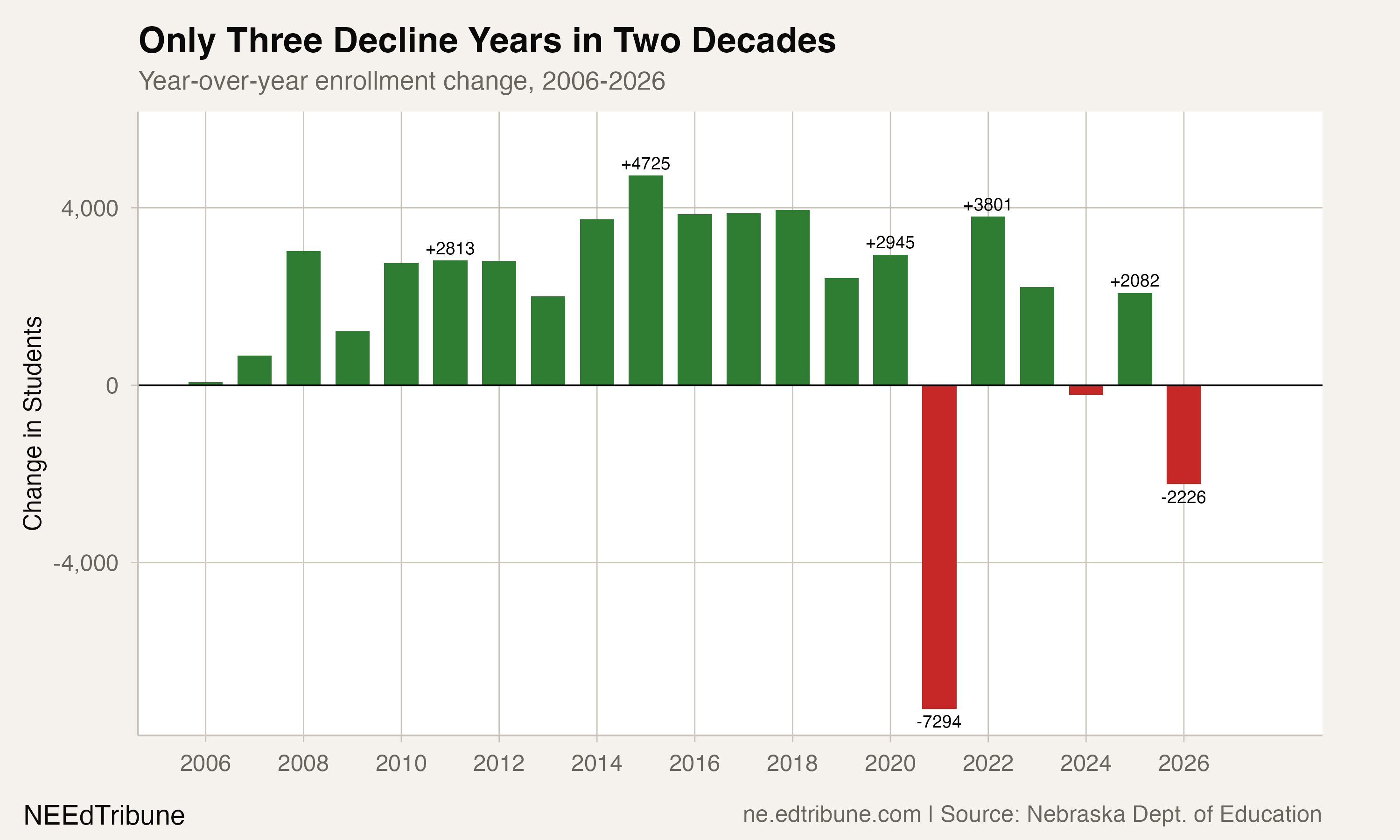
Nebraska's COVID experience was unusual in its timing. The state kept schools open more aggressively than most. 100% of public school districts offered in-person learning during the 2020-21 school year. The enrollment impact arrived anyway, just one year late: 2021 brought a loss of 5,114 students, a 1.6% single-year drop.
Where did they go? White students accounted for nearly the entire 2021 loss, shedding 5,016 students in a single year. Homeschool registrations surged nearly 70% during the pandemic, from roughly 9,450 students in 2019-20 to 14,780 in 2020-21. David Jespersen of the Nebraska Department of Education noted that most of those families eventually returned:
"The majority of that bump has returned to public or private school settings." -- Nebraska Public Media, 2023
The return showed up in the data. The year after the crash, Nebraska added 2,879 students, returning to its pre-pandemic growth pace. By 2023, the state had surpassed its pre-COVID level. By 2025, it had set a new all-time high.
The 2026 Reversal
Then came 2026. The 1,988-student decline was driven almost equally by white students (-1,120) and Hispanic students (-1,363). That Hispanic loss deserves attention: in 22 years of data, Hispanic enrollment in Nebraska has declined only twice, in 2021 (a rounding error of about 50 during COVID) and now in 2026 (-1,363, a 1.8% drop that broke a streak of annual gains averaging more than 2,000 students).
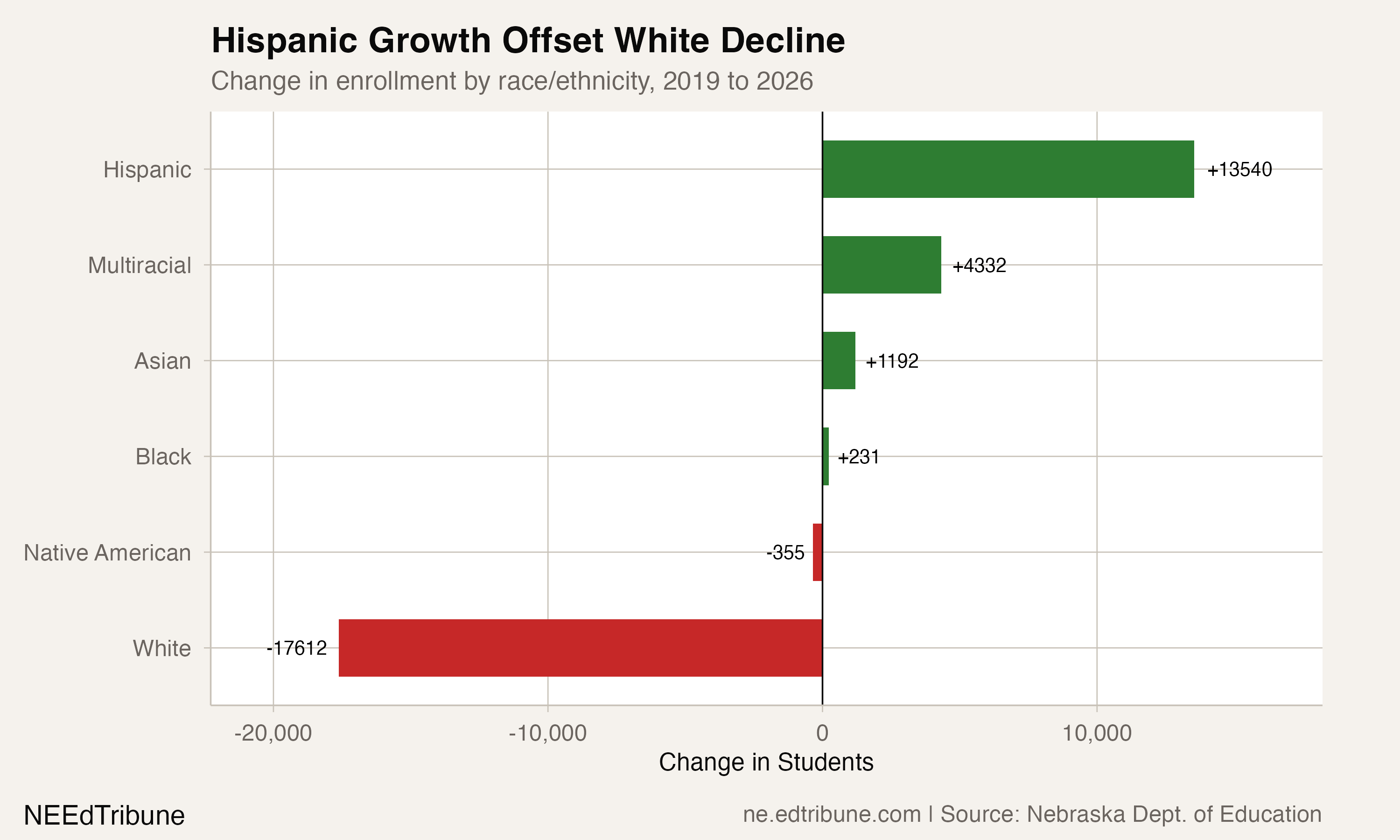
Since 2019, Hispanic enrollment has grown by 13,226 students (+21.2%), nearly offsetting the white loss of 15,849 (-7.4%). The net gap between the two has narrowed from about 152,800 students to about 123,800. (Multiracial enrollment showed a gain of 3,732, though a 2026 reclassification change makes that figure unreliable for trend analysis.)
The timing of the 2026 Hispanic decline aligns with a national reversal in immigration patterns. Census Bureau estimates show net international migration to the U.S. dropped from 2.7 million in 2024 to 1.3 million in 2025, which the bureau called a "historic decline." Nebraska, whose meatpacking and agricultural industries have been the primary draw for Hispanic families since the 1990s, would feel that shift directly. The enrollment data can't say whether fewer families arrived, existing families left, or both.
The District-Level Disconnect
The state's aggregate recovery masks a fractured landscape. Of the 127 districts that lost enrollment between 2019 and 2021, only 31, about a quarter, have recovered to their pre-COVID level by 2026. The statewide recovery was manufactured by a small number of fast-growing suburban districts that more than offset widespread losses elsewhere.
Elkhorn↗ET added 1,903 students since 2019, a 19.3% gain. Gretna↗ET, southwest of Omaha, grew by 1,694, a 30.8% surge. Bennington↗ET added 1,609, an increase of 54.9%. These three districts alone account for 5,206 new students, more than twice the state's net gain of 2,164.
On the other side: six of Nebraska's 10 largest districts remain below their 2019 enrollment. Omaha Public Schools↗ET, the state's largest, is down 1,099 students (-2.1%). Millard↗ET lost 1,039 (-4.3%). Bellevue↗ET is down 421 (-4.3%). Lincoln↗ET, the second-largest district, is 53 students short of its 2019 mark.
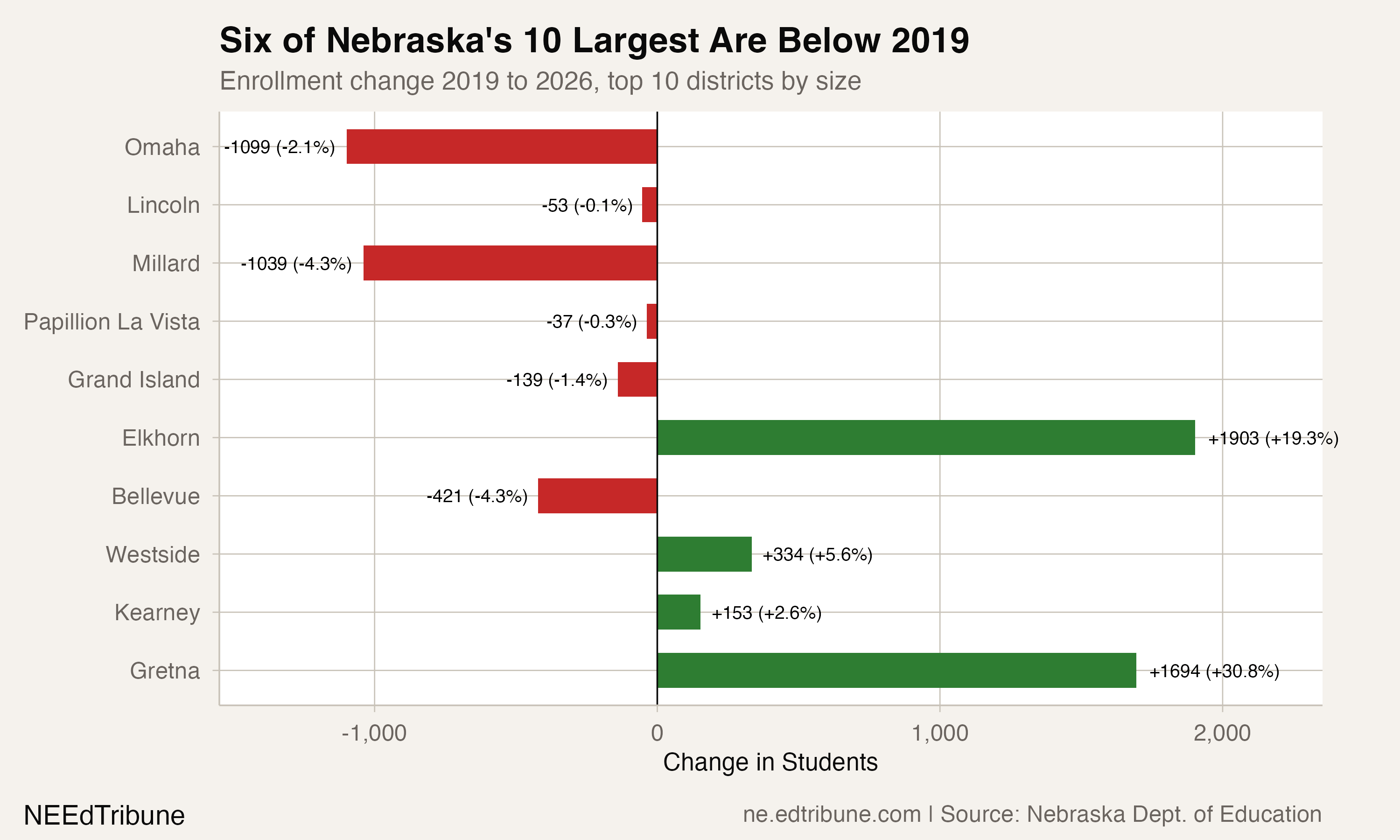
The pattern is a familiar suburban donut: the Omaha metro's outer ring grows while the core and inner suburbs shrink. The same dynamic plays out in smaller metros. Grand Island↗ET lost 139 students since 2019 (-1.4%), while nearby Schuyler↗ET dropped 130 in 2026 alone (-6.6%).
The Kindergarten Warning
The clearest signal that Nebraska's growth era has ended is at the front of the pipeline. Kindergarten enrollment hit 21,275 in 2026, down about 10.7% from its 2020 peak of 23,835. The 2026 class is almost identical in size to the 2005 class (21,191), erasing two decades of gains at the entry point.
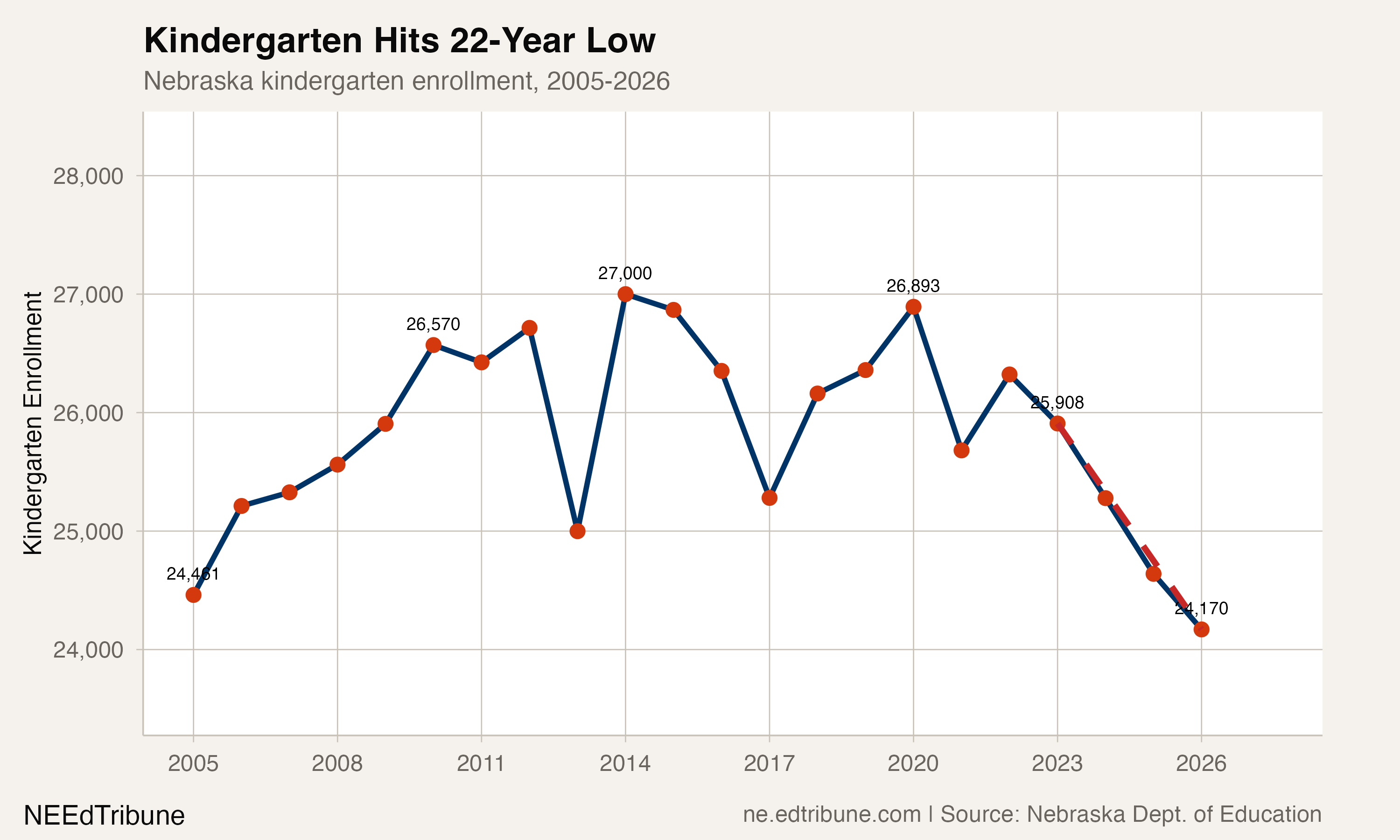
This is not a COVID artifact. The children entering kindergarten in 2026 were born in 2020 or 2021, years when national birth rates hit historic lows. Those smaller birth cohorts will move through the system for the next 12 years. Unless Nebraska sees sustained in-migration large enough to offset the shrinking pipeline, the 2025 all-time high of 330,136 may be the last one for a long time.
What 2026 Signals
Nebraska's COVID story was always more complicated than the headline suggested. The state grew in 2020 because it kept schools open. It crashed in 2021 when families bolted for homeschooling. It recovered by 2025 as they trickled back and Omaha's suburbs kept building.
The 2026 decline is different. It is not a pandemic hangover. It is the first year where demographic fundamentals — fewer births, slower Hispanic growth, steady white losses — outweigh the suburban construction that had been papering over the trend. Elkhorn added 107 students in 2026. Millard lost 247. Omaha lost 429. Bellevue lost 175. The suburbs are still growing, but the math no longer works: three districts gaining 439 students cannot cover six districts losing 1,370.
Detailed code that reproduces the analysis and figures in this article is available exclusively to EdTribune subscribers.
Discussion
Sign in to join the discussion.
Loading comments...