Gering Public Schools sits in the Nebraska panhandle, a small district of 139 seniors in a region better known for sugar beet production and Chimney Rock than for educational headlines. But Gering has quietly assembled one of the most consistent graduation rate improvement streaks in the state.
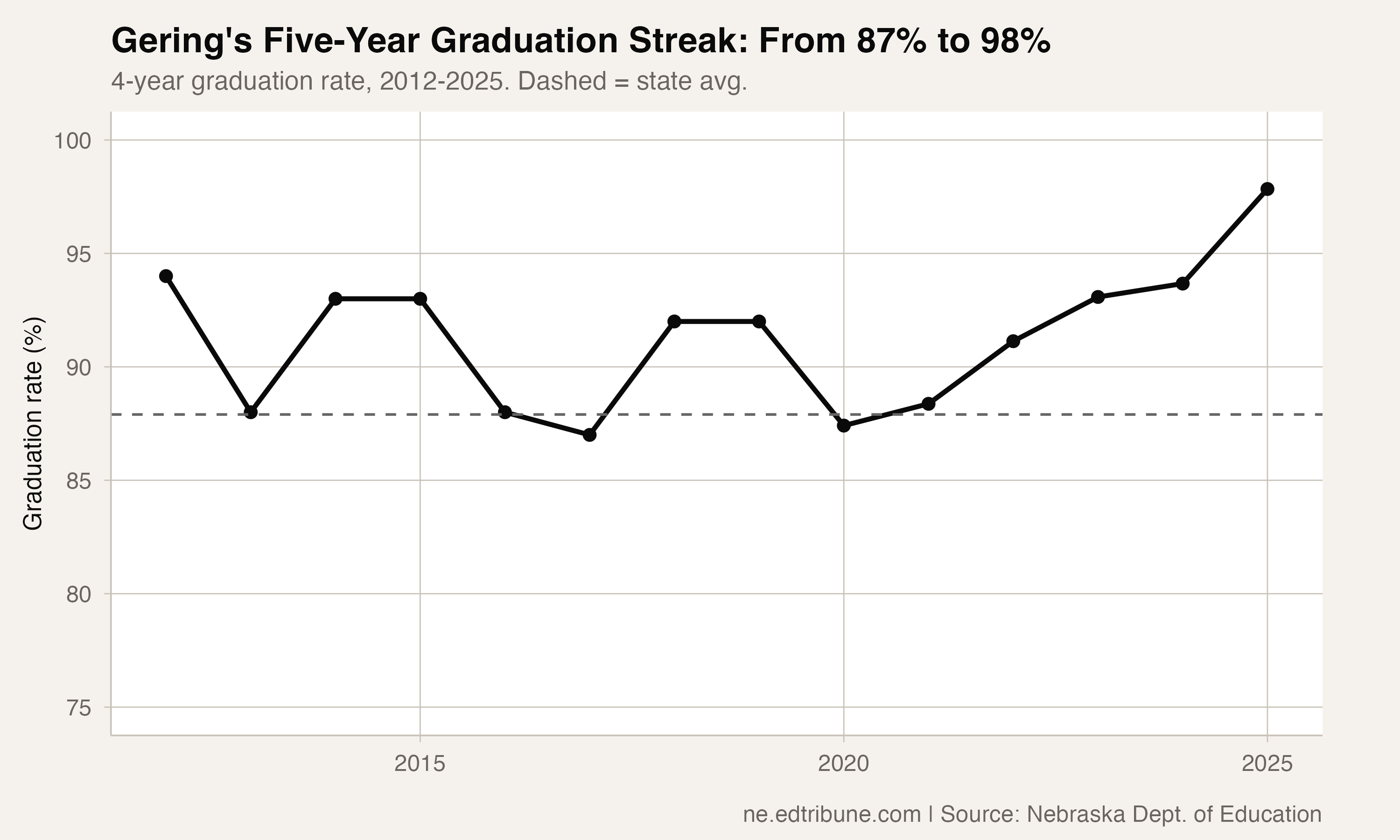
Five consecutive years of gains: 87.4% in 2020, 88.4% in 2021, 91.1% in 2022, 93.1% in 2023, 93.7% in 2024, 97.8% in 2025. A 10.4 percentage point climb that has taken a district from just below the state average to near perfection.
Only three students in Gering's 2025 cohort of 139 did not graduate on time.
Not just Gering
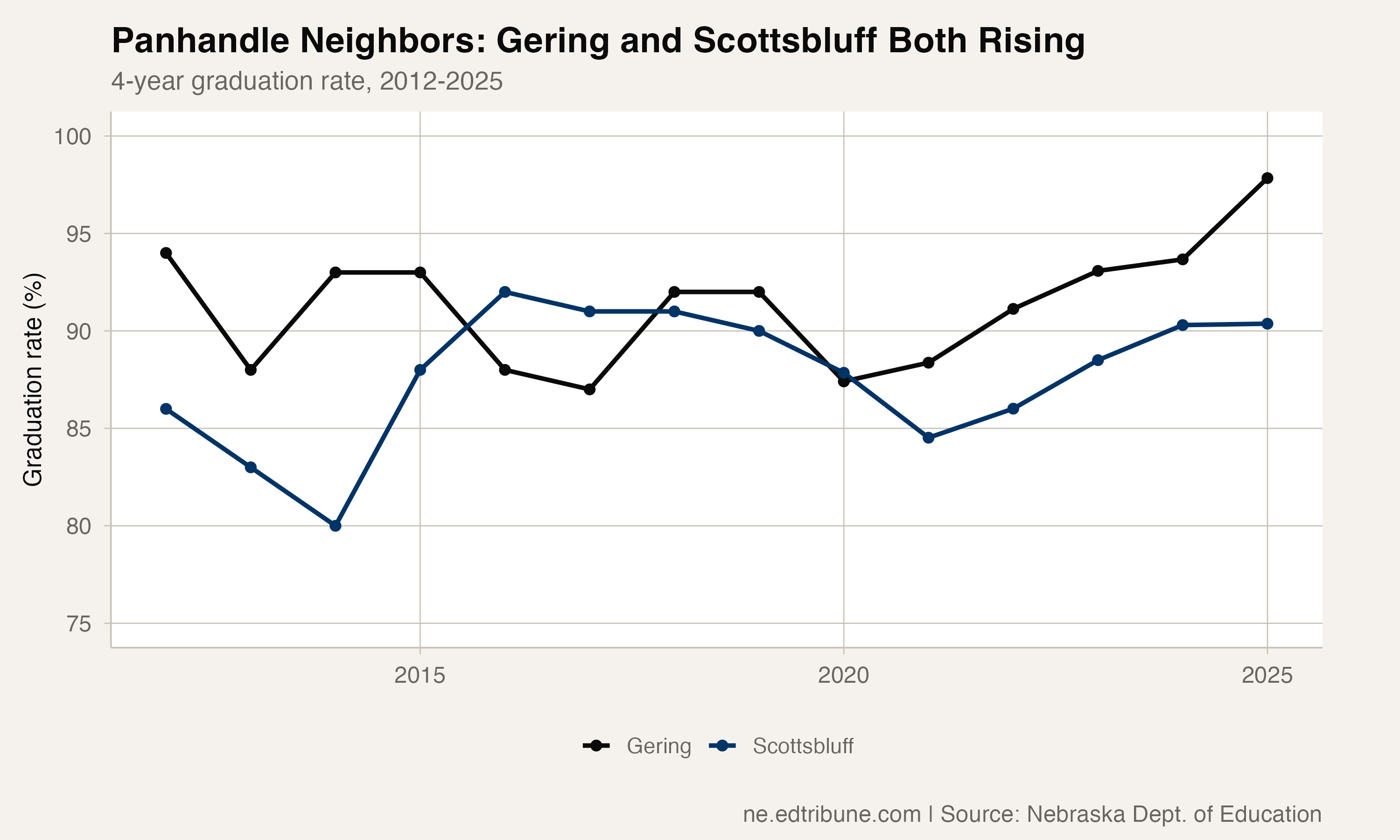
What makes the panhandle story more than a single-district anecdote is that Gering's neighbor is doing it too. Scottsbluff Public Schools, directly across the North Platte River, has posted four consecutive years of improvement: 84.5% in 2021, 86.0% in 2022, 88.5% in 2023, 90.3% in 2024, and 90.4% in 2025.
Scottsbluff's cohort of 270 students makes it nearly twice Gering's size, and its improvement trajectory, while not as dramatic, suggests regional momentum rather than a single district's lucky run.
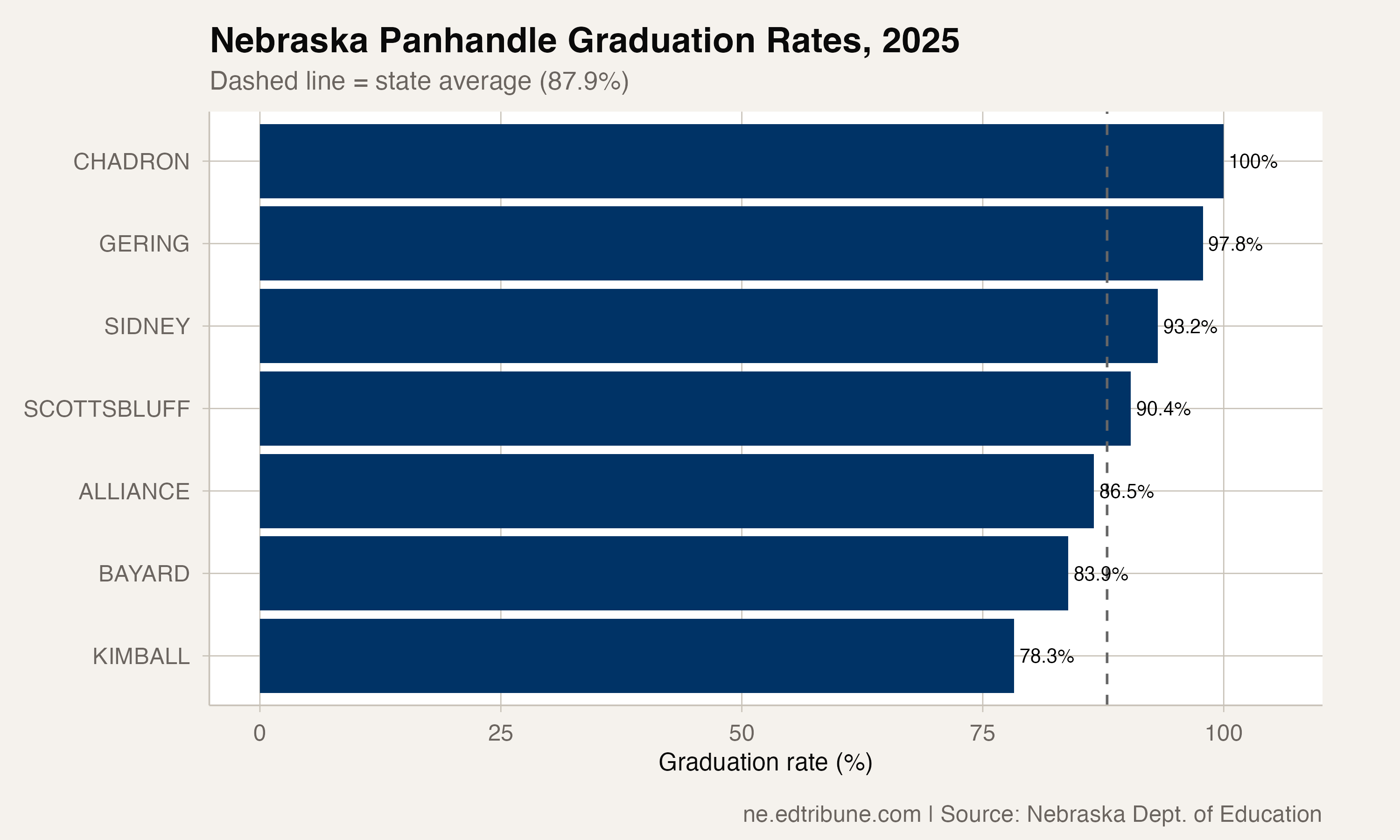
Chadron Public Schools, further west, posted 100.0% in 2025 with 54 students. Sidney posted 93.2% with 73 students, above the 87.9% state average.
The panhandle is not uniformly excellent. Kimball posted 78.3% with 23 students, and Bayard hit 83.9% with 31. But the overall trend in the region's larger districts has been upward, and Gering leads the way.
What a five-year streak means
In a state where the overall graduation rate has been stuck between 87.1% and 88.2% for the last six years, a five-year improvement streak stands out. Most Nebraska districts that improved post-COVID did so in a single bounce-back year (2024) before stalling or declining again. Gering has improved every year since 2020, including during the worst of the pandemic recovery.
The consistency is more impressive than the endpoint. Any small district can post a near-perfect rate in a single year when a cohort of 20-30 students produces zero or one non-graduate. But maintaining improvement across five years, through COVID disruption and a cohort that held roughly steady (143 students in 2020, 139 in 2025), suggests something more systematic.
Gering's longer history provides context. From 2012 through 2019, Gering averaged 90.9%. From 2020 through 2025, it averaged 91.9%.
The small district caveat
Gering's cohort of 139 students means each non-graduate shifts the rate by roughly 0.7 percentage points. The 2025 rate of 97.8% reflects approximately 3 non-graduates. A single additional student failing to complete requirements would have dropped the rate to 97.1%. Two more would have brought it to 96.4%.
This volatility is inherent in small-district data and does not diminish the achievement, but it does mean the 97.8% figure should not be treated as a locked-in new baseline. Gering's 2021-2025 average of 92.8% is probably a more reliable indicator of the district's sustained capacity.
Scottsbluff, with a larger cohort of 270, offers more statistical stability. Its four-year improvement trend is arguably the more meaningful benchmark for the region.
What Gering changed
The data does not explain every cause, but Gering says the streak followed a deliberate shift after COVID. Jennifer Sibal, the district's director of communications and engagement, said Gering created a graduation focus committee after seeing a post-pandemic dip and used those conversations to identify barriers students and families were facing.
One result was LINKS Alternative High School, which Sibal described as a flexible program that lets students keep working toward graduation through a hybrid model of online and in-person learning.
"For some students, removing barriers and providing a more personalized pathway made all the difference," Sibal said. She also pointed to intentional monitoring and support from school counselors as part of the district's approach.
The sustainability work now starts earlier, Sibal said. Counselors monitor students' progress toward graduation and begin conversations with students and families in the freshman and sophomore years, before credit recovery becomes a senior-year scramble.
Gering has also expanded the alternative program. Sibal said LINKS students now have access to dual-credit coursework, and the district expects its first LINKS student to graduate with both a high school diploma and a community college degree in 2026-27.
"Graduation rates tell an important story, but they don't tell the whole story," Sibal said. "Behind every number is a student with individual strengths, circumstances, and challenges."
The regional pattern, with both Gering and Scottsbluff improving at the same time, still suggests something beyond a single district's lucky run.
Western Nebraska has faced population decline for decades, and the panhandle's school districts serve communities where enrollment is often shrinking. In that context, improving graduation rates while enrollment holds relatively steady is doubly significant. Districts that are losing students often see graduation rates decline as the remaining population concentrates disadvantage.
Gering has gone the other direction. The class of 2025 is the most recent class in the state's published graduation data. Whether the streak reaches six years with the class of 2026 will be the next test, and the test after that will be whether the district can sustain these rates as cohort composition shifts over time.
Detailed code that reproduces the analysis and figures in this article is available exclusively to EdTribune subscribers.
Discussion
Sign in to join the discussion.
Loading comments...