Three students separated Gretna Public Schools↗ET from a perfect graduation rate in Nebraska's 2025 report. The district graduated 414 of its 417-student four-year cohort on time. Its published rate was 99.3%, ranking first among the 11 Nebraska districts with cohorts of at least 400 students.
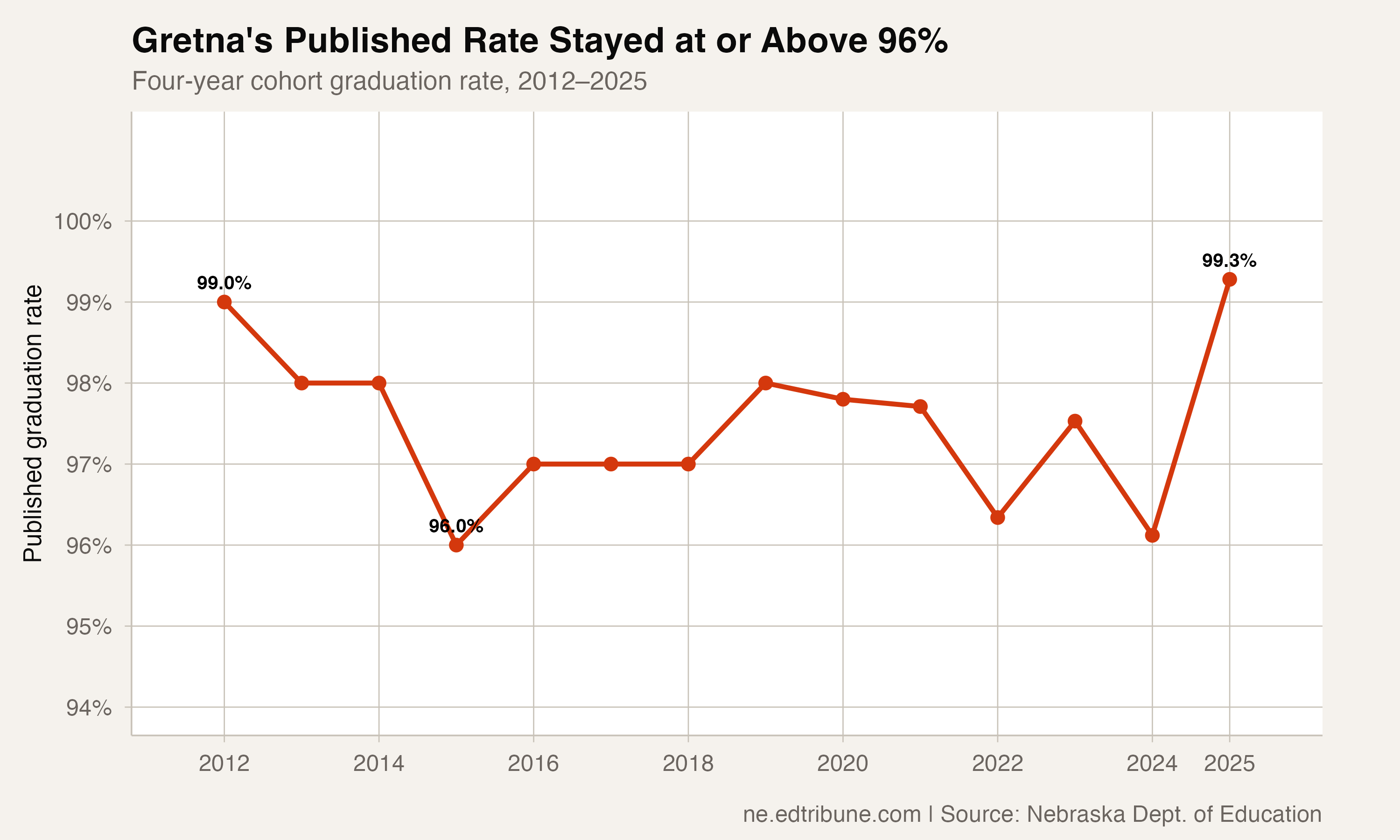
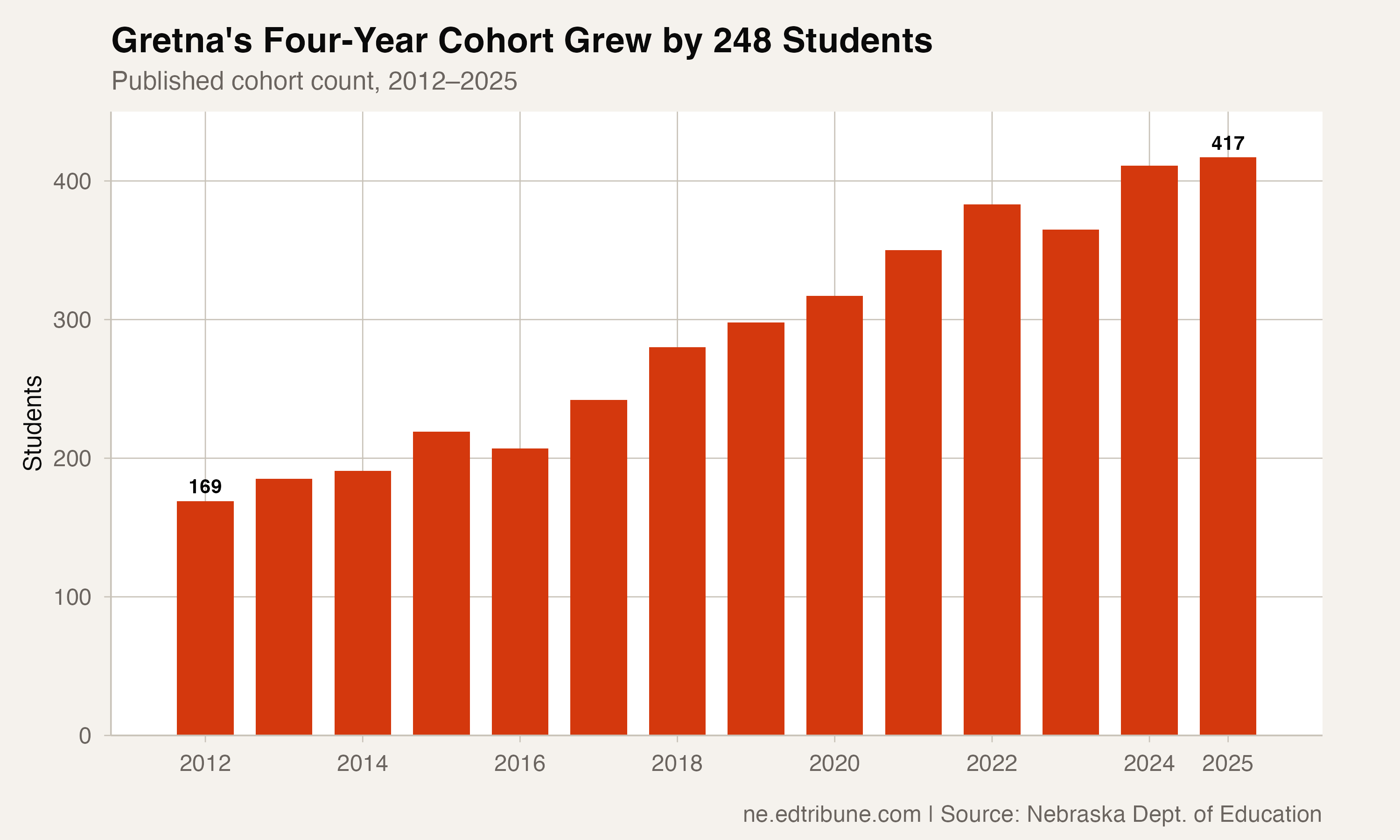
The result extends a long run of high published rates. Across the full 14-year four-year series from 2012 through 2025, Gretna never fell below 96.0%. Over the same span, its cohort grew from 169 students to 417, an increase of 146.7%.
A larger graduating class
Gretna added 248 students to its graduating cohort between 2012 and 2025. That works out to an average increase of 19.1 students per year across the interval.
Across those 14 reports, the district's published rate ranged from 96.0% to 99.3%. The 2012 and 2025 endpoint rates were 99.0% and 99.3%, respectively. Those figures describe the two trends alongside each other; they do not establish why Gretna maintained its graduation results as the cohort grew.
The suburban ring
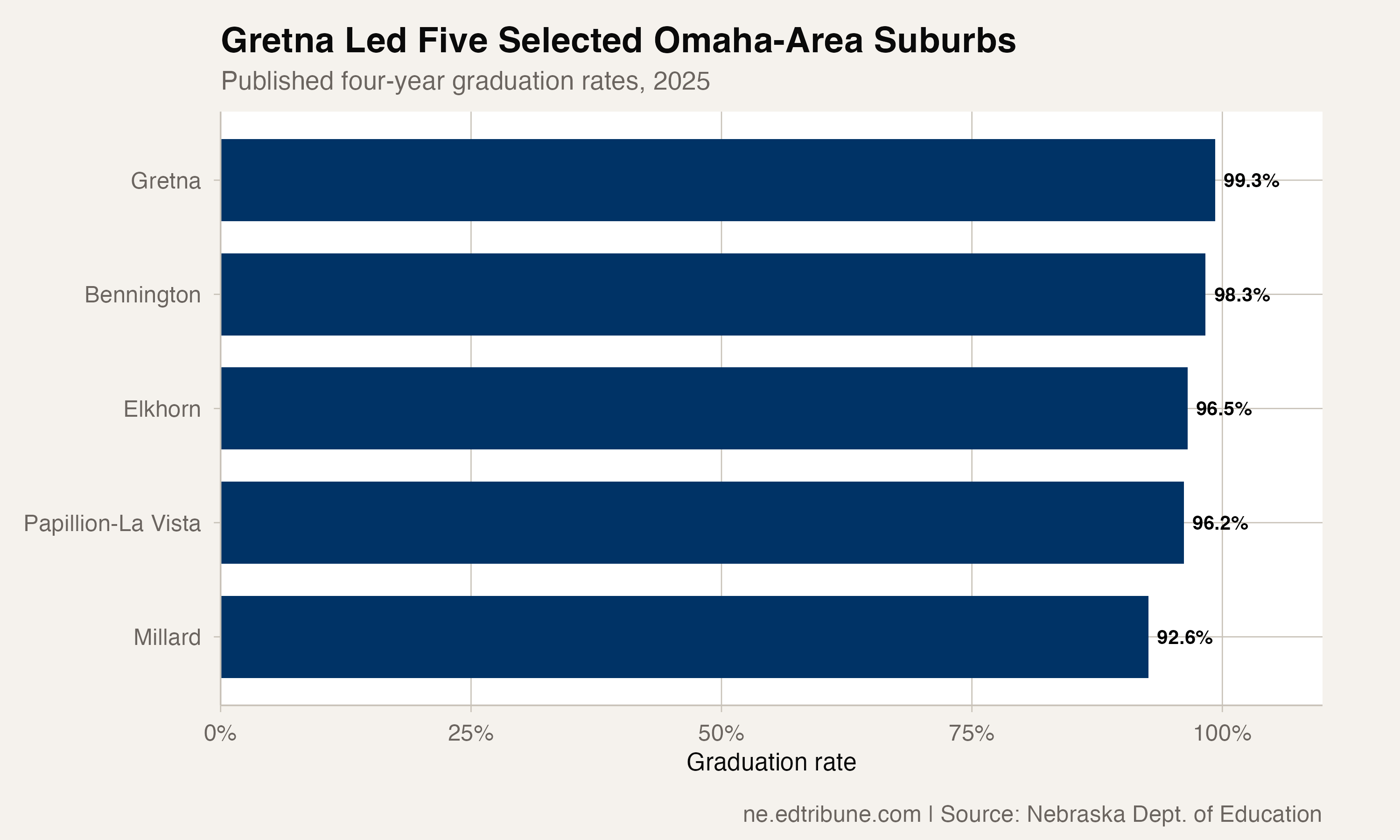
Gretna also led this selected comparison of five Omaha-area suburban districts. Bennington Public Schools↗ET posted 98.3% with 238 students. Elkhorn Public Schools↗ET reached 96.5% with 748 students. Papillion-La Vista Community Schools↗ET finished at 96.2% with 908 students. Millard Public Schools↗ET posted 92.6% with 1,762 students.
Together, the five districts had a published cohort total of 4,073 students and graduated 3,878 of them on time, a weighted rate of 95.2%.
Omaha Public Schools↗ET had a 3,806-student cohort and a published rate of 71.5%. The difference between Gretna's and Omaha's published rates was 27.8 percentage points. That is a comparison of district outcomes, not an explanation for the difference.
What near-perfection looks like
A 99.3% rate in a 417-student cohort corresponds to three students who did not graduate on time. The aggregate data do not show those students' circumstances.
The 96.0% floor across the 14-year series places the 2025 result within a persistent pattern of high published rates.
The conversation the data prompts
Gretna's combination of a growing cohort and consistently high graduation rates raises a question the aggregate data cannot answer: which district practices, student characteristics, and local conditions contributed to the pattern? The package establishes the outcomes, not their causes.
Detailed code that reproduces the analysis and figures in this article is available exclusively to EdTribune subscribers.
Discussion
Sign in to join the discussion.
Loading comments...